
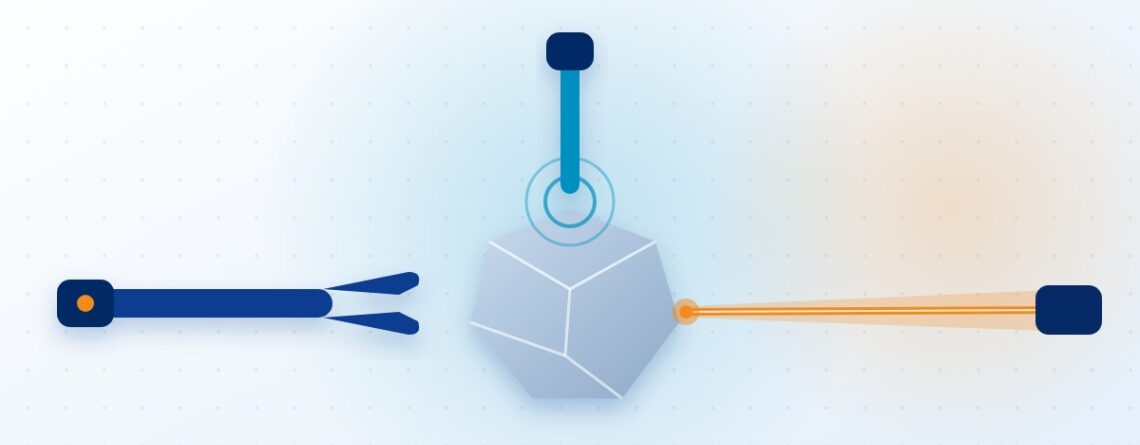
Stone Punch vs Pneumatic vs Laser Lithotripsy and How to Choose
Choosing bladder stone treatment equipment means choosing between three established ways of breaking the stone: a mechanical stone punch, a pneumatic lithotripter and a laser. Each has a different price, different running costs and different limits. The best choice for a hospital depends less on a headline comparison and more on the stones you treat, the procedures you already perform and the budget you can sustain.
This guide explains how each method works, summarises what the evidence says, compares costs, and gives a decision guide and worksheet for urology departments, OT managers and procurement teams. It is written for equipment decisions and does not replace the clinical judgement of the treating urologist.
Bladder stones: what equipment has to deal with
Bladder stones make up roughly 5 percent of urinary tract stones. They are often secondary to another problem, most commonly bladder outlet obstruction such as an enlarged prostate, but also neurogenic or augmented bladders, infection and foreign bodies. That matters for equipment buyers in two ways. First, many patients need the cause treated as well as the stone removed. Second, a department that sees bladder stones usually also sees prostate disease, so purchases tend to overlap.
Whatever method breaks the stone, the endoscopic set-up around it is similar: a sheath, a telescope, a light source, irrigation and a way to clear fragments. The lithotripsy method is the part you choose.
Treatment routes and where equipment fits
Bladder stones can be treated by open cystolithotomy, transurethral cystolithotripsy, percutaneous cystolithotripsy or shock wave lithotripsy. According to the EAU Urolithiasis Panel’s systematic review, endoscopic surgery appears equally effective as open surgery, shock wave lithotripsy appears less effective, and transurethral surgery, where feasible, tends to mean a shorter hospital stay than percutaneous surgery. So for most hospitals, the equipment question is about transurethral cystolithotripsy, also called cystolitholapaxy.
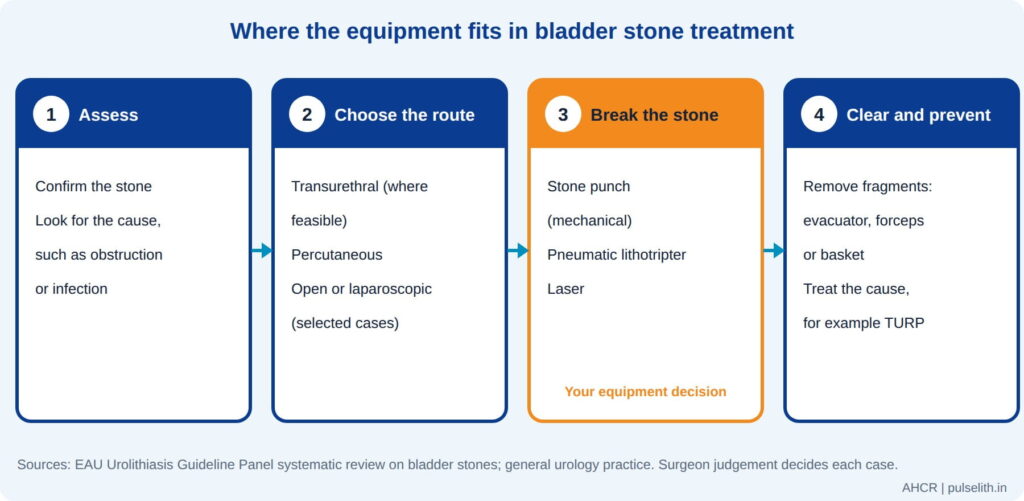 Four stages: assess the stone and its cause, choose the route, break the stone with a stone punch, pneumatic lithotripter or laser, then remove fragments and treat the cause.
Stone punch, pneumatic and laser lithotripsy compared
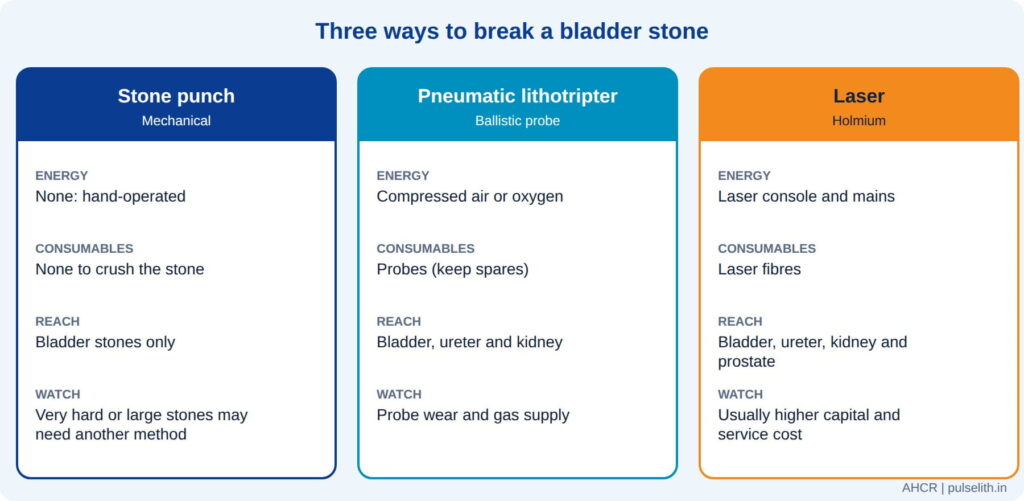
Stone punch (mechanical lithotripsy)
A stone punch resembles a resectoscope: it is passed through a sheath with a telescope, grips the stone between a crushing blade and a jaw, and breaks it into fragments that can be removed through the sheath. It is operated by hand, so it needs no power source, gas supply or probes. It is used for bladder stones only, and very hard or large stones may need another method or a combined approach. See the AHCR stone punch set, the stone punch, the sheath with obturator and the visual obturator.
Pneumatic lithotripsy
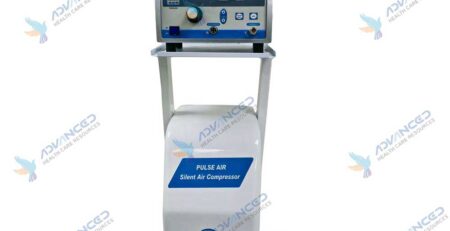
A pneumatic lithotripter uses compressed air or oxygen to drive a projectile inside the handpiece against a metal probe, and the probe transmits the impact to the stone. The same machine can be used in ureteroscopy and PCNL, which makes it a versatile investment. Running costs come from probes, and uptime depends on spares and a stable gas supply. Explore the Pulselith pneumatic lithotripter, its probes and handpiece, and read our guides on probe sizes and spare parts and troubleshooting.
Laser lithotripsy
A holmium laser breaks stones with light energy delivered through a fibre. The EAU laser guidelines describe laser energy as an optimal method for disintegrating urinary stones, and lasers are also used in prostate procedures. The trade-off is usually a higher purchase price plus fibres, service contracts and training. Our guide to pneumatic vs laser lithotripters covers the cost and ROI side in detail.
Other options
Ultrasonic and electrohydraulic lithotripsy are also used for bladder stones in some centres. They are less common in smaller departments, so this guide focuses on the three methods most hospitals compare.
What the evidence says
The EAU Urolithiasis Guideline Panel published a systematic review of bladder stone treatment that included 25 studies and 2,340 patients. Its main findings for equipment buyers:
- Endoscopic vs open: endoscopic surgery appears equally effective as open surgery in stone-free rate.
- Transurethral vs percutaneous: stone-free rates were similar in randomised trials, but transurethral surgery tended to mean a shorter hospital stay.
- Laser vs pneumatic: one randomised trial found no difference in stone-free rate.
- Shock wave lithotripsy: in adults, one trial found a lower stone-free rate than transurethral cystolithotripsy (risk ratio 0.88, low quality of evidence).
- Gaps: it is unclear whether stone size changes outcomes, and the reviewers called for more research on larger stones and on young children.
The takeaway is practical. The evidence does not show that one lithotripsy energy source is clearly better than another for bladder stones. That is why cost, case mix, reliability and training should drive the purchase.
Treating the cause: obstruction and TURP
Because many bladder stones are caused or kept going by outlet obstruction, urologists often treat the prostate and the stone together. A randomised study of 100 patients with bladder stones and BPH found that synchronous cystolitholapaxy and TURP gave better results than cystolitholapaxy plus medical therapy for BPH. For equipment planning, that means a bladder stone programme often sits alongside a TURP programme. Read our guides on monopolar vs bipolar TURP and how to choose a bipolar TURP machine, or see the 400W bipolar TURP system.
How to choose for your department
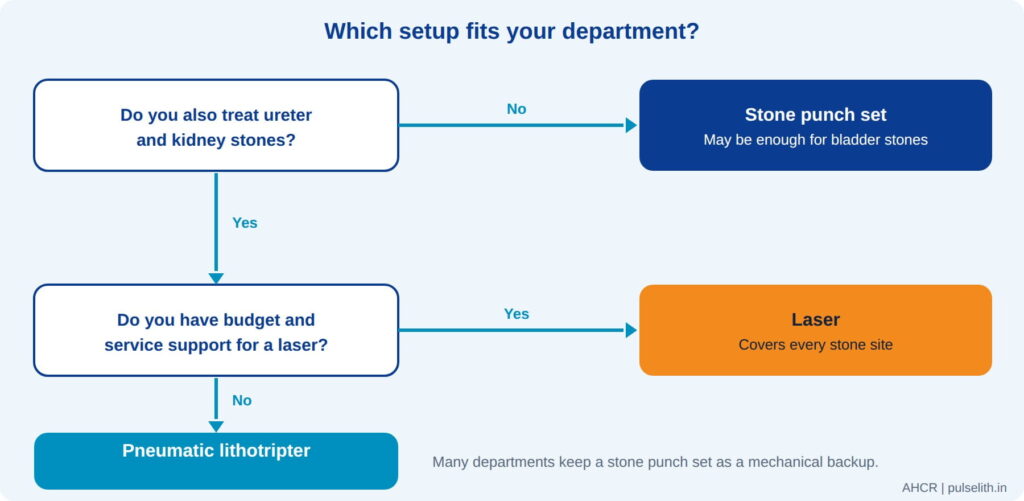
Work through these factors with your urology team:
- Case mix. If you treat mainly bladder stones, a stone punch set may be enough. If you also treat ureter and kidney stones, a pneumatic lithotripter or laser serves more procedures.
- Stone characteristics. Hard or large stones may call for a lithotripter, alone or with a punch.
- Budget over time. Compare purchase price plus probes, fibres, service and spares. See lithotripter cost versus ROI.
- Infrastructure. Pneumatic needs a gas supply, and laser needs mains and a service plan. Our portable vs fixed lithotripter guide helps with space.
- Training and reliability. Check training, spares and response time, and keep a mechanical backup.
Three illustrative department profiles
These examples show how the factors combine. They are starting points for discussion, not clinical recommendations.
| Department profile | Sensible starting point | Why |
|---|---|---|
| District or smaller hospital with occasional bladder stones and a basic OT | Stone punch set with an existing or matching cystoscope | Lowest cost, no power or gas supply, simple to reprocess |
| Mid-size urology department doing ureteroscopy, PCNL and bladder stones | Pneumatic lithotripter with probes for each procedure, plus a stone punch set as a mechanical backup | One machine covers several stone sites and the punch keeps the list running if a probe or handpiece fails |
| High-volume stone centre with budget and service support | Laser, with a pneumatic lithotripter as backup | Versatility across sites and procedures, with redundancy if the laser is down |
For the middle profile, our guide to choosing a pneumatic lithotripter for URS and PCNL explains which probe sizes and configuration to specify.
If you are buying through a tender, use our urology instrument tender specification checklist. For supplier selection, read how to choose a lithotripter supplier in India and the top things to check before buying a lithotripter.
Cost worksheet: compare quotations on total cost
Send these questions to each supplier and record the written answers next to each option.
| Cost line | Stone punch set | Pneumatic lithotripter | Laser | Ask the supplier |
|---|---|---|---|---|
| Equipment | Lowest of the three | Mid-range | Usually highest | What exactly is included in the quoted set? |
| Power or gas | None | Air or oxygen supply | Mains and cooling | What supply does my OT need? |
| Consumables | None to crush the stone | Probes | Fibres | Price and expected life of each probe or fibre? |
| Procedures covered | Bladder only | Bladder, ureter, kidney | Bladder, ureter, kidney, prostate | Which accessories does each procedure need? |
| Service and spares | Instrument reprocessing | Handpiece, tubing, probes | Console and fibres | Warranty, AMC rate and response time? |
| Training | Minimal | Short | Structured | Is on-site training included? |
Setup checklist and AHCR equipment
Besides the lithotripsy method, a cystolitholapaxy set-up usually needs:
- A sheath with obturator, with a visual obturator for entry under vision.
- A telescope or cystoscope and a matching light source and camera set-up.
- Irrigation and a way to remove fragments: an evacuator, forceps or a retrieval basket.
- Sterilisation and reprocessing capacity for reusable instruments.
- Spares and consumables: probes, handpiece, tubing and a backup instrument.
- Stone punch set (bladder stone set)
Stone punch, sheath with obturator, grasping forceps and cystoscope. See the full range. - Pneumatic lithotripter
For bladder, ureter and kidney stones. Available with a compressor or as a complete set with carry bag. - Probes and handpiece
Replacement parts so a single fault never stops the list. - 400W bipolar TURP system
For departments that treat obstruction and stones together.
Planning a whole unit? Read our checklists for setting up a lithotripsy unit and a stone management center, and the myths about lithotripsy machines. Importing? See how to import surgical instruments from India.
Common buying mistakes
- Comparing purchase price only. Consumables, service and downtime matter more over five years.
- Buying one method for every case. A backup method protects your list.
- Ignoring gas or power supply. Check your OT before you order.
- Skipping spares planning. A stock-out stops the machine as surely as a fault.
- Forgetting the cause. If obstruction drives your stones, plan prostate equipment too.
- Not checking compatibility. Confirm sheath, telescope and accessory fit with the supplier in writing.
Frequently asked questions
What is the best equipment for treating bladder stones?
There is no single best option. A stone punch crushes bladder stones mechanically, a pneumatic lithotripter uses a probe, and a laser fragments stones with light energy. An EAU Urolithiasis Panel systematic review found no difference in stone-free rate between laser and pneumatic cystolithotripsy in the one trial that compared them. The right choice depends on stone size and hardness, your case mix, budget and training.
Is a stone punch better than a pneumatic lithotripter for bladder stones?
Neither is better in every case. A stone punch needs no power or gas supply and is limited to bladder stones. A pneumatic lithotripter needs a gas supply and probes, but it can also be used in ureteroscopy and PCNL, and some surgeons combine it with a stone punch for hard or large stones.
Is a laser better than pneumatic lithotripsy for bladder stones?
The evidence does not show a clear difference in stone-free rate. A laser is versatile and is regarded as an excellent way to fragment urinary stones, but it usually costs more to buy and service. Many departments choose pneumatic equipment for value and keep a stone punch as a mechanical backup.
Does the cause of the bladder stone matter when choosing treatment?
Yes. Bladder stones are often linked to bladder outlet obstruction, for example from an enlarged prostate. One randomised study of 100 men found that treating the prostate with TURP at the same time as stone removal gave better results than stone removal plus medical therapy for BPH. The treating urologist decides the plan for each patient.
What equipment do I need for cystolitholapaxy?
You need a stone punch or lithotripter, a sheath with obturator, a telescope or cystoscope, a light source and camera set-up, irrigation, and a way to remove fragments such as an evacuator, forceps or basket. AHCR supplies a complete bladder stone set and matching accessories.
Can one machine treat bladder, ureteric and kidney stones?
A pneumatic lithotripter or a laser can be used for stones at several sites, including through a ureteroscope or in PCNL, while a stone punch is used for bladder stones only. If you treat stones at several sites, a pneumatic lithotripter or laser covers more procedures.
Does AHCR supply stone punch sets and pneumatic lithotripters for export?
Yes. AHCR is a New Delhi manufacturer that supplies hospitals, clinics and distributors in India and exports to the Asia-Pacific region, the Middle East, Africa and the Americas. Send your requirement through the contact page for specifications, documents and a quotation.
Ready to equip your bladder stone service?
AHCR (Advanced Health Care Resources) is an ISO 13485 and CE certified manufacturer based in Okhla Industrial Area, New Delhi, supplying hospitals, clinics and distributors in India and overseas.
This article is general information for equipment planning. It is not medical advice. The treating urologist chooses the method for each patient according to clinical judgement and local guidelines.



Leave a Reply