

A Step-by-Step Guide for Hospitals, Distributors and Importers (2026)
If you want to import surgical instruments from India, the process is simpler than most first-time buyers expect, as long as you get four things right: choosing a verified manufacturer, matching each product to your country’s rules, agreeing clear commercial terms, and having the paperwork ready before the goods leave. Get one of them wrong and you risk customs delays, rejected shipments, or instruments that never reach your operating theatre.
More hospitals and distributors now choose to buy surgical instruments from India because the range is wide and the prices are competitive, while established manufacturers hold international certifications. This guide walks through the full import process in seven steps, with three diagrams, a document map and a supplier-verification checklist you can use today.
Why importers source surgical instruments from India
India has a long-established medical device manufacturing base, with many producers in and around Delhi NCR, and it exports to Asia-Pacific, the Middle East, Africa, Europe and the Americas. Buyers usually come for five reasons:
- Competitive pricing. Lower labour and tooling costs than most European and North American makers.
- Range under one roof. One surgical instrument manufacturer and supplier in India can cover urology, laparoscopy and gynecology, keeping freight and paperwork low.
- Certified production. Established manufacturers hold ISO 13485 quality management certification and CE marking for their products.
- Flexibility. Many accept custom specifications, OEM orders and mixed-item shipments.
The trade-off is that quality varies a great deal between manufacturers, and between manufacturers and traders. That is why verification in Step 2 matters most. For a deeper look at the difference, read our guide on manufacturer vs trader for procurement teams.
The 7-step import process at a glance
Every successful import follows the same sequence, whether you are buying a few hundred forceps or a full operating-room setup. Use the diagram below as a map for the rest of this guide.
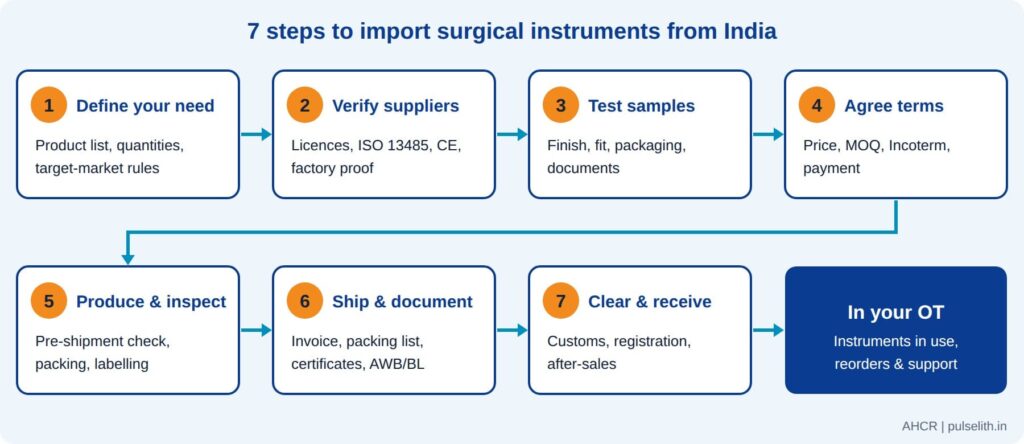 Flow diagram: define your need, verify suppliers, test samples, agree terms, produce and inspect, ship and document, clear and receive, then instruments in use with after-sales support.
Step 1: Define your requirements before you contact suppliers
Vague enquiries get vague quotes. Before you write to any supplier, prepare a product list that states, for each item:
- The exact name and size, for example “21 Fr cystoscopy sheath with obturator” rather than “cystoscope parts”.
- Material and finish, reusable or single-use, and sterile or non-sterile supply.
- Quantity per item, expected reorder volume, and packaging or labelling requirements.
Next, check what your national regulator expects. Rules differ widely. In the United States, foreign manufacturers must register with the FDA and list their devices, and many manual surgical instruments are exempt from 510(k) notification. The European Union requires CE marking under the Medical Device Regulation, and importers carry their own obligations. Saudi Arabia, Nigeria and other markets run their own systems through the SFDA, NAFDAC and similar bodies.
Device type matters too. Manual instruments usually face lighter requirements than electro-medical equipment such as a pneumatic lithotripter. Rules change, so confirm current requirements with your regulator before a large order, and decide who will hold the registration: you, a local agent or the manufacturer.
Step 2: Verify the surgical instruments manufacturer, not just the website
A professional website proves very little. Start with one question: does the company own the factory, or is it a trader? Traders can be reliable, but they cannot control quality, change a specification or support you after the sale in the same way a manufacturer can. Ask for production photos or a live video walk-through of the workshop.
Then ask for documents and check each one properly:
| Document | What it proves | What to check |
|---|---|---|
| ISO 13485 certificate | A quality management system for medical devices | Company name, scope covers your product type, issuing body, expiry date |
| CE certificate or declaration of conformity | Conformity with EU requirements, accepted by many other markets | The devices covered, the device class, and the notified body where one applies |
| Indian manufacturing licence | Legal permission to make the device under India’s Medical Devices Rules, 2017 | Licence number and covered products. State authorities license Class A and B (Form MD-5); CDSCO licenses Class C and D (Form MD-9). Some low-risk devices are exempt, so ask which applies |
| Importer Exporter Code (IEC) | The company is registered with India’s DGFT to export | Code matches the company name on the invoice |
| Inspection records and material certificates | Batch-level quality control | Sample reports for a recent order |
| Buyer references | Real export experience | Two references, ideally from your region |
An ISO 13485 CE certified surgical instruments manufacturer in India such as AHCR can share both certificates on request. For a detailed explanation of what each standard covers, see our article on which certifications Indian surgical instrument manufacturers need, and for hands-on inspection methods read how to validate quality before ordering bulk surgical instruments from India.
Red flags: reluctance to share certificates, a certificate in a different company’s name, only stock photos of a “factory”, prices far below the market, and no written warranty.
Step 3: Order and evaluate samples
Never skip samples to save a few weeks. Order one or two pieces of each critical item, or a small trial order, and have the people who will use them test them: surgeons, OT nurses and sterile-processing staff. Check:
- Finish, edges, joint movement, alignment and markings.
- Compatibility with your cleaning and autoclave routine, plus packaging, labels and instructions for use.
For equipment, run a full functional test. For a lithotripter, check probe compatibility and ask about spare probes and service. Ask whether the sample cost can be credited against your first bulk order.
Keep the approved sample as your reference and name it in the purchase contract, so bulk production is judged against it.
Step 4: Agree MOQ, pricing and payment terms for bulk surgical instruments
Minimum order quantity
MOQ depends on the manufacturer and the product. Standard catalogue items usually have lower minimums than custom or OEM items. Request MOQ in writing for each item, and ask whether you can combine products across categories to meet it. If you plan to sell under your own brand, see our guide to OEM and private-label surgical instruments from India.
Pricing: compare landed cost, not unit price
A good quotation states the unit price, currency, Incoterm, packing, validity period, lead time and warranty. Cheap quotes often hide costs elsewhere. Compare suppliers on landed cost: unit price plus freight, insurance, duty, clearance, registration and the cost of any rejected pieces.
Payment terms
| Payment method | How it works | Best used for |
|---|---|---|
| Advance bank transfer (TT) | You pay the full amount before production or dispatch | Small trial orders with a verified supplier |
| Deposit plus balance | A deposit starts production; the balance is paid before dispatch or against shipping documents | Most production orders |
| Letter of credit | Your bank guarantees payment once the supplier presents compliant documents | Larger first orders where trust is still being built |
| Open account | You pay after delivery on agreed credit terms | Long-standing relationships only |
Choosing the right Incoterm
The Incoterm in your contract decides who pays for each leg of the journey and who carries the risk. A wrong choice is one of the most common causes of unexpected costs. The diagram below shows five common terms.
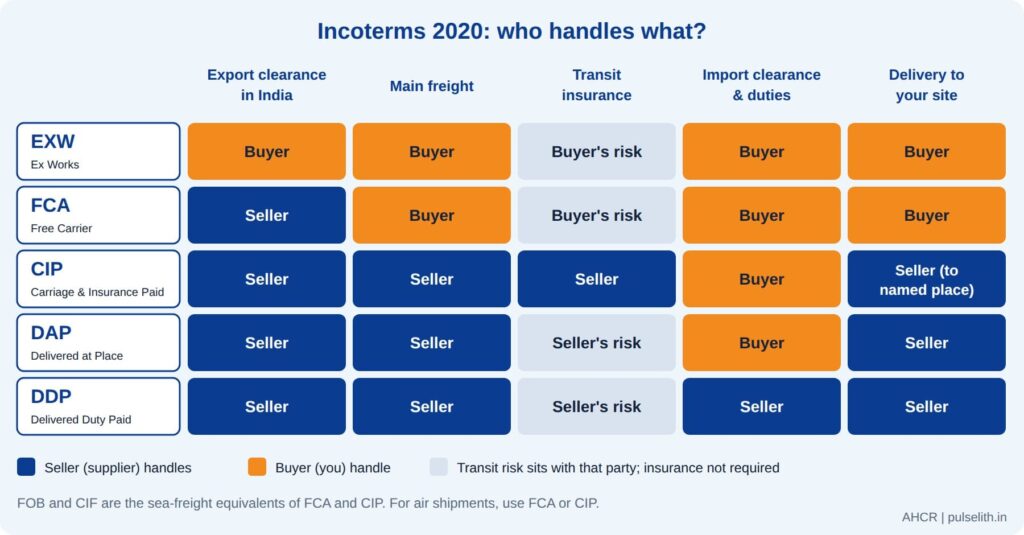 Figure 2: Responsibility split under five common Incoterms 2020 rules. Confirm the full wording with your freight forwarder.
Many first-time importers prefer CIP (air) or CIF (sea), so the supplier handles export clearance, freight and insurance while you focus on import clearance. Buyers with their own forwarder often choose FCA or FOB to control freight costs. Avoid EXW unless you have a partner in India who can handle export clearance. DDP looks convenient, but it only works if the supplier can legally clear goods and pay duties in your country.
Step 5: Production, pre-shipment inspection and packing
Confirm the lead time in writing, with milestones, and ask for photographs or short videos during production. Before shipment, inspect the goods against your approved sample. You can send your own inspector or hire an independent inspection agency. Check quantity, dimensions, finish, labelling, packing and, for equipment, serial numbers and a functional test.
Packing matters. Insist on protective inner packaging, moisture control and export-grade cartons, with batch or lot numbers on labels and any language your regulator requires.
Documents required to import surgical instruments from India
Missing paperwork is the leading reason medical device shipments are held at customs. The diagram below shows who is responsible for each document.
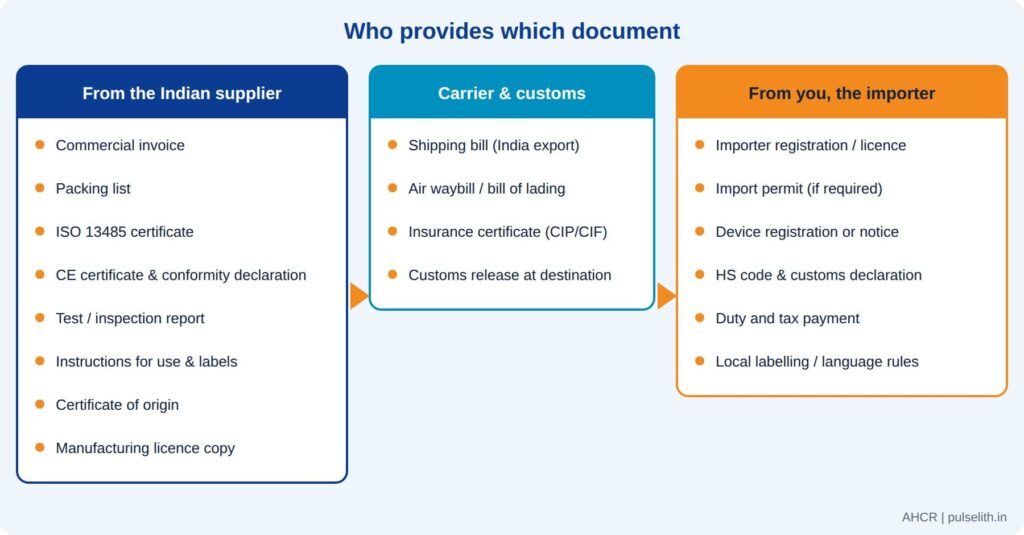 Figure 3: Document map for a surgical instrument import, split between supplier, carrier and customs, and importer.
Three points deserve extra attention, and descriptions, quantities and values must match across every document:
- HS code. Surgical and medical instruments generally fall under heading 9018 of the Harmonized System, but the exact subheading differs by item and country. Agree the code with your customs broker, because a wrong classification can trigger duty disputes.
- Certificate of origin. Some importers need it to claim preferential duty rates. Ask your broker whether you do.
- Free sale certificate. Some regulators ask for a certificate of free sale or an equivalent from the exporting country. Ask the supplier early how long it takes to obtain.
Steps 6 and 7: Shipping, customs clearance, registration and after-sales
Choose the right freight mode
Air freight suits samples, urgent orders and high-value equipment. Sea freight is generally cheaper for bulk instrument orders but slower. Use a forwarder with medical-device experience.
Clear customs and register
Your customs broker files the import declaration, pays duty and tax, and obtains release. Complete any device registration or importer licensing before the goods arrive, not after.
Inspect on arrival and plan after-sales
Check cartons against the packing list, photograph damage and report it to the carrier within its claim window. Record batch numbers, then confirm warranty terms, spare parts such as probes and handpieces, user training and reorder lead times. AHCR manages compliant packaging, complete documentation and coordinated shipping for export orders, and supports end users with training and after-sales service.
Seven common mistakes when buying surgical instruments from India
- Choosing on unit price alone.
- Accepting certificates without checking them.
- Skipping samples.
- Leaving the specification vague. Put material, finish and tolerances in the contract.
- Using EXW without a partner in India.
- Wrong HS code or missing documents.
- Ignoring after-sales. Confirm spares, service and training first.
Importer checklist: verify the supplier and be import-ready
Copy this checklist into your procurement file and tick each item before you pay.
| Stage | Check |
|---|---|
| Before you enquire | ☐ Product list with sizes, materials and quantities ☐ Your regulator’s requirements confirmed ☐ Registration holder decided (you, agent or manufacturer) |
| Before you order | ☐ ISO 13485 and CE certificates checked ☐ Indian licence number and IEC verified ☐ Factory proof (video or audit) and two references ☐ Samples approved by end users |
| Before you pay | ☐ MOQ, price, Incoterm, lead time and warranty in writing ☐ Approved sample named in the contract ☐ Payment terms and bank details confirmed by phone |
| Before it ships | ☐ Pre-shipment inspection completed ☐ Packing and labelling checked ☐ Invoice, packing list and certificates reviewed ☐ HS code agreed with your broker |
| When it arrives | ☐ Goods checked against the packing list ☐ Damage reported within the claim window ☐ Batch numbers recorded ☐ Registration and after-sales contacts filed |
Instruments importers ask for most
These are the product groups our export customers most often combine in one order. Each links to its product page or buying guide.
- Pneumatic lithotripter
Stone fragmentation system. Read the cost vs ROI guide and how to choose a lithotripter supplier in India. - PCNL instrument sets
Needles, dilators, sheaths and forceps. - Bipolar TURP system
Resection systems for prostate surgery. See our buying guide. - Cystoscopy sheaths
Sheaths with obturators. Read what urologists ask before buying. - Laparoscopic instruments
Graspers, scissors, trocars and accessories. - Hysteroscopy sets
Diagnostic and operative sets. Browse the gynecology range.
You can also browse the complete urology instruments exporter range or the full product catalogue.
Frequently asked questions
How do I import surgical instruments from India?
Define your product list and your country’s rules, verify the manufacturer’s certificates and licences, test samples, agree terms in writing, inspect before shipment, collect the export documents, then clear customs and complete any device registration your regulator requires.
What documents are required to import surgical instruments from India?
From the supplier: commercial invoice, packing list, ISO 13485 and CE certificates, inspection reports and instructions for use. From the carrier: an air waybill or bill of lading. From you: importer registration, any import permit or device registration, and the customs declaration. Requirements depend on your country.
How do I verify an Indian surgical instruments manufacturer?
Ask for the ISO 13485 certificate, the CE certificate, the Indian manufacturing licence number and the Importer Exporter Code. Check that names, scope and dates match, request a video audit and buyer references, and order samples first.
What is the minimum order quantity for surgical instruments from India?
MOQ varies by manufacturer and product. Standard items usually carry lower minimums than custom or OEM items. Ask for MOQ in writing for each item, and whether mixed-product orders can be combined to meet it.
What payment terms are used when buying surgical instruments from India?
Advance transfer suits small trial orders, a deposit plus balance suits production orders, and a letter of credit suits larger first orders. Open account terms usually come only after a long relationship.
Which Incoterm should I choose for surgical instruments from India?
First-time importers often choose CIP (air) or CIF (sea) so the supplier handles export clearance, freight and insurance. FCA or FOB suits buyers with their own forwarder. Avoid EXW unless you have a partner in India.
Does AHCR export surgical instruments to my country?
AHCR supplies customers across India and exports to the Asia-Pacific region, the Middle East, Africa and the Americas. Send your destination country and product list through the contact page, and the team will confirm what is available and what documents your market needs.
Ready to import surgical instruments from India?
AHCR (Advanced Health Care Resources) is an ISO 13485 and CE-certified manufacturer based in Okhla Industrial Area, New Delhi, supplying hospitals, clinics, distributors, and OEM partners in India and overseas. Tell us what you need and where it is going, and we will help you through each step in this guide.
This guide is general information and not legal, regulatory or customs advice. Import rules vary by country and change over time, so confirm current requirements with your regulator and customs broker.

Leave a Reply