

Ask any urologist what actually decides how smoothly a PCNL goes, and most won’t say the laser or the lithotripter. They’ll talk about the access — the needle puncture, the guidewire, the dilation, the sheath. Get that sequence right, and the rest of the case is straightforward. Get it wrong, and you’re chasing bleeding, re-puncturing a tract, or watching the surgeon fight a dilator that won’t advance.
This is a practical rundown of the four instruments that make up PCNL access: needles, guidewires, dilators, and sheaths. It covers where the Alken needle and Alken telescopic dilators fit in, why sizing tolerances matter more than most catalogs let on, and what to actually look for when you’re comparing a PCNL instrument set from one manufacturer against another.
Table of Contents
- Why Access Instruments Get Underrated
- Needles: The First Instrument That Touches the Patient
- The Alken Needle, Specifically
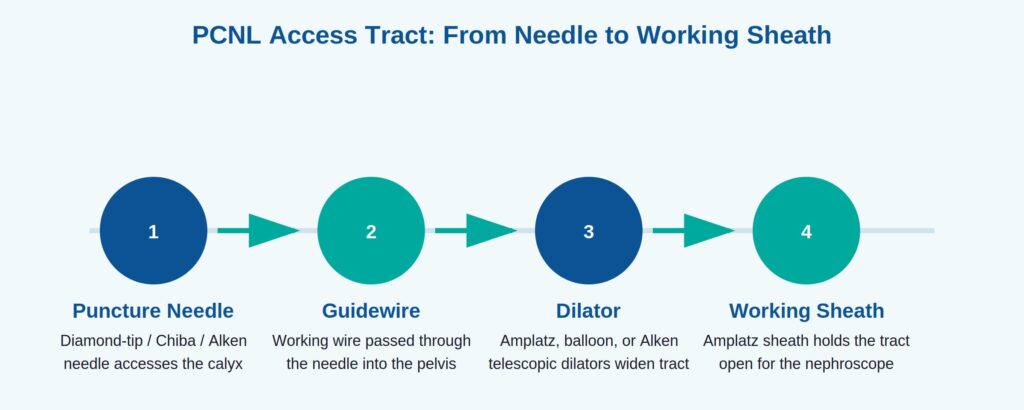
- The Access Sequence at a Glance
- Guidewires: Working Wire and Safety Wire
- Dilators: Amplatz, Balloon, and Alken Telescopic
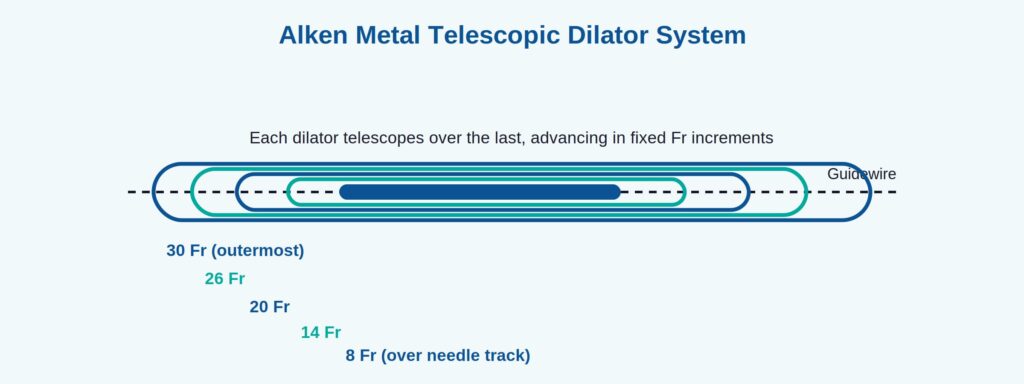
- How the Alken Telescopic Set Actually Works
- Sheaths: What the Rest of the Procedure Runs Through
- Buying These as a Matched Set
- Before You Sign a Purchase Order
- Common Questions
Why Access Instruments Get Underrated
Hospitals spend a lot of comparison time on lithotripters and laser fibers because those are the expensive, headline items. Access instruments — needles, wires, dilators, sheaths — get treated more like consumables, priced and ordered almost as an afterthought. That’s backwards, because a poor access set doesn’t just slow the surgeon down. It changes outcomes: longer fluoroscopy time, more bleeding, a higher chance of needing a second puncture.
A needle with slightly inconsistent wall thickness behaves differently under fluoroscopy than the gauge marking suggests. A guidewire that kinks the moment a dilator pushes against it can end a dilation attempt before it starts. None of this shows up on a spec sheet. It shows up in the OT, usually at the worst possible moment. So when procurement teams evaluate a PCNL instrument set, the needle-to-sheath sequence deserves the same scrutiny as the capital equipment, not less.
Needles: The First Instrument That Touches the Patient
The puncture needle’s only job is to get into the right calyx in one clean pass, without tearing through renal parenchyma or nicking something it shouldn’t. Everything downstream depends on that first puncture being accurate and atraumatic.
Three needle types tend to show up on PCNL trays, and they’re not interchangeable. Diamond-tip needles have a faceted, cutting edge that tracks cleanly through tissue and are usually the default for the initial calyceal puncture. Chiba needles are thinner — 18 to 22 gauge — and get used when precision matters more than speed, particularly for upper-pole access or a collecting system that isn’t well dilated. The Alken needle is a different animal altogether, built to pair with a specific dilation system rather than to stand alone as a diagnostic puncture needle.
What separates a needle that performs well from one that doesn’t isn’t really the design on paper. It’s manufacturing consistency: does the stylet seat flush with no wobble, does the cannula hold its shape under normal puncture pressure, is the gauge actually what the label says once you measure the wall thickness. A lot of low-cost needles pass a visual inspection and still behave inconsistently once they’re under fluoroscopy.
The Alken Needle, Specifically
If you search “alken needle,” you’re usually not looking for a generic puncture needle. You’re looking for the needle that’s built to work with the Alken metal telescopic dilator system, which is a specific and fairly old-school approach to tract dilation that a lot of high-volume centers still prefer because the dilators are reusable rather than disposable.
The reason the Alken needle gets its own name instead of just being “an 18-gauge needle” is that its puncture profile is matched to the inner bore of the smallest telescopic dilator. That match is what lets the surgeon move from needle to first dilator without disturbing the guidewire position — and losing guidewire position mid-dilation is one of the more common reasons a case stalls and the surgeon has to re-puncture. So the needle and the dilator set aren’t really two separate products. They’re one system, and most manufacturers, AHCR included, sell and spec them that way rather than as isolated SKUs.

Also read:
Alken Needle for PCNL: Specifications, Uses, and How to Choose the Right Gauge
Alken Needle vs Chiba Needle: Which Is Better for PCNL and Percutaneous Renal Access?
The Access Sequence at a Glance
Needle first, to open a single controlled track into the collecting system. Guidewire next, threaded through the needle and coiled in the renal pelvis, so there’s something for every instrument after it to ride on. Dilator third, whichever method is used, to bring the tract up to working diameter. Sheath last, to hold that tract open and give the nephroscope a clean channel to work through. Four steps, in that order, every time — the variation is in which needle, which dilation method, and which sheath, not in the sequence itself.
Guidewires: Working Wire and Safety Wire
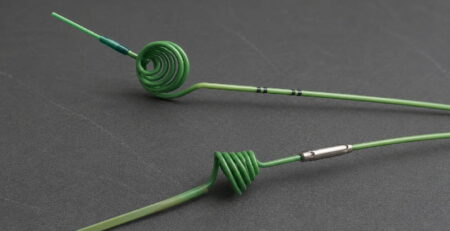
Once the needle is in, a guidewire goes through it and gets coiled inside the collecting system. This is the part people underestimate. Every dilator and the sheath itself will pass over this wire, so a wire that’s too soft, too stiff, or coated inconsistently changes how the entire rest of the procedure feels to the surgeon.
Most PCNL cases actually use two wires, not one. The working guidewire is the one everything tracks over — it needs a stiff enough shaft to hold its position under dilator pressure, paired with a soft, atraumatic tip so it doesn’t perforate the collecting system while it’s being placed.
The safety guidewire gets placed alongside it and then left completely alone for the rest of the case. It’s an insurance policy: if the working wire gets displaced or the tract has to be abandoned partway through, the safety wire keeps access into the kidney intact so the surgeon isn’t starting from a fresh, now-bleeding puncture.
Nitinol-PTFE hybrid wires have mostly become the standard because they combine a pushable core with a low-friction coating, which matters a lot once you’re sliding a metal dilator over the wire rather than just a plastic one. A wire that kinks under that pressure is one of the most common, and most avoidable, causes of a dilation attempt going sideways.
Dilators: Amplatz, Balloon, and Alken Telescopic
Dilation is where the tract gets built out from a needle track to a working channel, usually 24 to 30 Fr for a standard PCNL. There are three established ways to do this, and most instrument sets are built around one of them.
Amplatz fascial dilators are the most common approach: a sequential series of semi-rigid plastic dilators, each a size larger than the last, passed one at a time over the guidewire until you reach the target diameter. It’s predictable, the equipment cost is low, and most surgeons are trained on it first.
Balloon dilation takes a different route — a single balloon catheter inflated once to a fixed diameter, which is faster but needs an inflation device and costs more per case. Then there’s the Alken metal telescopic system: a set of graduated, hollow metal dilators that nest inside one another and advance as a connected unit over the guidewire. Because they’re reusable rather than single-use, high-volume centers often lean on Alken dilators specifically to keep the per-case instrument cost down.
The telescopic system only works, though, if the machining is tight. If the outer diameter of one dilator doesn’t match the inner diameter of the next almost exactly, the telescoping action catches instead of sliding, and the surgeon ends up fighting the instrument rather than dilating the tract.

How the Alken Telescopic Set Actually Works
Picture five hollow metal tubes of increasing diameter, each one just barely wider than the last, all riding over the same guidewire. The smallest, usually around 8 Fr, follows the needle track directly. Each subsequent dilator slides over the one before it and is advanced a short distance further into the tract, until the largest — typically 30 Fr for a standard-size PCNL — is seated and the tract is ready for the sheath.
Because the dilators are metal and reusable, the same set gets sterilized and used again, which is the main reason hospitals with high PCNL volumes tend to favor this system over disposable plastic dilators even though the upfront cost of the set is higher.
Sheaths: What the Rest of the Procedure Runs Through
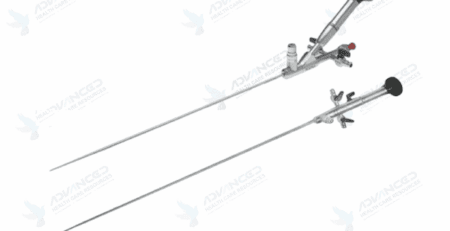
Once the tract is dilated, a sheath goes in over the final dilator and stays there as the working channel for the rest of the case. The nephroscope, the lithotripsy probe, irrigation fluid, stone baskets — all of it passes through this one sheath, so its internal diameter, wall thickness, and how well it matches the dilator set have a direct effect on visibility and how much room the surgeon actually has to work with.
The Amplatz working sheath is the standard: rigid, radiopaque, sized to match whatever the final dilation diameter was, and built to keep the tract open while also letting irrigation fluid drain out continuously, which is part of what keeps intrarenal pressure — and infection risk — under control during the case. Peel-away sheaths are the alternative, used mainly with balloon dilation, and designed to split open once the balloon catheter and nephroscope are in position.
Sheath sizing has to line up exactly with the dilator it’s following. A sheath even one size off either won’t slide cleanly over the tract or leaves enough of a gap that the tract starts to collapse before the sheath is fully seated. This is one of the more common problems procurement teams run into when they mix and match sheaths and dilators across different manufacturers instead of buying a matched set to begin with.
Buying These as a Matched Set
The compatibility issues above — needle-to-dilator transitions, dilator-to-sheath sizing — mostly disappear when the whole access sequence comes from one manufacturer that has actually toleranced the pieces to fit each other. Pulselith’s PCNL instrument set line covers puncture needles including the Alken needle, working and safety guidewires, both Amplatz and Alken metal telescopic dilators, and Amplatz working sheaths sized to match.
The rest of AHCR’s catalog sits alongside this: pneumatic lithotripters, cystoscopy sheaths, bipolar TURP systems, and laparoscopic accessories, all manufactured under ISO 13485 and CE certification. For hospitals and distributors, that certification isn’t just a compliance checkbox — it’s usually the documentation tender committees and import authorities actually ask for.
Before You Sign a Purchase Order
A few things worth checking before finalizing a PCNL instrument set order, instead of comparing purely on price:
- Does the needle gauge actually match the labeled Fr size, and does the stylet sit flush with no play in it?
- Are the working and safety guidewires sold as a matched pair, with the tip type (floppy or J-tip) clearly specified?
- Are the dilator size increments close enough together that the surgeon isn’t forced to skip steps?
- Does the largest dilator size line up exactly with the working sheath’s internal diameter?
- Is the set backed by ISO 13485 and CE documentation you can actually use for a tender or import filing?
- Can the manufacturer supply the Alken needle and Alken telescopic dilators as one matched system, rather than sourcing them from separate lines?
Common Questions
What is an Alken needle used for?
It’s the puncture needle built to start a PCNL tract that will then be dilated using the Alken metal telescopic dilator system. Its bore is sized to match the smallest telescopic dilator so the transition doesn’t disturb the guidewire.
What’s the actual difference between Amplatz dilators and Alken dilators?
Amplatz dilators are single-use plastic dilators passed one at a time in sequence. Alken dilators are reusable metal dilators that telescope inside one another and advance together as a connected system over the guidewire.
Why use two guidewires instead of one?
The working wire is what the dilators and sheath actually ride over. The safety wire sits untouched as a backup, so if the working wire gets displaced mid-procedure, the surgeon still has access into the kidney instead of having to re-puncture.
How do you pick the right working sheath size?
Match it to whatever the final dilator diameter was — usually 24 to 30 Fr for standard PCNL, smaller (12 to 20 Fr) for Mini-PCNL. A sheath that doesn’t match the last dilator either won’t seat properly or leaves a gap the tract can collapse into.
The needle-to-sheath sequence isn’t the most exciting part of a PCNL case, but it’s the part where problems actually start. Whether a hospital is sticking with Amplatz sequential dilation or moving to Alken telescopic dilators to cut per-case cost, the instruments work best evaluated as one connected system rather than four separate line items on a purchase order. See the full range of ISO 13485 and CE-certified PCNL instrument sets from AHCR.
Contact urology equipment manufacturer to buy or to learn more.







Leave a Reply