
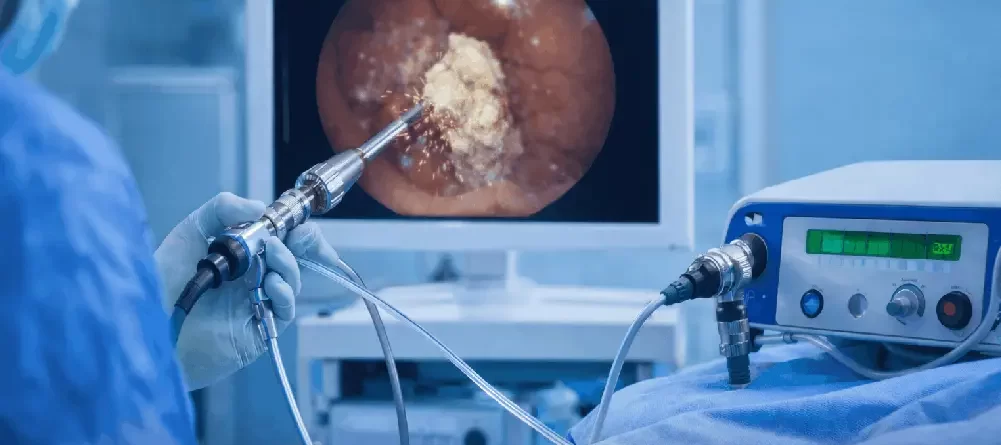
Use a probe that is too wide for a narrow ureter, and you risk mucosal trauma. Use one that is too fine for a large, hard renal stone, and you will spend unnecessary time in the OT with incomplete fragmentation. Probe selection is a clinical decision that directly affects procedural efficiency, patient safety, and stone clearance rates.
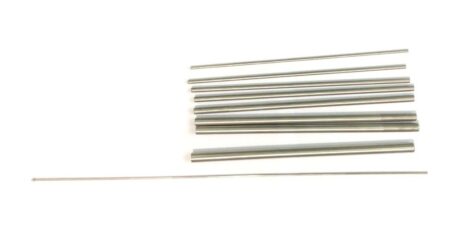
This guide is written for urologists, OT coordinators, and biomedical procurement teams who work with the Pulselith Intracorporeal Pneumatic Lithotripter. It covers the full probe range — 0.8 mm, 1.0 mm, 1.2 mm, 1.5 mm, 2.0 mm, and 2.5 mm — with the clinical rationale for each.
How Probe Size Affects Stone Fragmentation
In a pneumatic lithotripter, compressed air (or oxygen) drives a metallic projectile inside the handpiece. This projectile impacts the probe, which transmits kinetic energy to the stone. The probe diameter directly influences three things:
- Impact force — thicker probes transmit more energy per pulse
- Fragment size — thicker probes produce larger fragments that may need secondary clearance
- Passage safety — thinner probes are safer for narrow anatomy like the distal ureter
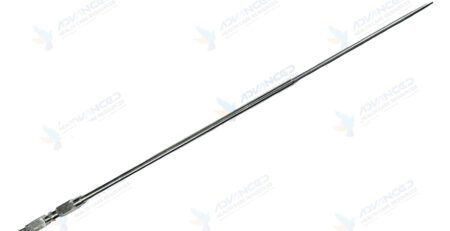
The Pulselith system supports probes from 0.8 mm to 2.5 mm, with two probe lengths: 640 mm for URS (ureteroscopy) and 450 mm for PCNL (percutaneous nephrolithotomy). All probe sizes are compatible with the same handpiece — the selection is based entirely on clinical need.
Quick Reference: Probe Size Selection Table
Use this table as a fast reference during surgical planning or equipment procurement:
| Probe Size | 0.8 mm | 1.0 mm | 1.2 mm | 1.5 mm | 2.0 mm | 2.5 mm |
|---|---|---|---|---|---|---|
| Procedure | URS | URS | URS / PCNL | PCNL | PCNL | PCNL |
| Stone Location | Distal / mid ureter | Mid / proximal ureter | Proximal ureter / kidney | Kidney / bladder | Kidney | Large renal calculi |
| Stone Size | < 10 mm | < 12 mm | 10–15 mm | 10–20 mm | > 15 mm | > 20 mm |
| Impact Force | Lower | Moderate | Moderate–High | High | Very High | Maximum |
| Tissue Trauma Risk | Minimal | Low | Low–Moderate | Moderate | Moderate | Higher |
| Fragment Size | Fine dust | Fine–medium | Medium | Medium–large | Large | Larger fragments |
| Probe Length | 640 mm (URS) | 640 mm (URS) | 640 / 450 mm | 450 mm (PCNL) | 450 mm (PCNL) | 450 mm (PCNL) |
Probe-by-Probe Clinical Guide
- 0.8 mm
- Fine Precision for Distal Ureteric Stones
- The stone is in the distal or mid-ureter
- The ureter has not been pre-dilated
- The stone is small (< 10 mm) but impacted and not passing spontaneously
- Working through a small-calibre ureteroscope working channel
The 0.8 mm probe delivers comparatively lower impact force per pulse — sufficient for most ureteric stones. Fragments produced are fine and flush out easily with irrigation. Tissue trauma risk is minimal, which is a significant advantage in the ureter where mucosal injury can lead to stricture formation.
- 1.0 mm
- The Versatile URS Workhorse
The 1.0 mm probe delivers a step up in energy and suits a wider range of ureteric stones. It works well in both semi-rigid and flexible ureteroscopy. Recommended for:
- Mid and proximal ureteric stones up to approximately 12 mm
- Stones with moderate hardness (e.g., calcium oxalate dihydrate)
- Cases where the 0.8 mm probe is fragmenting too slowly
Fragments are slightly larger than those produced by the 0.8 mm probe and may require active retrieval with a stone basket in some cases. It remains safe for ureteric use but should be used with care in very tight distal ureter anatomy.
- 1.2 mm
- Bridging URS and PCNL
The 1.2 mm probe occupies a useful middle ground and is available in both probe lengths: 640 mm for URS and 450 mm for PCNL. It is appropriate for:
- Larger ureteric stones (10–15 mm) where finer probes would require excessive pulse time
- Small to medium renal calculi approached via PCNL
- Cases where the procedure may need to adapt between ureter and renal pelvis access
Impact force is meaningfully higher than the 0.8 mm or 1.0 mm probes. Fragment clearance may require active irrigation or secondary basket retrieval in the renal pelvis.
- 1.5 mm
- Standard PCNL Probe for Most Renal Calculi
- Renal calculi of 10–20 mm
- Staghorn stones where initial access has been established and fragmentation is in progress
- Bladder stones being treated endoscopically
The higher energy delivery accelerates stone clearance time in PCNL — a clinical and anaesthesia benefit. Fragments produced are larger and are typically removed with suction or graspers.
- 2.0 mm & 2.5 mm
- Maximum Energy for Large, Hard Stones
- Large renal calculi (over 15–20 mm) requiring aggressive fragmentation
- Hard stone compositions such as calcium oxalate monohydrate or brushite
- Staghorn or partial staghorn stones during PCNL
- Bulk stone burden reduction in a heavily loaded renal pelvis
These probes generate larger fragments and require active fragment management. The Power-Pulse mode on the Pulselith system is most beneficial with 2.0 mm and 2.5 mm probes, delivering high-energy bursts for resistant stone material.
Probe Selection by Procedure Type
For URS (Ureteroscopy) — 640 mm Probe Length
In ureteroscopy, access is through the urethra and ureter. Most semi-rigid ureteroscope working channels accommodate probes up to 1.0 mm or 1.2 mm; flexible ureteroscopes typically accommodate up to 1.0 mm.
- 0.8 mm — distal and mid-ureteric stones, tight or un-dilated anatomy
- 1.0 mm — mid and proximal ureteric stones, standard cases
- 1.2 mm — larger ureteric stones, wider working channel ureteroscopes
For PCNL (Percutaneous Nephrolithotomy) — 450 mm Probe Length
In PCNL, access is percutaneous through the renal parenchyma. The nephroscope working channel accommodates larger probes, enabling higher energy delivery.
- 1.2 mm — smaller renal calculi, initial fragmentation passes
- 1.5 mm — standard renal calculi, most routine PCNL cases
- 2.0 mm — large calculi, staghorn stones, harder stone compositions
- 2.5 mm — maximum energy delivery for large, dense stone burden
Probe Lifespan and Replacement Considerations
Pneumatic lithotripter probes are consumable accessories. Repeated impact cycles cause metal fatigue, which can result in probe tip fracture during a procedure — a complication requiring immediate cystoscopic retrieval of the fragment. Signs that a probe needs replacement include:
- Visible bending or deformation at the tip
- Reduced fragmentation efficiency despite adequate pressure settings
- Surface pitting or micro-cracking visible under light
- Prior use at maximum pressure for an extended procedure duration
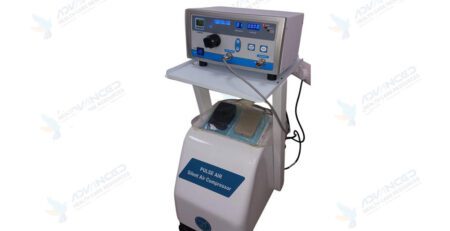
Pulselith Pneumatic Lithotripter — Technical Specifications
| Available Probe Sizes | 0.8 mm, 1.0 mm, 1.2 mm, 1.5 mm, 2.0 mm, 2.5 mm |
| URS Probe Length | 640 mm |
| PCNL Probe Length | 450 mm |
| Pulse Modes | Single / Multiple / Power-Pulse |
| Projectile Impact Frequency | 1 Hz – 12 Hz and 14 Hz |
| Output Pressure | 2.5 to 4.5 Kg/cm² |
| Inlet Supply (max / min) | 6 Kg/cm² (max) / 4 Kg/cm² (min) |
| Input Gas | Oxygen or Compressed Air |
| Mains Voltage | 180–230 Vac, 50 Hz |
| Power Consumption | 40 Watts |
| Handpiece Length & Weight | 185 mm | 175 g |
| Certifications | ISO 13485:2012 | CE Certified |
| Manufacturer | AHCR (Advanced Health Care Resources), New Delhi, India |
Frequently Asked Questions
Summary: Probe Selection at a Glance
- Use 0.8–1.0 mm for ureteroscopy in the distal and mid-ureter
- Use 1.0–1.2 mm for proximal ureteric and transitional cases
- Use 1.5 mm as the standard PCNL probe for most renal calculi
- Use 2.0–2.5 mm for large, hard, or staghorn stones via PCNL
- Never use the 2.5 mm probe through a ureteroscope
- Inspect all probes before each use and replace on signs of fatigue or deformation
The Pulselith Intracorporeal Pneumatic Lithotripter includes all six probe sizes in the complete system, giving surgical teams the flexibility to address the full spectrum of urinary stone disease from a single, ISO-certified device manufactured in India.
Enquire About the Pulselith Pneumatic Lithotripter
ISO 13485:2012 & CE Certified | Manufactured in New Delhi, India | Export Worldwide






Leave a Reply