
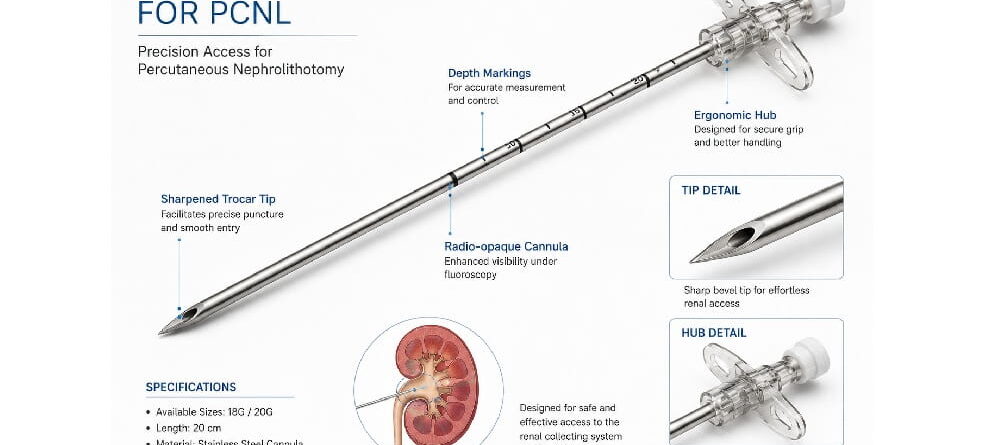
Renal access is the single most decisive step in percutaneous nephrolithotomy (PCNL) — get it right, and the rest of the procedure follows a predictable path; get it wrong, and surgeons face longer access times, higher bleeding risk, and a harder road to stone clearance. The Alken needle sits at the center of this step for a large share of PCNL surgeons worldwide, particularly those using the Alken telescopic metal dilator technique. This guide covers what the Alken needle is, its technical specifications, how it performs clinically against alternatives, and how to choose the right gauge for your case.
Table of Contents
- What Is an Alken Needle?
- Alken Needle Specifications
- How the Alken Needle Works in PCNL
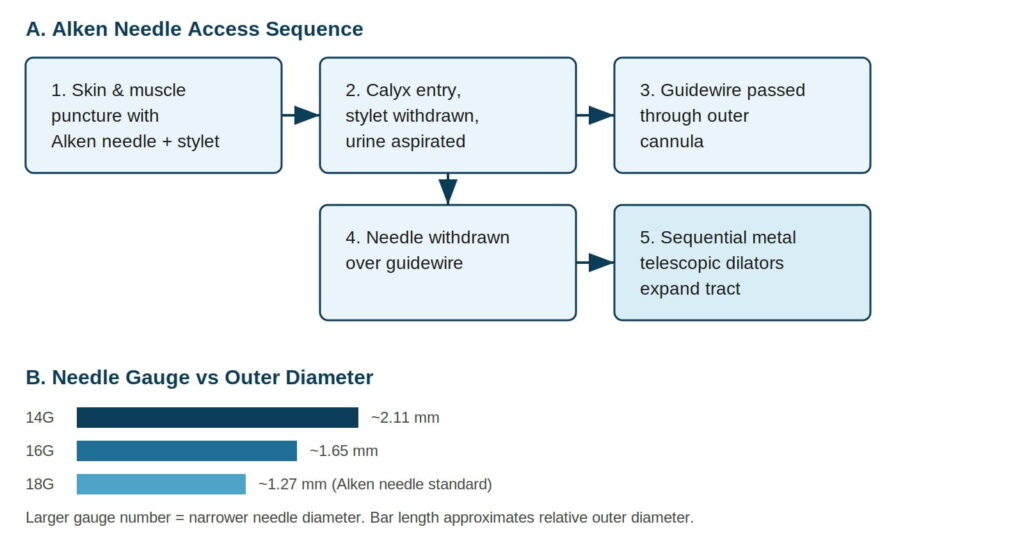
- Diagram: Alken Needle Access and Gauge Comparison
- Clinical Evidence: Alken vs Amplatz Dilation
- How to Choose the Right Gauge
- What to Look for When Buying an Alken Needle
- Frequently Asked Questions
- Sources
What Is an Alken Needle?
The Alken needle is a precision percutaneous puncture needle used to gain initial access to the renal collecting system during PCNL. It is a two-part instrument — an outer cannula paired with an inner trocar-tipped stylet — engineered specifically to work with the Alken telescopic metal dilator system. Once the needle punctures the target calyx and urine or contrast is aspirated to confirm position, the stylet is withdrawn, a guidewire is passed through the outer cannula, and sequential metal dilators are advanced over that same access point to build the working tract.
This tight integration between puncture and dilation is what distinguishes the Alken needle from a generic access needle. It isn’t just a puncture tool; it’s the entry point of a complete, self-contained tract-dilation workflow that many urology centers standardize on for both routine and complex stone cases, including staghorn calculi and horseshoe kidney anatomy.
Alken Needle Specifications
Understanding the physical specifications of the Alken needle helps surgical teams select the right instrument for their access technique and patient anatomy. Typical specifications include:
- Gauge: Standard 18G, offering a balance of stiffness and a narrow puncture profile suited to renal access
- Length: Approximately 15–18 cm, sufficient reach for most percutaneous renal access depths regardless of patient body habitus
- Tip design: Sharp bevel tip for a clean, low-trauma entry through skin, muscle, and renal parenchyma
- Construction: Hollow metallic outer cannula with a removable inner stylet, built for tactile feedback during puncture
- Compatibility: Designed to accept a standard PCNL guidewire once the stylet is withdrawn, and to interface directly with telescopic metal dilator sets
The 18G gauge is significant because gauge size directly determines outer needle diameter — and outer diameter is a major factor in both puncture control and the risk profile of the initial access. For reference, an 18G needle has an outer diameter of roughly 1.27 mm, noticeably narrower than a 16G needle at approximately 1.65 mm.[1] That narrower profile is part of why 18G remains the conventional choice for the first percutaneous puncture in PCNL.
How the Alken Needle Works in PCNL
The Alken needle is used at the very beginning of the percutaneous access sequence, typically under fluoroscopic or ultrasound guidance:
- The surgeon selects a target calyx, usually guided by prior CT imaging and either fluoroscopy or ultrasound intraoperatively
- The Alken needle, with its stylet in place, is advanced through skin and soft tissue toward the calyx
- Surgeons rely on tactile feedback through the needle as it passes each tissue layer, helping confirm depth and direction without over-relying on imaging alone
- Once urine or contrast is aspirated confirming collecting-system entry, the stylet is removed
- A guidewire is passed through the outer cannula into the collecting system
- The needle is withdrawn over the guidewire, and telescopic metal dilators are advanced sequentially over the same wire to expand the tract to working size
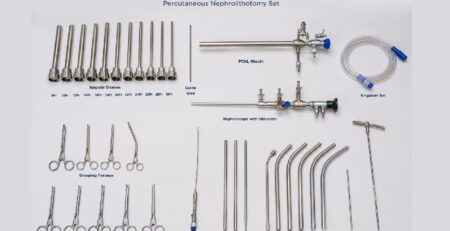
This sequence is why the Alken needle is rarely purchased or used in isolation — it functions as the first link in the Alken metal telescopic dilator chain, and most hospitals order it as part of a complete dilator set rather than as a standalone item.
Diagram: Alken Needle Access and Gauge Comparison
Clinical Evidence: Alken vs Amplatz Dilation
Beyond specifications, the clinical performance of Alken-based access has been directly studied against the alternative Amplatz serial dilation technique. A 2024 retrospective comparative study of 80 PCNL patients found that mean access time was shorter in the Alken dilator group than in the Amplatz group, at 7.3 minutes versus 8.1 minutes.
The same study reported that intraoperative bleeding was notably lower with Alken dilation at 4.7% compared to 15.7% in the Amplatz group, and that hemoglobin drop and the need for blood transfusion were both significantly lower in the Alken group. Postoperative urosepsis was also less frequent with the Alken technique in this cohort, while stone clearance success was comparable between the two methods.
Separately, research into ultrasound-guided supine PCNL using the Alken metal telescopic dilator found that tract dilatation time decreased significantly once a surgeon had performed roughly 20 procedures, with stone-free rates improving markedly at that same experience threshold and further gains appearing after 40 procedures.
This underlines a practical point often missed in equipment comparisons: outcomes with the Alken system are strongly tied to operator experience, not just the instrument itself.
The Alken telescopic metal dilator technique has also been used successfully in complex anatomy, including a documented X-ray-free PCNL case in a horseshoe kidney with a large staghorn calculus, demonstrating the system’s adaptability beyond routine cases.[5]
How to Choose the Right Gauge
While the Alken needle is manufactured as a standard 18G instrument, understanding why 18G is the default — and when other gauges appear in related renal puncture contexts — helps surgical teams make informed sourcing and technique decisions.
- 18G (Alken needle standard): Offers a narrower puncture profile with an outer diameter of roughly 1.27 mm, reducing tissue trauma at first entry while still providing enough rigidity for controlled, tactile-guided puncture and reliable guidewire passage.[1]
- 16G: Used in some renal access and biopsy contexts where a larger working lumen is prioritized; comes with a wider outer diameter of approximately 1.65 mm.[1] Comparative data from renal biopsy literature shows 16G needles can be associated with higher rates of certain complications despite better sample or flow characteristics.[4]
- 14G: Occasionally referenced in wider-bore access literature but rarely used for the initial PCNL puncture itself, given the trauma associated with a substantially larger entry diameter.
For standard PCNL cases, 18G remains the practical default because it balances three requirements simultaneously: enough stiffness to maintain direction through soft tissue, a narrow enough profile to minimize bleeding risk at first puncture, and full compatibility with the guidewire and telescopic dilator sizes used downstream.
Surgeons should select gauge based on their specific dilation system, patient anatomy, and institutional protocol rather than defaulting purely on habit — but for centers using the Alken telescopic metal dilator technique, the needle’s fixed 18G specification is what the entire downstream tract-dilation sequence is calibrated around.
What to Look for When Buying an Alken Needle
Hospitals and procurement teams sourcing Alken needles for their urology department should evaluate:
- Certification: Confirm the manufacturer holds ISO 13485 and CE certification, which reflects adherence to recognized medical device quality management standards
- Material and finish: Surgical-grade stainless steel with a consistent, corrosion-resistant finish supports both durability and reliable tactile feedback during puncture
- Bevel sharpness and consistency: A precisely ground bevel tip is central to clean, low-trauma entry — inconsistent grinding across a batch can affect puncture control
- Compatibility with your existing dilator set: Since the Alken needle is the entry point to a telescopic metal dilation sequence, cannula dimensions must match the rest of your dilator system
- Complete set availability: Sourcing the needle as part of a full Alken telescopic dilator set, rather than piecemeal, reduces compatibility risk and simplifies procurement
Pulselith manufactures the Alken needle as part of its ISO 13485 and CE certified urology instrument range, engineered for precise renal access with an 18G gauge and sharp bevel tip designed to minimize trauma during puncture. Full specifications for the Alken Needle for PCNL are available on the Pulselith product page, alongside the company’s broader range of PCNL access and dilation instruments at pulselith.in.
Frequently Asked Questions
What gauge is a standard Alken needle?
The Alken needle is manufactured as a standard 18G instrument, typically 15–18 cm in length, sized to work directly with Alken telescopic metal dilator sets.
Is the Alken needle better than a standard puncture needle?
“Better” depends on the dilation system in use. The Alken needle is purpose-built for the telescopic metal dilator technique and, per comparative clinical data, has shown shorter access times and lower intraoperative bleeding than Amplatz dilation in at least one retrospective study.[2] A standard puncture needle offers more flexibility if your team uses balloon or Amplatz dilation instead.
Can the Alken needle be used for complex stone anatomy?
Yes. Case reports describe successful use of the Alken telescopic metal dilator technique in complex presentations, including large staghorn stones in horseshoe kidney anatomy.[5]
Does operator experience affect outcomes with the Alken needle system?
Significantly. Studies on the learning curve for Alken-based access report meaningful reductions in dilatation time and improvements in stone-free rates after a surgeon has performed approximately 20 to 40 procedures using the technique.[3]
Is the Alken needle reusable?
Most Alken needles are reusable, surgical-grade stainless steel instruments intended for reprocessing between cases according to standard sterilization protocols, subject to manufacturer instructions.
Sources
- Xie W, et al. “Adequacy and complication rates of percutaneous renal biopsy with 18- vs. 16-gauge needles in native kidneys in Chinese individuals.” BMC Nephrology, 2020. Available at: pmc.ncbi.nlm.nih.gov
- Khwairakpam A, et al. “A Comparison of the Alken Metallic Telescopic Dilator and Amplatz Serial Dilator for Renal Access in Percutaneous Nephrolithotomy.” Cureus, 2024. DOI: 10.7759/cureus.72509
- “The learning curve for a single surgeon using ultrasonography to guide supine percutaneous nephrolithotomy with an Alken metal telescopic dilator.” PMC, 2022.
- Zhan T, Lou A. “Comparison of outcomes of an 18-gauge vs 16-gauge ultrasound-guided percutaneous renal biopsy: a systematic review and meta-analysis.” 2023. DOI: 10.1080/0886022X.2023.2257806
- Rachman RI, et al. “X-ray free Percutaneous Nephrolithotomy (PCNL) with Alken Telescopic Metal Dilator for large stone in horseshoe kidney: A case report.” 2023. DOI: 10.1016/j.eucr.2023.102616
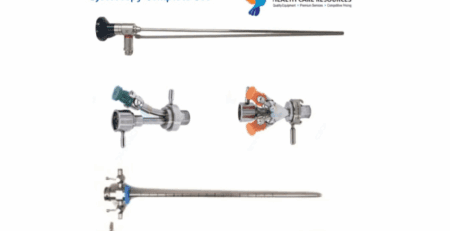
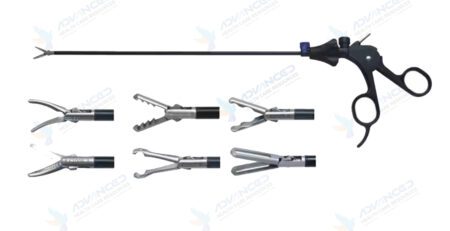
Pulselith is a New Delhi-based manufacturer and exporter of urology and laparoscopic surgical instruments, operating under Advanced Health Care Resources (AHCR), with an ISO 13485 and CE-certified product range spanning Alken needles, telescopic metal dilator sets, pneumatic lithotripters, and complete PCNL equipment. Explore the full catalog at pulselith.in.








Leave a Reply