
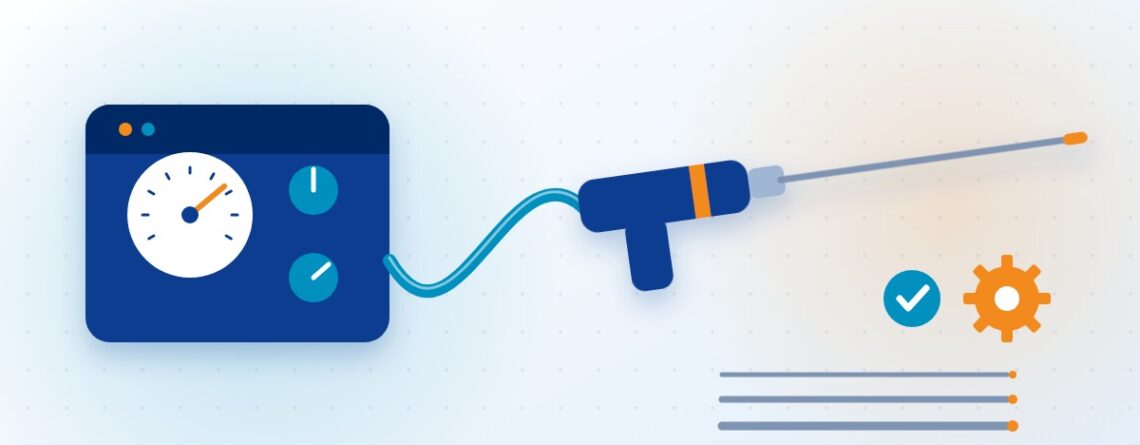
Probe, Handpiece and Compressor Guide for Hospitals
When a pneumatic lithotripter stops firing in the middle of an operating list, the real cost is not the repair. It is the delayed case, the idle OT and the patient who has to be rescheduled. Nearly all of these stoppages trace back to a short list of parts: the probe, the handpiece, the tubing and connectors, the gas supply and the foot switch.
This guide covers pneumatic lithotripter spare parts and troubleshooting in one place. You will learn which parts wear out and how often to reorder them, how to judge a lithotripter probe replacement, how to care for the handpiece, how to check the compressor or gas supply, and what to do on the day a unit is not firing. It is written for urologists, OT managers, biomedical engineers and procurement teams, and it supports, but never replaces, your manufacturer’s instruction manual.
How a pneumatic lithotripter works, and where it fails
Compressed air or oxygen flows from the source through a regulator and tubing to the control unit, which sets pressure, frequency and pulse mode. When the surgeon presses the foot switch, pulses travel to the handpiece, where a small projectile strikes the end of the probe. The probe carries that impact to the stone. Each link in this chain is a place where a fault can start.
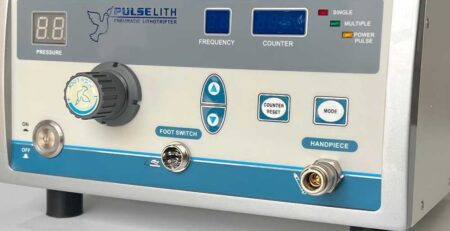
For reference, the Pulselith pneumatic lithotripter is specified for an inlet supply of 4 to 6 kg/cm² and an output pressure of 2.5 to 4.5 kg/cm², with single, multiple and power-pulse modes and a projectile frequency of 1 to 12 Hz and 14 Hz. Knowing your own unit’s ranges makes every later check faster.
Which parts wear out and how often to stock them
Not every part ages at the same speed. Probes are consumables. Tubing, connectors and foot switches wear with handling. Handpieces and compressors are serviceable. The control unit is long-life and should be maintained through an annual maintenance contract (AMC). The diagram shows how to think about reordering.
| Part | How it wears | Stocking starting point |
|---|---|---|
| Probes | Metal fatigue from repeated impacts; bending, pitting, cracks | Spares of every size you use often; more 0.8 and 1.0 mm for URS-heavy centres, more 1.5 and 2.0 mm for PCNL-heavy centres |
| Handpiece with tubing | Moisture damage, air leaks, loss of impact | At least one spare |
| Tubing and connectors | Kinks, cracks, loose or leaking joints | One spare set |
| Foot switch | Cable and connector wear | One spare if the unit is used daily |
| Regulator and regulator tubing | Leaks, damaged fittings | Spare tubing |
| Air compressor (if used) | Gradual loss of performance, noise | Service contact and a service interval from the supplier |
| Control unit | Rare; electronics, gauge and switches | Annual AMC visit |
These are starting points. Adjust them to your case volume and to how quickly your supplier can deliver.
Lithotripter probe replacement: when and how
The probe takes the most punishment, so it is the part you will buy most often. A fatigued probe can lose fragmentation efficiency, and in the worst case the tip can fracture during a procedure, which means the fragment must be retrieved. That is why replacement should be based on condition, not on waiting for failure.
Replace a probe when you see
- Bending or deformation, especially near the tip.
- Surface pitting or micro-cracks when you inspect it under good light.
- Reduced fragmentation even though pressure and settings are correct.
- A long history of use at high pressure or after a very long procedure.
How to inspect and fit a probe
- Run your fingers and eyes along the full length before every case, under good light.
- Confirm the diameter and length match the endoscope: 640 mm for URS and 450 mm for PCNL on the Pulselith system.
- Seat the probe fully in the handpiece as the manual describes, without forcing it.
- Never push an oversized probe through a narrow working channel. Our guide to pneumatic lithotripter probe sizes explains which size suits which procedure.
Planning your reorder
Track how many probes of each size you use each month for three months. Keep that number, plus a safety margin, as spares. If you buy lithotripter probes in bulk, ask for pricing by size and confirm delivery time, because a stock-out stops the lithotripter just as surely as a fault does. You can order replacement lithotripter probes from AHCR by size.
Handpiece care, testing and replacement
The handpiece contains the moving parts that generate each impact, so it needs the gentlest handling. A few habits prevent most handpiece failures:
- Clean and sterilise exactly as the manual says. Do not improvise a method.
- Keep the connector dry. Handpiece manuals commonly warn that moisture inside the handpiece or at the connector can damage it.
- Run the function test before each case. Confirm that the handpiece produces impacts and passes them to the probe.
- Handle it like a precision instrument. Avoid drops and kinked tubing, and never dismantle it yourself.
Replace the handpiece, or swap in your spare, if impact weakens, air escapes at the joints, tubing is cracked, or the unit is damaged. Send the faulty handpiece for manufacturer service. A department that owns only one handpiece has no backup, so keep at least one spare. The Pulselith handpiece with tubing is listed separately for exactly this purpose, and the standard system is listed with two handpieces (please confirm the current configuration with AHCR).
Compressor and gas supply checks
Unstable or low pressure is one of the most common reasons a lithotripter weakens or stops. A short routine catches it early:
- Check the inlet pressure against your unit’s specified range. For the Pulselith system that is 4 to 6 kg/cm².
- Watch the pressure gauge during use. A reading that drifts or drops suggests a leak or a weak source.
- Look and listen for leaks at the regulator, tubing and connectors. Use an approved leak-detection solution, not guesswork.
- Replace damaged tubing immediately. A cracked hose will not hold pressure. Spare oxygen regulator tubing and an oxygen regulator are available.
Safety note: when oxygen is the source, follow your hospital’s gas-safety rules. Never use oil or grease on regulators or fittings, and keep cylinders secured.
If your facility has no suitable gas supply, you can choose a configuration with a dedicated compressor, such as the Pulselith pneumatic lithotripter with Pulse Silent Air Compressor. Ask the supplier for its service interval and for who services it in your region, then add it to your AMC.
Troubleshooting: lithotripter not firing
When the unit stays silent, resist the urge to adjust everything at once. Change one thing at a time, in this order, so you know what fixed it.
| Symptom | Likely causes | What to check |
|---|---|---|
| Powered on but no pulses | Gas off or low; tubing disconnected; foot switch not connected; handpiece blocked or not connected | Source and regulator, tubing joints, foot-switch plug, handpiece connection |
| Weak fragmentation | Pressure set too low; worn or bent probe; a leak; wrong probe for the stone | Gauge reading, probe condition, joints for hissing, probe choice |
| Erratic or uneven firing | Pressure fluctuation; leak; moisture in the handpiece; damaged foot switch cable | Stable source pressure, connector dryness, foot-switch cable |
| Probe loose or will not seat | Wrong size or length; debris; worn fitting | Probe specification, clean seating area, try a new probe |
| Hissing sound | Air leak at tubing, connector or regulator | Each joint with a leak-detection solution |
| Unit will not power up | Mains supply or power cord fault | Mains outlet and voltage, power cord and connections |
Stop and call service if you smell burning, see damage to the control unit, find pressure that stays erratic despite a good supply, or the unit still does not fire after you have swapped in spares. Do not open the control unit. Internal repair belongs to the manufacturer or an authorised engineer.
Prevention beats rescue. Always have a spare probe and handpiece in the room before the first case, so a single fault does not stop the list.
Preventive maintenance schedule you can copy
Print this table for your OT or biomedical engineering file. It is a suggested routine, so always adapt it to your instruction manual and to your case volume.
| When | Tasks |
|---|---|
| Before each case | ☐ Inspect the probe for bending, pitting and cracks ☐ Confirm probe size and length ☐ Check the gas source and inlet pressure ☐ Check the connector is dry and run the function test ☐ Place a spare probe and handpiece in the room |
| After each case | ☐ Clean and sterilise reusable parts as the manual specifies ☐ Dry connectors before storage ☐ Inspect tubing and foot-switch cable ☐ Log probes used and any faults |
| Monthly | ☐ Check all joints for leaks ☐ Review probe stock against use ☐ Test the foot switch and spare handpiece |
| Every 6 to 12 months | ☐ AMC visit and electrical safety check ☐ Verify gauge accuracy and pressure output ☐ Service the compressor, if used ☐ Refresh operator training |
What to ask your supplier about spares, service and AMC
The best time to check spare availability is before you buy the machine. These questions apply to any lithotripter supplier:
- Can I buy replacement probes in each size separately, and at what bulk price?
- How quickly can you deliver a handpiece, tubing or foot switch to my city or country?
- What does the warranty cover, and are consumables such as probes excluded?
- What does the AMC include, and what is the response time for a fault?
- Is operator and biomedical training included?
- Will you provide the instruction manual and the certificates for my market?
Our guides on how to choose a lithotripter supplier in India, the top things to check before buying a lithotripter machine and lithotripter cost versus ROI go deeper on supplier selection. If you import equipment, see how to import surgical instruments from India and which certifications matter.
Spare parts and accessories from AHCR
AHCR (Advanced Health Care Resources) lists the parts below separately, so you can reorder only what you need. Quantities and configurations should be confirmed in your quotation.
- Pneumatic lithotripter probes
Replacement probes from 0.8 mm to 2.5 mm, with 640 mm URS and 450 mm PCNL lengths. - Handpiece with tubing
A spare handpiece so one fault never stops a list. - Oxygen regulator
Regulator for oxygen-supplied configurations. - Oxygen regulator tubing
Replacement tubing between the regulator and the unit. - Lithotripter with Pulse Silent Air Compressor
For facilities that need a dedicated air source. - Complete set with carry bag
Control unit, handpiece, probes, foot switch and accessories in one portable set.
Browse all lithotripter accessories and the Pulselith pneumatic lithotripter range. Still choosing a machine? Read about portable vs fixed lithotripters, choosing a pneumatic lithotripter for URS and PCNL, and pneumatic vs laser lithotripters.
Common mistakes with lithotripter spares and service
- Waiting for a probe to fail. Replace on condition, not after a breakage.
- Owning one handpiece. A single fault then stops the list.
- Ignoring small leaks. They cause weak, uneven firing and waste gas.
- Letting connectors get wet. Moisture is a common cause of handpiece damage.
- Changing several things at once. You never learn what the real fault was.
- Skipping the AMC. Unplanned downtime costs more than a service plan.
For wider planning, see our checklists for setting up a lithotripsy unit and a stone management center, the common myths about lithotripsy machines, and common challenges during ureteroscopy. More guides are in our lithotripters section.
Frequently asked questions
Why is my pneumatic lithotripter not firing?
Work through the chain in order: gas supply and pressure, tubing and connections, foot switch and power, then handpiece and probe. Swap in a spare probe and handpiece, one at a time, to find the faulty part. If the unit still does not fire, stop and contact the manufacturer’s service team.
How often should lithotripter probes be replaced?
There is no fixed number, because wear depends on probe size, pressure settings and how long each procedure runs. Replace a probe as soon as you see bending, pitting, cracks or reduced fragmentation, and track monthly probe use so you can reorder before you run short.
Can a pneumatic lithotripter run on compressed air instead of oxygen?
The Pulselith system is specified for oxygen or compressed air with an inlet supply of 4 to 6 kg/cm². What matters is that your source delivers stable pressure inside that range. Facilities without a suitable supply can choose the configuration with a dedicated air compressor.
Which spare parts should I keep for a pneumatic lithotripter?
Keep spare probes in every size you use regularly, at least one spare handpiece with tubing, spare tubing and connectors, and a spare foot switch if the unit is used daily. Adjust quantities to your case volume and to how quickly your supplier can deliver.
Can a lithotripter handpiece be repaired?
Handpieces are precision parts and should be serviced by the manufacturer or an authorised engineer. Do not dismantle one yourself. If a handpiece loses impact or leaks air, replace it with a spare and send the faulty one for service.
Does AHCR supply replacement probes and handpieces separately?
Yes. Replacement probes are available in individual sizes, and handpieces with tubing, oxygen regulators and regulator tubing are listed as separate products. Contact AHCR with your probe sizes and quantities for availability and bulk pricing.
Does AHCR export lithotripter spare parts?
AHCR exports to the Asia-Pacific region, the Middle East, Africa and the Americas. Send your destination country, the equipment you own and the parts you need through the contact page, and the team will confirm availability and shipping.
Keep your lithotripter running
AHCR is an ISO 13485 and CE certified manufacturer based in Okhla Industrial Area, New Delhi, supplying hospitals, clinics and distributors in India and overseas. Tell us what you need and we will help you plan spares, service and training.
This guide is general information. It does not replace the manufacturer’s instruction manual, your hospital’s biomedical and gas-safety procedures, or clinical judgement. Always follow the manual for your own equipment.





Leave a Reply