
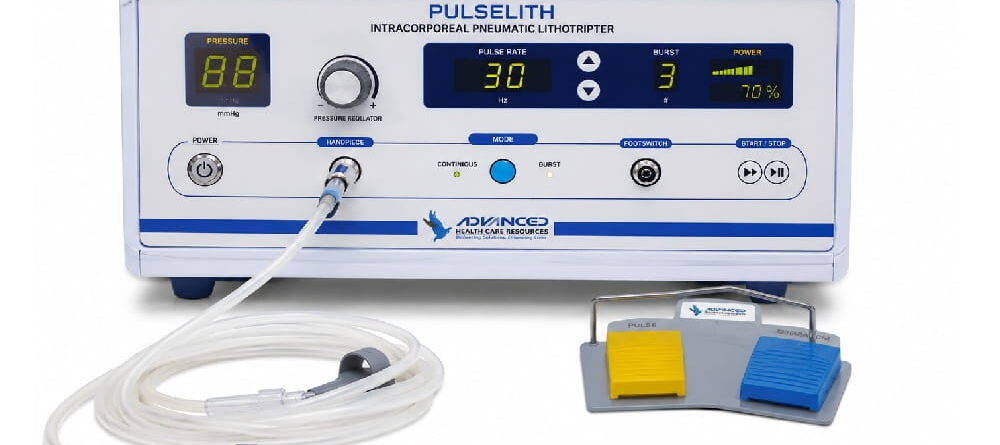
For a small or mid-size hospital evaluating a urology department upgrade, the lithotripter purchase decision usually comes down to one uncomfortable question: will this machine pay for itself? Kidney stone disease is common and recurring, but capital budgets are tight, and a wrong equipment call can tie up funds for years. This guide breaks down what a lithotripter machine actually costs in India today, what drives the price up or down, and how to build a realistic ROI model before you sign a purchase order.
Table of Contents
- Understanding Lithotripter Machine Costs
- Cost Breakdown: Beyond the Purchase Price
- Pneumatic vs. ESWL: Cost and Suitability by Hospital Size
- What Drives ROI in a Urology Program
- Building a Realistic ROI Model
- Breakeven Timeline: A Visual Guide
- Hidden Costs That Erode ROI
- Financing and Procurement Options Worth Comparing
- Decision Checklist for Small and Mid-Size Hospitals
- Frequently Asked Questions
Understanding Lithotripter Machine Costs
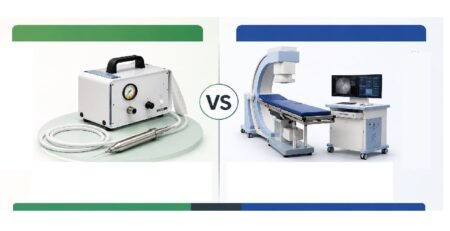
Lithotripter pricing in India spans a wide range because “lithotripter” covers two fundamentally different technologies. Intracorporeal pneumatic lithotripters — inserted through an endoscope to fragment stones directly are the entry point for most small and mid-size hospitals, with quality Indian-made units typically priced between roughly ₹55,000 and ₹1,50,000 depending on compressor design, probe sizes included, and digital control features.
Extracorporeal shock wave lithotripsy (ESWL) systems, which treat stones non-invasively from outside the body, sit in an entirely different bracket often ₹25 lakh to over ₹45 lakh because they involve imaging integration, shock-wave generators, and patient positioning tables.
This gap matters enormously for ROI planning. A hospital comparing a ₹90,000 pneumatic unit against a ₹30 lakh ESWL system isn’t really choosing between two products; it’s choosing between two different service lines, patient volumes, and payback horizons.
Cost Breakdown: Beyond the Purchase Price
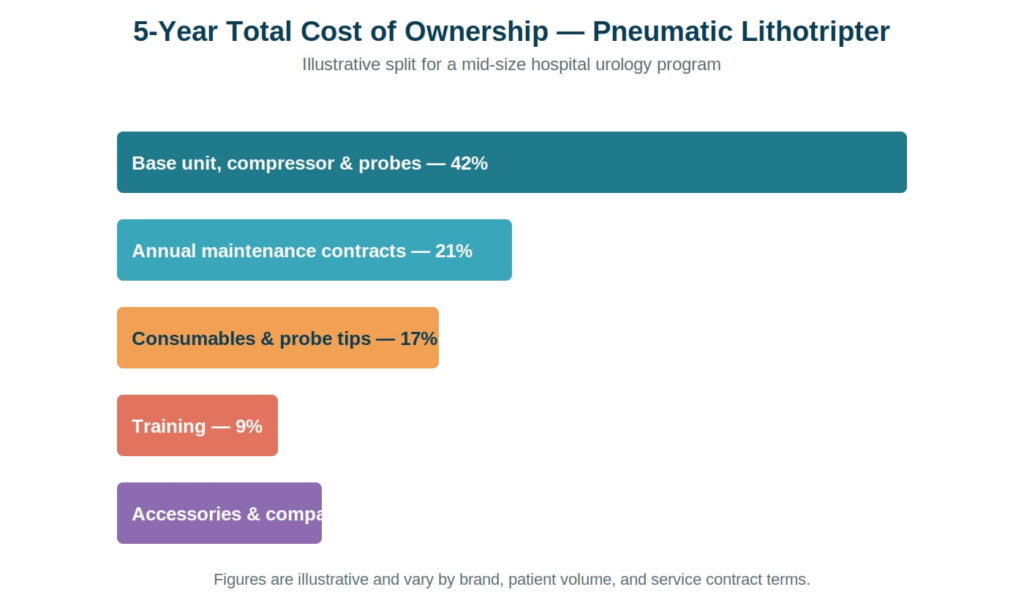
The invoice price is only the starting point. A realistic total cost of ownership (TCO) model for a pneumatic lithotripter includes:
- Base unit and compressor: the console, air compressor, and control unit.
- Probes and handpieces: different Fr sizes for ureteral vs. renal stones; most hospitals need at least two to three probe configurations.
- Endoscope compatibility accessories: couplers and adaptors if the existing cystoscope or nephroscope isn’t already matched to the new unit.
- Installation and commissioning: usually bundled by Indian manufacturers, but worth confirming in writing.
- Annual maintenance contract (AMC): typically 8–12% of purchase price per year after the warranty period ends.
- Consumables: probe tips wear out with use and need periodic replacement.
- Staff training: often included by the manufacturer for pneumatic units, but a real cost for ESWL systems.
The diagram below shows how a typical five-year cost envelope splits across these categories for a mid-range pneumatic lithotripter program.
Pneumatic vs. ESWL: Cost and Suitability by Hospital Size
For hospitals doing under roughly 150–200 stone procedures a year, a pneumatic (intracorporeal) lithotripter is almost always the more defensible investment. It pairs with equipment the urology department likely already owns — a cystoscope, ureteroscope, or nephroscope — and the lower entry price means the machine can reach breakeven even at modest case volumes. ESWL systems, by contrast, make financial sense mainly for hospitals or diagnostic centers positioned to draw a wider catchment area, run outpatient stone clinics, and sustain the case volume needed to justify a seven-figure capital outlay.
Many mid-size hospitals in India solve this by starting with a pneumatic system to build a track record and referral base in stone management, then evaluating ESWL later once volumes justify it — an incremental approach that keeps early risk low.
What Drives ROI in a Urology Program
Return on investment for a lithotripter isn’t just “procedures performed minus running costs.” Four factors dominate the real-world numbers:
- Case volume: the single biggest lever. A hospital doing 8 stone cases a month reaches breakeven far faster than one doing 2.
- Reimbursement and package rates: whether cases are self-pay, insurance, or government scheme (Ayushman Bharat/CGHS-linked packages) materially changes per-case margin.
- Reduced referral leakage: every patient referred out for stone treatment is lost revenue and a lost relationship with the referring physician network.
- Downstream utilization: a functioning lithotripsy service tends to increase related admissions, follow-up imaging, and repeat urology consultations.
Building a Realistic ROI Model
A workable ROI model for a small or mid-size hospital should be built in five steps:
- Estimate realistic monthly case volume based on current referral-out numbers and regional stone-disease prevalence, not aspirational projections.
- Calculate per-case contribution margin — package price minus consumables, probe wear allocation, and OT time cost.
- Add fixed annual costs — AMC, calibration, and any dedicated staff time.
- Divide total capital outlay by monthly contribution margin to get a breakeven point in months.
- Stress-test the model at 70% and 130% of your estimated volume to see how sensitive the payback period is to patient flow.
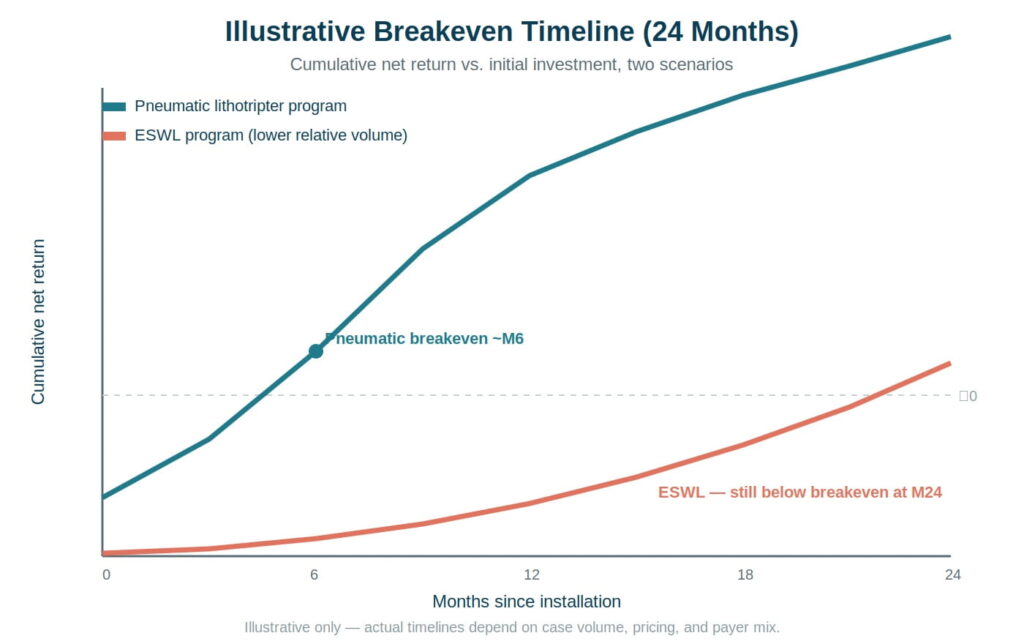
As a rough illustration: a hospital investing around ₹1.2 lakh in a pneumatic lithotripter (unit, probes, and first-year consumables) that captures 6 stone cases a month at a net contribution margin of ₹8,000 per case would reach breakeven in roughly 2.5 months on the equipment cost alone — a very different picture from an ESWL system carrying a ₹30+ lakh outlay, where breakeven realistically stretches into years unless volumes are high.
Breakeven Timeline: A Visual Guide
The chart below compares cumulative net return over a 24-month horizon for the two scenarios described above — a low-cost pneumatic program at modest volume versus a higher-cost ESWL program requiring higher volume to justify the investment.
Hidden Costs That Erode ROI
Hospitals frequently underestimate three cost lines that quietly damage payback timelines:
- Probe replacement cadence: heavy-use pneumatic probes wear faster than expected in high-volume units; budgeting for replacements only “as needed” understates true cost.
- Downtime during service visits: a machine with poor local service network availability means canceled procedures and lost OT slots, not just repair bills.
- Underused capacity: buying a higher-spec unit than current case volume supports ties up capital that could otherwise fund staff training or marketing to build the referral pipeline.
Choosing a manufacturer with strong in-country spare-parts availability and responsive AMC support — rather than the lowest sticker price alone — is often the single biggest lever for protecting ROI over a five-year horizon.
Financing and Procurement Options Worth Comparing
How a hospital pays for the lithotripter can shift the ROI picture as much as the case volume assumption does. Outright purchase keeps recurring costs lowest over the long run and avoids interest charges, but it locks up working capital that a small hospital may need elsewhere. Equipment loans and hospital-focused asset finance schemes spread the cost over 24–48 months, which can make sense when a hospital is confident in projected volume but wants to preserve cash flow during the ramp-up period.
Some manufacturers, including several Indian pneumatic lithotripter brands, also offer partial upfront payment with the balance on delivery, or bundled AMC-inclusive pricing that locks in service costs for two to three years — useful for hospitals that want cost predictability baked into their ROI model rather than negotiating AMC renewals annually.
Whichever route is chosen, it’s worth running the ROI model separately for the “cash purchase” and “financed purchase” scenarios, since interest costs on a financed pneumatic unit are usually small in absolute terms but can matter more for higher-ticket ESWL purchases.
Procurement timing matters too. Hospitals that align a lithotripter purchase with a broader urology department launch — new cystoscopy suite, expanded OT slot, or a newly onboarded urologist — tend to see case volume ramp up faster than hospitals that add the equipment in isolation, because referral pathways and patient awareness build simultaneously rather than sequentially.
Decision Checklist for Small and Mid-Size Hospitals
- Have you calculated realistic monthly stone-case volume from your own referral data, not industry averages?
- Does the quoted price include probes, accessories, and first-year consumables, or just the base console?
- What is the AMC cost after year one, and is it fixed or negotiable at purchase?
- Does the vendor have verifiable service response times in your city or state?
- Have you modeled breakeven at 70% of expected volume, not just the optimistic case?
- Is your current endoscopy equipment compatible, or will you need additional adaptors?
Frequently Asked Questions
How much does a lithotripter machine cost in India?
Pneumatic intracorporeal lithotripters typically range from roughly ₹55,000 to ₹1,50,000 depending on brand, compressor quality, and included probes, while ESWL systems range from approximately ₹25 lakh to over ₹45 lakh depending on imaging integration and features.
How long does it take for a lithotripter to pay for itself?
For a pneumatic unit at a small or mid-size hospital with steady stone-case referrals, breakeven often falls within a few months to about a year. ESWL systems generally need much higher sustained volume and can take considerably longer to reach payback.
Is a pneumatic lithotripter a good fit for a small hospital?
Yes — pneumatic lithotripter machines are the most common entry point for small and mid-size hospitals because they have a lower capital requirement, integrate with existing endoscopy equipment, and can reach breakeven at modest case volumes.
What ongoing costs should hospitals budget for after purchase?
Beyond the purchase price, hospitals should budget for annual maintenance contracts (commonly 8–12% of purchase price per year post-warranty), consumable probe tips, and occasional accessory or adaptor costs for compatibility with existing endoscopes.


Leave a Reply