
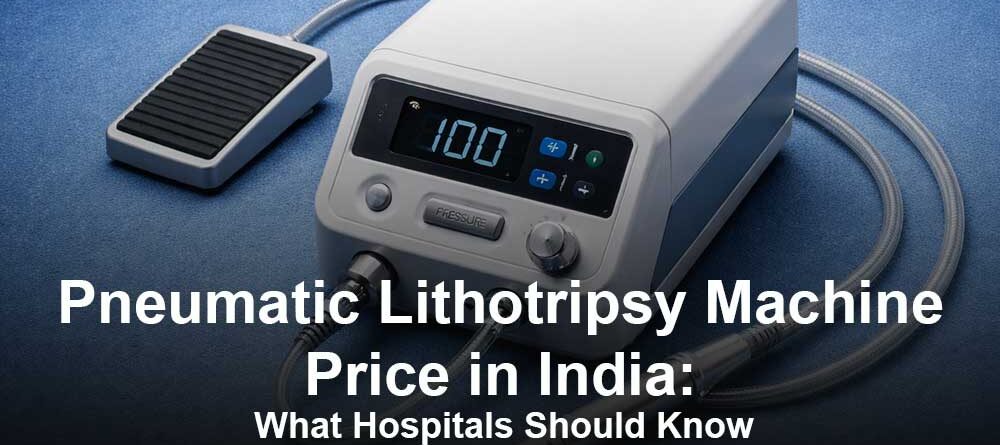
Pneumatic lithotripter prices in India vary depending on the equipment configuration, handpiece, probe options, operating specifications, accessories, compressor requirements, warranty, and after-sales support included with the system. For hospitals and urology centres planning to purchase a pneumatic lithotripter, comparing the headline price alone can make it difficult to determine which equipment package offers the right value.
A pneumatic lithotripter is an intracorporeal stone-fragmentation system that uses compressed air to generate ballistic energy through a compatible probe. The equipment may form part of the stone-management setup used for procedures such as ureteroscopy (URS) and percutaneous nephrolithotomy (PCNL), depending on the clinical workflow and equipment configuration.
When evaluating the cost of a pneumatic lithotripter in India, hospitals should therefore consider the complete system rather than the generator alone. Probe sizes, handpiece configuration, operating modes, air or gas requirements, accessories, technical support, warranty, and availability of replacement components can all affect the overall procurement decision.
This guide explains the key factors that influence pneumatic lithotripter price in India, what hospitals should check in a quotation, how to compare different configurations, and what to consider before purchasing a pneumatic lithotripsy system. It also provides an overview of the Pulselith Pneumatic Lithotripter and its available specifications.
What Affects Pneumatic Lithotripter Price in India?
The price of a pneumatic lithotripter in India depends on the configuration of the system rather than the generator alone. Hospitals comparing different models should evaluate the equipment specifications, handpiece, probe options, operating controls, air or oxygen requirements, accessories, warranty, and after-sales support included in the quotation.
Two pneumatic lithotripters may appear similar at first glance but have different prices because they offer different configurations, probe options, control features, supporting equipment, or service arrangements. The following factors are particularly important when comparing quotations.
1. Lithotripter Generator and Control System
The generator is the core component that produces and controls the pneumatic pulses delivered through the handpiece and probe. Buyers should review the available operating modes, pulse-frequency range, controls, and other technical specifications rather than comparing machines solely by their external appearance or headline price.
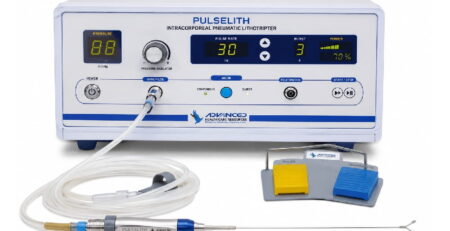
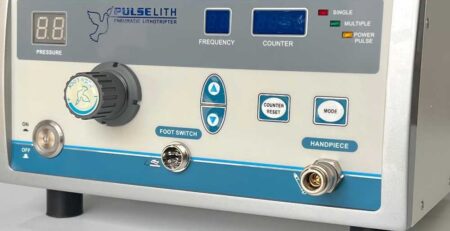
For example, the Pulselith Pneumatic Lithotripter uses a microprocessor-controlled pneumatic system with Single, Multiple, and Power-Pulse operating modes. Its specified projectile impact frequency ranges from 1 Hz to 12 Hz and 14 Hz.
2. Handpiece Configuration
The handpiece transfers the pneumatic energy generated by the system to the compatible lithotripsy probe. Its design, weight, connection system, and compatibility with available probes are therefore important procurement considerations.
Hospitals should confirm whether the handpiece is included in the quoted package and whether replacement handpieces or tubing are available separately. The Pulselith system, for example, specifies a handpiece measuring 185 mm in length and weighing 175 g.
3. Probe Sizes and Options
Pneumatic lithotripter probes are an important part of the overall system configuration and can have a direct effect on procurement cost. Buyers should check which probe sizes are included, which are available separately, and whether replacement probes can be sourced when required.
The Pulselith Pneumatic Lithotripter supports probe sizes of 0.8 mm, 1.0 mm, 1.2 mm, 1.5 mm, 2.0 mm, and 2.5 mm. Its listed probe lengths include 640 mm for URS and 450 mm for PCNL applications.
When comparing a pneumatic lithotripter price, always ask for the complete probe list and determine whether the quoted price includes the probes required for your intended configuration.
4. Air or Oxygen Requirements
Pneumatic lithotripters require a suitable gas supply to generate the operating pulses. The required inlet pressure and input-gas specification should therefore be considered when evaluating the equipment.
For example, the Pulselith system specifies compressed air or oxygen as the input gas, with an inlet supply range of 4 to 6 kg/cm² and an output pressure range of 2.5 to 4.5 kg/cm².
Hospitals should verify their available infrastructure and determine whether additional supporting equipment, such as a compressor, is required for the selected configuration.
5. Accessories Included With the System
The final pneumatic lithotripsy machine price can vary depending on which accessories are included. A quotation may cover only the main unit, while another may include the handpiece, probes, foot pedal, tubing, carrying case, or other components.
Always request an itemized quotation so that different manufacturers are being compared on an equivalent configuration.
6. Product Quality and Manufacturing Standards
The manufacturer’s quality systems, product documentation, certifications, manufacturing capabilities, and quality-control processes should also be considered when comparing pneumatic lithotripters.
For example, Pulselith states that its pneumatic lithotripter is manufactured in India under an ISO 13485-certified quality system and carries CE certification. Buyers should request and verify the applicable documentation for the specific product and market before making a procurement decision.
7. Warranty and After-Sales Support
A lower initial pneumatic lithotripter cost does not necessarily represent better value if replacement components or technical support are difficult to obtain. Buyers should compare warranty coverage, service arrangements, spare-parts availability, response times, and technical assistance alongside the equipment price.
8. Configuration-Specific Requirements
Hospitals may require different configurations depending on their urology workflow, procedure mix, existing equipment, and procurement requirements. A system intended for a department performing both URS and PCNL may require a different probe and accessory configuration from a system purchased for a narrower application.
For this reason, the most useful way to compare pneumatic lithotripter prices in India is to request quotations based on the same required configuration and compare the complete package rather than a standalone machine price.
What Is Included in a Pneumatic Lithotripter Package?
When comparing pneumatic lithotripter prices in India, buyers should confirm exactly what is included in the quoted package. A lower equipment price may simply reflect a more basic configuration, while another quotation may include additional probes, a handpiece, accessories, or supporting equipment.
Requesting an itemized configuration makes it easier for hospitals and distributors to compare different pneumatic lithotripters on an equivalent basis.
1. Pneumatic Lithotripter Generator
The generator is the primary unit that controls the pneumatic energy delivered to the lithotripsy probe. The quotation should identify the model, operating modes, pulse-frequency range, power requirements, and other relevant technical specifications.
For example, the Pulselith Pneumatic Lithotripter uses a microprocessor-controlled system with Single, Multiple, and Power-Pulse operating modes and a specified projectile impact frequency of 1 Hz–12 Hz and 14 Hz.
2. Handpiece
The handpiece connects the pneumatic system to the compatible lithotripsy probe. Buyers should confirm whether the handpiece is included, whether tubing or connecting components are supplied, and whether replacement handpieces are available.
Pulselith specifies a handpiece measuring 185 mm in length and weighing 175 g.
3. Lithotripsy Probes
Probe availability is an important consideration when evaluating a pneumatic lithotripter cost. Hospitals should check which probe sizes are included in the quoted configuration and whether additional or replacement probes can be purchased separately.
The Pulselith system lists probe sizes of 0.8 mm, 1.0 mm, 1.2 mm, 1.5 mm, 2.0 mm, and 2.5 mm, with listed probe lengths of 640 mm for URS and 450 mm for PCNL applications.
4. Foot Pedal and Operating Controls
A pneumatic lithotripter package may include a foot pedal or footswitch for controlling the frequency of projectile pulses during operation. Buyers should confirm the controls and accessories supplied with the system.
The Pulselith configuration includes a foot paddle for adjusting projectile frequency and a manual pressure gauge system for pressure adjustment during surgery.
5. Air or Oxygen Connection
Pneumatic lithotripters require an appropriate gas supply. Depending on the system, the required infrastructure may be available at the hospital or may need to be supplied as part of the equipment configuration.
Pulselith specifies compressed air or oxygen as its input gas, with an inlet supply range of 4–6 kg/cm² and an output pressure range of 2.5–4.5 kg/cm².
6. Compressor, Where Required
Some buyers may require a pneumatic lithotripter configuration that includes a dedicated air compressor. This should be clearly identified in the quotation because a standalone lithotripter and a complete lithotripter-plus-compressor package are not equivalent configurations.
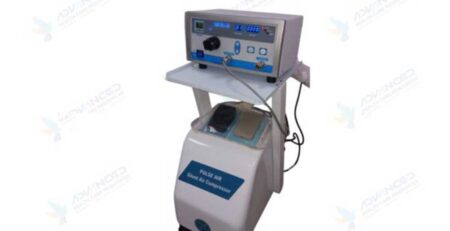
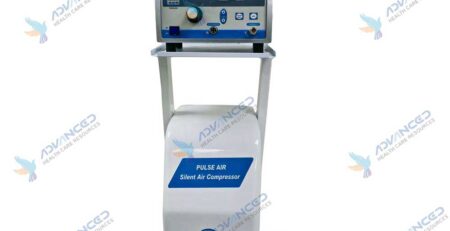
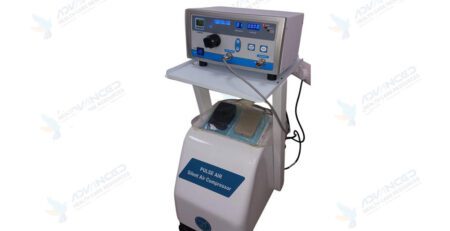
Hospitals evaluating this type of setup can review the Pulselith Pneumatic Lithotripter with Pulse Silent Air Compressor configuration.
7. Accessories and Supporting Components
Depending on the configuration, the package may include additional components such as connecting tubing, carrying cases, accessories, or other supporting items. Buyers should request a complete list rather than assuming that all components shown in product photographs are included.
8. Documentation and Warranty
The quotation should also specify the product documentation, warranty terms, installation arrangements, training, and technical support included with the purchase. These factors can influence the overall value of a pneumatic lithotripsy system even when they do not appear in the headline equipment price.
What to Ask for in a Pneumatic Lithotripter Quotation
- Exact equipment model and configuration
- Generator and operating modes
- Handpiece and connecting components
- Probe sizes and quantities
- Foot pedal or footswitch
- Air or oxygen requirements
- Compressor, where applicable
- Other included accessories
- Installation and commissioning terms
- Training and technical support
- Warranty coverage
- Spare-parts and replacement-accessory availability
- Delivery and documentation
A detailed quotation based on the same configuration allows hospitals to make a more meaningful comparison between pneumatic lithotripter manufacturers and suppliers.
Pneumatic Lithotripter With Compressor: What Buyers Should Know
A pneumatic lithotripter with compressor is a configuration in which the lithotripsy system is supplied together with a dedicated air compressor to provide the required pneumatic energy source. For hospitals that do not have a suitable compressed-air supply available for the equipment, a combined configuration can simplify procurement and installation planning.
However, buyers should not compare the price of a standalone pneumatic lithotripter directly with the price of a lithotripter supplied with a compressor. The two quotations represent different equipment packages and should be evaluated based on their complete configurations.
Why Does the Compressor Matter?
Pneumatic lithotripsy systems require a suitable gas supply to generate the pulses delivered through the handpiece and probe. Depending on the equipment specification and hospital infrastructure, the required supply may be available through the facility’s existing system or may need to be provided through a dedicated compressor.
Before purchasing, confirm the lithotripter’s required inlet pressure, gas type, connection requirements, and whether the hospital’s existing infrastructure meets those specifications.
What Should Be Checked in a Compressor Configuration?
When evaluating a pneumatic lithotripter with compressor, hospitals should check:
- Compressor model and specifications
- Required input and output pressure
- Compatibility with the lithotripter
- Noise and operating environment
- Power requirements
- Connection and tubing requirements
- Installation requirements
- Maintenance and service requirements
- Warranty coverage for the compressor
- Availability of replacement parts
Standalone Lithotripter vs. Lithotripter With Compressor
| Consideration | Standalone Pneumatic Lithotripter | Pneumatic Lithotripter With Compressor |
|---|---|---|
| Equipment package | Lithotripter system and specified accessories | Lithotripter system plus dedicated compressor and related components |
| Compressed-air infrastructure | May rely on existing hospital infrastructure | Includes dedicated supporting equipment |
| Procurement scope | Suitable where required infrastructure is already available | Useful where a dedicated compressor is required |
| Price comparison | Should be compared with equivalent standalone configurations | Should be compared with other complete compressor configurations |
Pulselith Pneumatic Lithotripter With Pulse Silent Air Compressor
For hospitals evaluating a combined configuration, the Pulselith Pneumatic Lithotripter with Pulse Silent Air Compressor provides a configuration that combines the pneumatic lithotripter with a dedicated compressor.
Buyers should review the product specifications and confirm the complete supplied configuration, accessories, warranty, installation requirements, and technical support before requesting a quotation.
When comparing pneumatic lithotripter prices in India, always specify whether a compressor is required so that manufacturers can provide quotations for an equivalent equipment configuration.
Pneumatic Lithotripter for URS and PCNL
Pneumatic lithotripters are used for intracorporeal stone fragmentation during endourological procedures. Hospitals considering this equipment for ureteroscopy (URS) or percutaneous nephrolithotomy (PCNL) should evaluate the probe configuration, working length, handpiece, operating controls, and compatibility with the instruments used in their existing stone-management setup.
Pneumatic Lithotripter for URS
During ureteroscopy, a compatible pneumatic lithotripsy probe can be used to deliver mechanical energy to urinary stones through the endoscopic working channel. The equipment configuration should therefore be evaluated alongside the ureteroscope and other instruments used by the urology team.
When purchasing a pneumatic lithotripter for URS, buyers should check the available probe sizes and working lengths, handpiece configuration, operating modes, connection requirements, and availability of replacement probes.
The Pulselith Pneumatic Lithotripter lists a 640 mm probe length for URS applications and offers multiple probe diameters. Buyers should confirm the appropriate configuration for their intended equipment and procedure requirements. ([pulselith.in](https://pulselith.in/product/pulselith-pneumatic-lithotripter/))
Pneumatic Lithotripter for PCNL
PCNL is an endourological procedure in which instruments are introduced through a percutaneous access tract to facilitate kidney stone management. Depending on the clinical workflow and equipment configuration, a pneumatic lithotripter may be incorporated into the stone-fragmentation setup.
For PCNL applications, hospitals should evaluate probe working length, compatible accessories, handpiece configuration, gas requirements, and compatibility with the existing PCNL equipment.
The Pulselith system lists a 450 mm probe length for PCNL applications. As with any medical-device procurement, the final configuration should be confirmed against the hospital’s specific equipment and procedural requirements. ([pulselith.in](https://pulselith.in/product/pulselith-pneumatic-lithotripter/))
Why Probe Configuration Matters
The probe is the component that delivers the pneumatic energy to the treatment site, so probe diameter and working length are important when evaluating a pneumatic lithotripsy system. A hospital may require different probe configurations depending on the procedures it performs and the instruments used with the system.
Before purchasing, ask the manufacturer to confirm:
- Available probe diameters
- Available probe lengths
- Compatibility with the supplied handpiece
- Compatibility with the hospital’s existing instruments
- Availability of additional and replacement probes
- Recommended configuration for the intended application
This information should form part of the procurement specification rather than being treated as an afterthought once the equipment has been purchased.
Indian vs. Imported Pneumatic Lithotripters: What Should Hospitals Compare?
Hospitals evaluating a pneumatic lithotripter in India may encounter equipment from both Indian and international manufacturers. The country of manufacture should not be the only factor in the purchasing decision. Instead, buyers should compare the complete equipment specification, quality documentation, service support, accessories, warranty, delivery requirements, and total cost of ownership.
Product Specifications
Start by comparing the technical specifications of equivalent equipment configurations. Important factors may include operating modes, pulse frequency, pressure requirements, handpiece configuration, probe sizes and lengths, gas requirements, and available accessories.
A higher or lower purchase price does not necessarily indicate that one system is better. The equipment should first be evaluated against the hospital’s specific technical and procedural requirements.
Quality and Regulatory Documentation
Buyers should request the applicable quality and regulatory documentation for the specific product being considered. Depending on the product and destination market, this may include quality-management certifications, product certifications, technical documentation, instructions for use, and other regulatory records.
Rather than assuming that imported equipment is automatically higher quality or that locally manufactured equipment is automatically more economical, hospitals should evaluate the documentation and product credentials of each manufacturer.
Warranty and Service Support
After-sales support can be particularly important for equipment used in a hospital environment. Compare warranty periods, covered components, service arrangements, technical assistance, spare-parts availability, and expected response times.
A manufacturer with accessible technical support and replacement components may provide practical advantages, regardless of where the equipment is manufactured.
Accessories and Replacement Components
Check whether commonly required probes, handpieces, tubing, and other accessories are readily available. Also ask about the expected lead time and cost of replacement components.
This is important because the initial pneumatic lithotripter price does not represent the entire cost of operating the system over its useful life.
Delivery and Procurement Requirements
Imported equipment may involve additional considerations such as international shipping, customs documentation, import procedures, delivery timelines, and destination-market requirements. Locally manufactured equipment may involve a different logistics and documentation process.
These factors should be included when comparing the complete procurement cost and delivery requirements.
Total Cost of Ownership
Instead of comparing only the purchase price, evaluate the expected total cost of ownership. Consider:
- Initial equipment configuration
- Included probes and accessories
- Compressor or supporting equipment, where required
- Installation and commissioning
- Training and technical support
- Warranty coverage
- Replacement probes and accessories
- Spare-parts availability
- Maintenance and service requirements
- Delivery and procurement costs
The best choice is ultimately the system that meets the hospital’s technical requirements while providing appropriate documentation, support, reliability, and long-term value.
Questions to Ask Before Choosing a Manufacturer
- What is the exact equipment configuration being quoted?
- Which probes and accessories are included?
- What operating specifications does the system provide?
- What quality and regulatory documentation is available?
- What does the warranty cover?
- How are service requests handled?
- How readily are replacement probes and spare parts available?
- Is installation or training included?
- What are the delivery and documentation requirements?
- What is the expected total cost of ownership?
Comparing manufacturers on these factors provides a more reliable basis for selecting a pneumatic lithotripter than using country of manufacture or purchase price as the deciding factor alone.
How to Compare Pneumatic Lithotripter Quotations
Once a hospital has identified its required pneumatic lithotripter configuration, comparing supplier quotations becomes much easier. The key is to ensure that each quotation covers a comparable equipment package. A lower headline price may simply reflect fewer probes, accessories, services, or supporting components being included.
Compare the Same Equipment Configuration
Ask each manufacturer or supplier to quote the same basic configuration wherever possible. The comparison should clearly identify the lithotripter model, operating specifications, handpiece, probe sizes and quantities, compressor requirements, and other accessories.
Check What Is Included
Read the itemized quotation carefully and identify which components are included in the stated pneumatic lithotripter price. Pay particular attention to:
- Generator
- Handpiece
- Probe sizes and quantities
- Foot pedal or footswitch
- Connecting tubing and accessories
- Compressor, where applicable
- Carrying or storage case
- Installation and commissioning
- Training
Compare Warranty and Service Terms
Two suppliers may offer similar equipment at different prices but provide different levels of warranty and technical support. Compare the warranty period, covered components, service arrangements, response process, and availability of replacement parts.
Check Replacement Probe Availability
Because probes are an important working component of pneumatic lithotripsy systems, buyers should ask about the availability of additional and replacement probes. Confirm the available sizes, compatibility with the handpiece, expected delivery time, and applicable pricing.
Review Installation and Training
Confirm whether installation, commissioning, operator orientation, or technical training is included in the quotation. If these services are charged separately, include them when calculating the total procurement cost.
Check Delivery and Documentation
The quotation should clearly specify delivery terms, expected timelines, packaging, product documentation, and any other applicable procurement requirements. International buyers should also confirm export documentation and destination-market requirements.
Compare Total Cost, Not Just the Headline Price
A useful quotation comparison should consider the complete financial commitment:
| Cost consideration | What to check |
|---|---|
| Equipment | Exact model and configuration |
| Probes | Sizes, quantities and replacement availability |
| Accessories | Handpiece, foot pedal, tubing and other supplied components |
| Compressor | Whether included and compatible with the system |
| Warranty | Duration, coverage and exclusions |
| Service | Technical support and spare-parts availability |
| Installation | Installation and commissioning requirements |
| Training | Operator or technical training included |
| Delivery | Timeline, shipping and documentation |
Comparing quotations using the same checklist helps procurement teams identify the actual differences between suppliers and make a better-informed purchasing decision.
Total Cost of Ownership of a Pneumatic Lithotripter
The initial pneumatic lithotripter price is only one part of the overall investment. Hospitals should also consider the costs associated with probes, accessories, maintenance, spare parts, servicing, training, and equipment support over the useful life of the system.
Evaluating the total cost of ownership helps procurement teams compare different pneumatic lithotripters more accurately and avoid selecting equipment solely because it has a lower initial purchase price.
Probes and Replacement Accessories
Pneumatic lithotripsy probes are working components of the system and may need to be replaced or replenished over time. Buyers should therefore consider the availability of different probe sizes, replacement options, compatibility, expected lead times, and associated costs.
The same principle applies to other replaceable or serviceable components supplied with the equipment.
Maintenance and Servicing
Before purchasing a pneumatic lithotripter, ask the manufacturer about recommended maintenance, servicing requirements, technical support, and procedures for addressing equipment issues. Understanding these requirements helps hospitals plan for ongoing ownership costs.
Spare Parts Availability
Access to appropriate replacement parts can affect equipment availability and long-term operating costs. Buyers should ask whether genuine spare parts are available, how they are supplied, and what technical support is provided when replacement components are required.
Warranty Coverage
Warranty terms can reduce the financial risk associated with equipment issues during the covered period. Compare the warranty duration, covered components, exclusions, service process, and whether technical assistance is included.
Compressor and Supporting Equipment
If the selected pneumatic lithotripter requires a dedicated compressor, include the compressor’s purchase, installation, maintenance, and service requirements in the overall ownership assessment.
This is particularly important when comparing a standalone pneumatic lithotripter with a pneumatic lithotripter with compressor.
Training and Technical Support
Training and technical support can also form part of the overall procurement value. Confirm whether installation, commissioning, operator orientation, and technical assistance are included in the purchase package or quoted separately.
Equipment Downtime and Service Response
Equipment downtime can disrupt planned procedures and affect departmental operations. When comparing manufacturers, consider the availability of technical support, service response processes, replacement components, and expected turnaround times for repairs.
How to Evaluate Total Ownership Cost
For a more complete comparison, consider the following factors together:
- Initial equipment configuration
- Included probes and accessories
- Additional and replacement probes
- Compressor and supporting equipment, where applicable
- Installation and commissioning
- Training and technical support
- Warranty coverage
- Maintenance and servicing
- Spare-parts availability
- Expected service and support requirements
The most cost-effective pneumatic lithotripter is not necessarily the one with the lowest initial price. A system with an appropriate configuration, reliable support, accessible replacement components, and suitable long-term service arrangements may provide greater overall value for a hospital.
What to Check Before Buying a Pneumatic Lithotripter
Before purchasing a pneumatic lithotripter, hospitals should evaluate the complete system, not just the quoted equipment price. A structured review of the technical specifications, configuration, accessories, documentation, warranty, and service support can help procurement teams compare manufacturers more effectively.
Technical Specifications
- Confirm the exact lithotripter model and configuration.
- Review the available operating modes and pulse-frequency range.
- Check the required input gas and pressure range.
- Verify electrical and installation requirements.
- Review the handpiece specifications and connection system.
Probe Configuration
- Confirm the available probe diameters.
- Check probe lengths for the intended applications.
- Verify compatibility between the probes and handpiece.
- Confirm which probes are included in the quotation.
- Ask about the availability of additional and replacement probes.
Compressor and Infrastructure
- Determine whether the hospital has a suitable compressed-air or gas supply.
- Confirm the lithotripter’s required inlet pressure.
- Determine whether a dedicated compressor is required.
- If a compressor is included, verify its specifications and compatibility.
- Check installation, power, space, and maintenance requirements.
Quality and Product Documentation
- Request the manufacturer’s technical datasheet.
- Review the applicable quality and regulatory documentation.
- Confirm the product certification applicable to the intended market.
- Request instructions for use and relevant technical documentation.
- Verify the manufacturer’s company and product information.
Warranty and After-Sales Support
- Confirm the warranty duration and covered components.
- Ask how technical service requests are handled.
- Check the availability of trained service personnel.
- Verify spare-parts availability.
- Ask about replacement probe availability and lead times.
- Understand recommended maintenance requirements.
Quotation and Commercial Terms
- Request an itemized quotation for the complete configuration.
- Confirm which accessories are included.
- Check whether installation and commissioning are included.
- Confirm whether training is included.
- Review delivery timelines and shipping terms.
- Check whether taxes, shipping, or other charges apply separately.
Ask for a Configuration-Specific Quote
The most reliable way to determine the pneumatic lithotripter price in India is to request a quotation based on your actual equipment requirements. Provide the manufacturer with information about the intended procedures, required probe configuration, compressor requirements, quantity, delivery location, and any other procurement specifications.
This allows the manufacturer to provide a more accurate quotation and helps ensure that different suppliers are being compared on an equivalent basis.
Pulselith Pneumatic Lithotripter
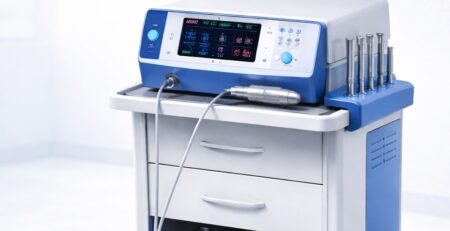
For hospitals and urology centres evaluating a pneumatic lithotripsy system, the Pulselith Pneumatic Lithotripter provides a configurable system for intracorporeal stone-fragmentation applications.
The system features microprocessor-controlled pneumatic operation with Single, Multiple, and Power-Pulse modes. The specified projectile impact frequency ranges from 1 Hz to 12 Hz and 14 Hz, while the system can operate using compressed air or oxygen within the specified inlet-pressure range. ([pulselith.in](https://pulselith.in/product/pulselith-pneumatic-lithotripter/))
Pulselith Probe Options
Probe configuration is an important consideration when evaluating a pneumatic lithotripter. Pulselith lists probe diameters of 0.8 mm, 1.0 mm, 1.2 mm, 1.5 mm, 2.0 mm, and 2.5 mm, with probe lengths specified for URS and PCNL applications.
The listed probe length is 640 mm for URS and 450 mm for PCNL. Hospitals should confirm the appropriate probe configuration based on their intended applications and existing instruments. ([pulselith.in](https://pulselith.in/product/pulselith-pneumatic-lithotripter/))
Pulselith With Pulse Silent Air Compressor
For facilities that require a dedicated compressor, Pulselith also offers a Pulselith Pneumatic Lithotripter with Pulse Silent Air Compressor. This configuration combines the lithotripter with supporting compressor equipment, allowing buyers to evaluate the complete package according to their infrastructure and procurement requirements.
What Buyers Should Confirm Before Requesting a Quote
Before requesting a quotation, provide details about:
- Intended applications and procedures
- Required probe sizes and lengths
- Whether a dedicated compressor is required
- Required quantity
- Delivery location
- Additional accessories or configuration requirements
Providing these details allows the equipment configuration to be matched more closely to the hospital’s requirements and makes the resulting quotation easier to compare with other suppliers.
View Pulselith Pneumatic Lithotripter Specifications
Frequently Asked Questions About Pneumatic Lithotripter Price
What is the price of a pneumatic lithotripter in India?
The pneumatic lithotripter price in India depends on the equipment configuration, handpiece, probe options, operating specifications, accessories, compressor requirements, warranty, and after-sales support. Because configurations can vary between hospitals, manufacturers should provide a quotation based on the required equipment package rather than relying on a generic price range.
What factors affect pneumatic lithotripter cost?
Important factors include the generator and control system, handpiece, probe sizes and lengths, operating modes, gas requirements, compressor configuration, accessories, quality and regulatory documentation, warranty, service support, and replacement-part availability.
What is included with a pneumatic lithotripter?
The supplied configuration varies by manufacturer and model. A package may include the generator, handpiece, probes, foot pedal or footswitch, connecting components, and other accessories. A compressor may be included in some configurations or supplied separately. Always request an itemized equipment list with the quotation.
Do I need a compressor with a pneumatic lithotripter?
It depends on the equipment configuration and the infrastructure available at the hospital. Some pneumatic lithotripters can use an appropriate existing compressed-air or gas supply, while buyers may prefer a dedicated compressor configuration. Check the manufacturer’s required inlet pressure, gas specification, and connection requirements before purchasing.
Can a pneumatic lithotripter be used for URS and PCNL?
Pneumatic lithotripters are used for intracorporeal stone fragmentation and may form part of equipment setups for procedures such as ureteroscopy (URS) and percutaneous nephrolithotomy (PCNL). The appropriate probe configuration and equipment compatibility should be confirmed with the manufacturer based on the intended application.
How do I compare pneumatic lithotripter prices from different manufacturers?
Compare quotations using the same equipment configuration. Check the generator, operating specifications, handpiece, probe sizes and quantities, compressor requirements, accessories, warranty, installation, training, service support, spare-parts availability, and delivery terms. Comparing the complete package provides a more meaningful assessment than comparing the headline machine price alone.
What should I ask a manufacturer before buying a pneumatic lithotripter?
Ask for the complete technical specification, equipment configuration, probe options, gas and pressure requirements, applicable quality and regulatory documentation, warranty terms, service arrangements, spare-parts availability, delivery timeline, and details of included accessories and supporting equipment.
How can I request a quotation for a Pulselith Pneumatic Lithotripter?
To request a quotation, provide details about your intended applications, required probe configuration, compressor requirements, quantity, delivery location, and any additional equipment requirements. You can contact the AHCR team for a Pulselith Pneumatic Lithotripter quotation.
Request a Pneumatic Lithotripter Quote
Choosing a pneumatic lithotripter requires more than comparing the lowest equipment price. Hospitals should evaluate the complete configuration, including the generator, handpiece, probes, operating specifications, compressor requirements, accessories, warranty, technical support, and long-term service requirements.
If you are evaluating a pneumatic lithotripter in India, the Pulselith team can provide product specifications and discuss the configuration required for your hospital or urology centre.
For a more accurate quotation, share your intended application, required probe sizes, whether a compressor is required, quantity, and delivery location with the equipment team.




Comment (1)
[…] evaluating the pneumatic lithotripter cost, hospitals also need to consider accessories, probes, maintenance, calibration, staff training, […]