

India has become one of the world’s largest hubs for surgical instrument manufacturing, and urology equipment is no exception. Search “lithotripter supplier in India” and you’ll find dozens of names within seconds — manufacturers, traders, and re-sellers all claiming to offer the “best price” and “export quality.” For a hospital administrator, procurement officer, or distributor, that abundance of choice is exactly the problem: how do you tell a genuine pneumatic lithotripter manufacturer from a reseller cutting corners on materials, testing, and after-sales support?
A lithotripter isn’t a low-stakes purchase. It’s a device that sits inside the operating theatre, fragments kidney and ureteric stones in real time, and needs to perform consistently for years. Choosing the wrong urology instrument manufacturer doesn’t just risk equipment downtime — it risks patient safety, surgeon confidence, and your hospital’s reputation. This guide walks through exactly what to check before you sign a purchase order, so you can find a lithotripter supplier in India that holds up under real-world use, not just on a glossy product page.
Table of Contents
- Why the Right Supplier Choice Matters
- A Quick Primer on Lithotripter Types
- 1. Verify Certifications and Regulatory Compliance
- 2. Confirm They Actually Manufacture the Device
- 3. Examine Build Quality and Material Standards
- 4. Ask for Testing Data and Documentation
- 5. Check Product Range and Accessory Compatibility
- 6. Evaluate After-Sales Support and Service Network
- 7. Look Past the Sticker Price
- 8. Ask for References and Export History
- Red Flags vs. Green Flags: A Quick Visual Check
- Frequently Asked Questions
- A Practical Buying Checklist
- Final Thoughts
Why the Right Supplier Choice Matters
Urology stone management devices are used repeatedly, often across multiple procedures in a single day. A device built with substandard steel, inconsistent air pressure calibration, or poorly sealed probes can fail mid-procedure, extend operating time, or damage delicate tissue. Beyond the clinical risk, an unreliable lithotripter machine supplier also creates operational headaches: parts that are hard to source, warranty claims that go unanswered, and technicians who can’t explain how their own product works.
There’s also a financial dimension that’s easy to underestimate at the time of purchase. A device sourced from an unverified supplier often looks like a bargain on paper, until the first probe fails, the compressor seal degrades early, or a replacement part takes six weeks to arrive from an intermediary who never manufactured the unit in the first place. Multiply that downtime across a busy urology OT, and the “savings” from a lower quote disappear quickly. Hospitals and surgical centers that treat supplier vetting as a one-time formality tend to relearn this lesson the hard way, usually mid-procedure.
On the other hand, a supplier who manufactures in-house, tests every batch, and stands behind the product with real after-sales service becomes a long-term partner rather than a one-time vendor. That distinction — vendor versus partner — is really what this entire guide is about.
A Quick Primer on Lithotripter Types
Before evaluating suppliers, it helps to be clear on what you’re buying. Three broad categories dominate the Indian and export markets:
- Pneumatic lithotripters — use compressed air to drive a probe that mechanically fragments stones; valued for reliability, lower running cost, and compatibility with PCNL and ureteroscopy procedures.
- Laser lithotripters (Holmium/Thulium) — use fiber-optic laser energy, offering precision for smaller or harder stones but at a higher acquisition and maintenance cost.
- Ultrasonic lithotripters — often combined with pneumatic systems (pneumatic-ultrasonic combo devices) for larger stone burdens during PCNL.
Most Indian hospitals and ambulatory surgical centers lean toward pneumatic lithotripters because of their durability, straightforward maintenance, and lower total cost of ownership — which is exactly why supplier quality matters even more: a simpler device only stays simple if it’s engineered and tested properly.
1. Verify Certifications and Regulatory Compliance
This is the single most important filter, and it takes two minutes. Any legitimate lithotripter manufacturer in India should be able to produce, on request:
- ISO 13485 certification — the international quality management standard specific to medical devices, covering design control, risk management, and production traceability.
- CE certification — required for export to the European Economic Area, and a strong general indicator of design and safety compliance even for domestic buyers.
- CDSCO registration / compliance with India’s Medical Device Rules — relevant for devices classified under India’s regulatory framework.
Don’t just accept a logo on a website. Ask for the certificate number and issuing body, and cross-check it independently. A supplier that hesitates, stalls, or gets vague when asked for documentation has already told you what you need to know.
2. Confirm They Actually Manufacture the Device
India’s surgical instruments export market includes genuine manufacturers alongside traders who rebrand devices sourced elsewhere. Neither is automatically “wrong,” but you should know which one you’re dealing with, because it directly affects quality control, customization ability, and your leverage when something goes wrong.
Practical ways to verify manufacturing capability:
- Ask directly whether the lithotripter is manufactured in-house or sourced from a third party.
- Request a factory tour — in person or via video call. A real manufacturer will show you the production floor without hesitation.
- Check whether the company can customize probe sizes, handpiece configurations, or accessory sets. Traders typically cannot; manufacturers can.
- Look at how long the company has operated and whether its export history (APAC, Middle East, Africa, the Americas, etc.) lines up with genuine production capacity.
It’s also worth asking whether the company supports OEM and bulk-order manufacturing. Suppliers that can handle OEM requirements while maintaining consistent quality across large production runs are, almost by definition, running their own manufacturing line rather than reselling someone else’s stock. For distributors and international buyers, this also opens the door to private-labeling or region-specific packaging, which a pure trading company typically cannot offer.
3. Examine Build Quality and Material Standards
Surgical-grade stainless steel, properly sealed pneumatic components, and ergonomic handpiece design aren’t cosmetic details — they determine how the device performs after the 500th procedure, not just the first. When reviewing a device or requesting a demo unit, pay attention to:
- Material grade used for probes and handpieces (surgical stainless steel is standard; ask what grade is used).
- Consistency of air pressure delivery and probe vibration control.
- Autoclave and sterilization compatibility without degrading seals or coatings.
- Weight and ergonomics — a device that’s difficult to hold steadily over a long procedure adds fatigue and risk.
4. Ask for Testing Data and Documentation
Quality claims mean little without paperwork behind them. A supplier confident in their process will readily share:
- Batch-wise quality control reports.
- Instructions for Use (IFU) with clear technical specifications.
- Calibration certificates for pneumatic pressure and probe performance.
- Warranty terms in writing — not verbal assurances.
This documentation also matters for your own compliance and audit trail, particularly for hospitals undergoing NABH or similar accreditation, and for distributors re-exporting the device to regulated markets.
5. Check Product Range and Accessory Compatibility
A lithotripter rarely works in isolation — it’s part of a broader instrument set that includes probes, sheaths, forceps, and dilators depending on the procedure. Suppliers with a genuine manufacturing base for PCNL equipment, cystoscopy sheaths, and related urology instruments can usually offer better compatibility, bundled pricing, and faster replacement parts than a supplier who only stocks the core unit. If PCNL procedures are part of your caseload, it’s worth reviewing a complete PCNL instrument set from the same manufacturer, rather than sourcing components from multiple vendors.
6. Evaluate After-Sales Support and Service Network
This is where many otherwise-promising suppliers fall short. A lithotripter that breaks down mid-week and sits idle for a month while parts are sourced from abroad is a real operational cost — not a hypothetical one. Before finalizing a supplier, ask:
- What’s the average turnaround time for spare parts and repairs?
- Is installation and staff training included, or billed separately?
- Is there a direct line to someone technical, or only a general sales inbox?
- What does the warranty actually cover — parts, labor, or both?
A supplier who treats support as a core part of the relationship, not an afterthought, is usually the one who manufactures the device themselves and has a stake in its long-term performance.
7. Look Past the Sticker Price
The lowest quote is rarely the lowest total cost. A cheaper lithotripter with a short service life, poor spare-parts availability, or no calibration support can end up costing more in downtime and replacement than a slightly higher-priced unit from a certified manufacturer. When comparing quotes, ask what’s included — probes, handpieces, a compressor, training, and warranty period — rather than comparing bare unit prices across suppliers. Transparent suppliers will walk you through exactly what drives their pricing; evasive ones will deflect the question.
8. Ask for References and Export History
A supplier with genuine hospital relationships and export experience across regions like APAC, the Middle East, Africa, or the Americas will usually be willing to share references, case studies, or at least general details about their client base. This is particularly relevant if you’re sourcing as a distributor or exporter yourself — a manufacturer’s international compliance track record directly affects how smoothly your own downstream approvals go.
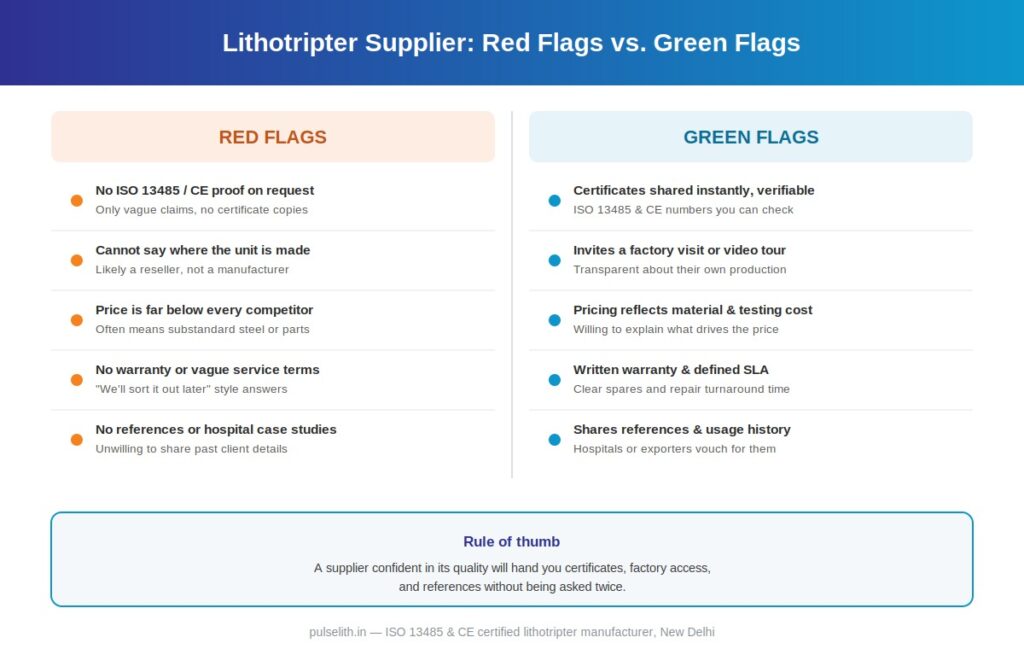
Red Flags vs. Green Flags: A Quick Visual Check

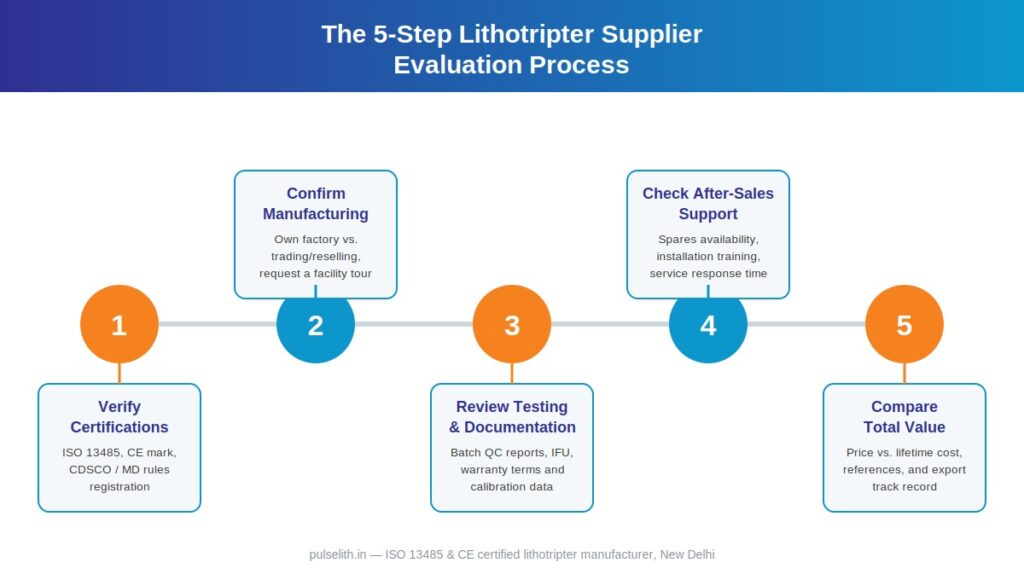 The five steps above summarize the evaluation order most procurement teams find effective: start with certifications (fastest to verify), confirm manufacturing capability, review testing documentation, check after-sales infrastructure, and only then compare pricing on a like-for-like basis.
If a supplier trips more than one or two items in the red-flag column, treat it as a serious signal rather than a minor inconsistency — these issues tend to compound once the device is in daily clinical use.
 Frequently Asked Questions
How do I verify a supplier’s ISO 13485 or CE certificate is genuine?
Ask for the certificate number and issuing/notified body, then contact that body directly or search their public database. A genuine certificate holder will never object to this being checked.
Is a lower lithotripter price in India always a bad sign?
Not automatically, but a price significantly below every other certified manufacturer usually reflects a cut corner somewhere — material grade, testing, or after-sales support. Ask the supplier to explain the cost breakdown rather than assuming either the best or the worst.
What’s the difference between buying from a manufacturer versus a trading company?
A manufacturer controls production, testing, and customization directly, which usually means faster issue resolution and better spare-parts access. A trading company adds a layer between you and the factory, which can slow down warranty claims and limit customization.
Do I need different suppliers for the lithotripter and the rest of my PCNL instrument set?
Not necessarily. Sourcing the lithotripter alongside compatible PCNL instruments from one certified manufacturer usually simplifies compatibility, spares, and after-sales support compared to mixing vendors.
A Practical Buying Checklist
- ✅ ISO 13485 and CE certificates verified independently, not just displayed on the website.
- ✅ Manufacturing facility confirmed — either visited or shown via video walkthrough.
- ✅ Material specifications and pneumatic testing data provided in writing.
- ✅ Warranty and after-sales support terms documented, with clear response-time commitments.
- ✅ Accessory and instrument-set compatibility checked against your actual caseload.
- ✅ Pricing compared on total value (unit + accessories + training + warranty), not sticker price alone.
- ✅ At least one reference or export case study reviewed.
Final Thoughts
Choosing a lithotripter supplier in India without compromising quality really comes down to one habit: verify before you buy. Certifications, factory transparency, documentation, and after-sales infrastructure aren’t extra requests — they’re the baseline a genuine manufacturer will meet without hesitation. Suppliers who dodge these questions are telling you something important about what happens after the sale.
None of the steps in this guide require specialized expertise — they require asking direct questions and expecting direct answers. Hospitals, distributors, and exporters who build this vetting process into every procurement cycle, rather than treating it as a one-off checklist, consistently end up with equipment that performs reliably case after case, and with a supplier relationship that holds up when something eventually needs attention.
Advanced Health Care Resources (AHCR) in New Delhi, is built around exactly this standard: ISO 13485 and CE certified pneumatic lithotripters, in-house manufacturing, and direct technical support rather than a sales-only relationship. Browse the pneumatic lithotripter range, explore the full urology instruments catalog, or get in touch to request certification documents and a facility walkthrough before you decide.
Related reading: more urology equipment and procurement guides on the Pulselith blog.



Comment (1)
[…] a new department? Read how to choose a lithotripter supplier in India and our guide to more procurement […]