
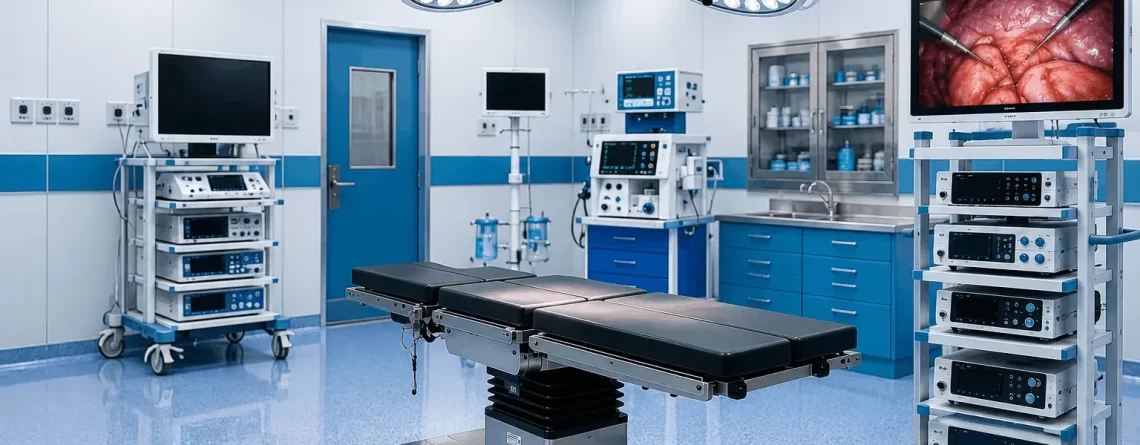
India has quietly become one of the world’s largest sources of reusable surgical instruments, urology devices, and laparoscopic equipment. Hospitals across Europe, the Middle East, Africa, and Southeast Asia now source instruments from Indian manufacturers because of the combination of engineering skill and competitive pricing. But none of that matters if a manufacturer cannot prove, on paper, that its instruments are safe, traceable, and built to a repeatable quality standard.
Certifications are how that proof is delivered. For an Indian surgical instrument manufacturer, certifications are not a marketing checkbox — they are the legal and commercial gateway to almost every serious buyer, whether that buyer is a government hospital in Delhi or a private clinic in Frankfurt. This guide breaks down exactly which certifications matter, what each one actually covers, and why skipping any of them quietly closes off entire markets.
Jump to a section
- ISO 13485 – Quality Management System
- CDSCO Manufacturing License (India)
- CE Marking (European Union)
- US FDA 510(k) Clearance
- BIS Certification
- Other Export-Market Certifications
- Raw Material and Sterilization Certifications
- Certification Comparison at a Glance
- Common Mistakes Manufacturers Make
- Conclusion
1. ISO 13485 – Quality Management System
ISO 13485 is the single most important certification a surgical instrument manufacturer can hold. It is the internationally recognized standard for a Quality Management System (QMS) specific to medical devices, covering everything from design control and risk management to production, storage, installation, and servicing.
Almost every serious buyer — hospital procurement teams, distributors, and regulatory bodies alike — treats ISO 13485 as a baseline requirement rather than a bonus. Without it, a manufacturer cannot realistically pursue CE marking, and many CDSCO license applications move faster and more smoothly when a valid ISO 13485 certificate is already on file.
What ISO 13485 actually verifies is process discipline: that raw materials are traceable, that manufacturing steps are documented and repeatable, that non-conforming products are identified and contained, and that corrective actions are tracked over time. For a urology or laparoscopic instrument manufacturer, this means every lithotripter probe, cystoscope sheath, or PCNL dilator can be traced back to its raw material batch and the specific process steps it went through.
2. CDSCO Manufacturing License (India)
Within India, the Central Drugs Standard Control Organization (CDSCO) regulates the manufacture, sale, and distribution of medical devices under the Medical Device Rules, 2017. Any company manufacturing notified medical devices for the Indian market needs a valid CDSCO manufacturing license — and manufacturing without one is not legally permitted.
The license form depends on the device’s risk classification:
- Class A (low risk) and Class B (low-to-moderate risk) devices — most general surgical instruments fall here — require an MD-5 license, filed via Form MD-3 and granted by the State Licensing Authority.
- Class C (moderate-to-high risk) and Class D (high risk) devices require an MD-9 license, granted at the central level.
Classification is the foundation of the entire process — a misclassified device can send a manufacturer down the wrong licensing pathway entirely. Since October 2023, every Class C and Class D device sold or imported in India has needed a valid CDSCO license, closing a gap that previously let some higher-risk categories operate as “non-notified” devices. More recently, an October 2025 exemption carved out an allowance for Class A Non-Sterile, Non-Measuring (NSNM) devices, though sterile and measuring devices within Class A still require full licensing. This distinction matters for manufacturers with mixed product lines, since a single product family may include variants that need a license and others that are exempt.
Applications are filed through the CDSCO SUGAM portal, and once granted, a manufacturing license is valid for five years before renewal is required. In practice, ISO 13485 implementation is treated as a near-prerequisite for a smooth CDSCO application, since much of the required documentation — quality manuals, device master files, risk management records — overlaps directly with what ISO 13485 already demands.
3. CE Marking (European Union)
For any Indian manufacturer exporting to the European Union, EEA countries, or the many markets that recognize CE marking as a proxy for quality (parts of the Middle East, Africa, and Southeast Asia included), CE marking is close to non-negotiable. It certifies that a device meets the EU Medical Device Regulation (MDR) requirements for safety, performance, and clinical evaluation.
Getting there involves a technical file for each device family, a declaration of conformity, and — depending on the device’s risk class under the EU’s own classification rules — assessment by a Notified Body. Reusable surgical instruments typically fall under Class I or Class IIa, but even Class I devices require documented evidence of conformity, and many buyers expect it to be backed by ISO 13485 certification behind the scenes.
CE marking is often the deciding factor in tenders and distributor agreements outside India — a device without it is effectively locked out of the EU market and heavily disadvantaged in many others, regardless of how well it performs clinically.
4. US FDA 510(k) Clearance
Manufacturers targeting the United States need to navigate the FDA’s regulatory pathway, most commonly the 510(k) premarket notification process, which requires demonstrating that a device is “substantially equivalent” to a legally marketed predicate device. Some lower-risk instruments may qualify for exemption from 510(k), but this needs to be confirmed device by device rather than assumed.
US FDA registration also requires the manufacturing facility to be registered with the FDA and listed under the appropriate product code, along with adherence to the FDA’s Quality System Regulation (21 CFR Part 820), which closely mirrors — but is not identical to — ISO 13485’s requirements. Manufacturers already running an ISO 13485 system have a significant head start here, since much of the documentation structure carries over.
5. BIS Certification
The Bureau of Indian Standards (BIS) maintains standards for specific categories of medical devices and equipment sold within India. While BIS certification is not universally mandatory across every surgical instrument category the way CDSCO licensing is, certain notified product categories do require it, and government tenders within India frequently list BIS conformity as a prerequisite for bidding. Manufacturers supplying to Indian government hospitals, defence medical establishments, or public procurement programs should confirm whether their specific product category falls under a BIS-notified standard before assuming it is optional.
6. Other Export-Market Certifications
Beyond the EU and US, several other markets carry their own registration requirements that Indian manufacturers exporting surgical instruments should be aware of:
- Gulf Cooperation Council (GCC) countries often require registration through each country’s own health authority, though several increasingly accept CE marking as supporting evidence.
- Free Sale Certificates (FSC), issued in India, are frequently demanded by importing countries as proof that a device is legally sold in its country of origin.
- WHO-GMP certification, while more commonly associated with pharmaceuticals, is sometimes requested by tender authorities in Africa and parts of Asia as an added quality signal.
None of these replace ISO 13485 or CE marking — they sit alongside them as market-specific add-ons that widen a manufacturer’s addressable geography.
7. Raw Material and Sterilization Certifications
Certifications don’t stop at the finished-device level. Surgical instrument manufacturers also need to substantiate the materials and processes behind each product:
- Material certification confirming the grade of surgical stainless steel (commonly AISI 410 or 420 series) used in instrument bodies, jaws, and cutting edges.
- Biocompatibility testing in line with ISO 10993 for any device components in contact with tissue or body fluids.
- Sterilization validation where relevant, confirming that autoclave or ethylene oxide sterilization cycles reliably achieve the required sterility assurance level.
Hospital procurement teams increasingly ask for this documentation upfront, particularly for tender-based government purchasing, so having it prepared and organized ahead of a request shortens sales cycles considerably.
Certification Comparison at a Glance
| Certification | Governing Body | Primary Market | What It Covers |
|---|---|---|---|
| ISO 13485 | International (via accredited certification bodies) | Global baseline | Quality management system for design, production, and traceability |
| CDSCO Manufacturing License (MD-5/MD-9) | Central Drugs Standard Control Organization | India | Legal authorization to manufacture notified medical devices |
| CE Marking | EU Notified Bodies / Medical Device Regulation | European Union and CE-recognizing markets | Conformity with EU safety and performance requirements |
| US FDA 510(k) | U.S. Food and Drug Administration | United States | Substantial equivalence to a legally marketed predicate device |
| BIS Certification | Bureau of Indian Standards | India (select categories) | Conformity with Indian national product standards |
Common Mistakes Manufacturers Make
- Assuming one certification covers every market. ISO 13485 is foundational but does not by itself grant market access anywhere — it supports other certifications rather than replacing them.
- Misclassifying devices under CDSCO rules. A device wrongly filed as Class A when it should be Class B (or vice versa) can delay licensing by months.
- Treating BIS as optional across the board. Some product categories genuinely require it for domestic tenders, and assuming otherwise can disqualify a bid.
- Letting certifications lapse. CDSCO manufacturing licenses need renewal every five years, and ISO 13485 certificates require periodic surveillance audits — a lapsed certificate can quietly halt shipments mid-contract.
- Not preparing material and sterilization documentation in advance. Hospital buyers increasingly request this before finalizing large orders, and scrambling to produce it after the fact slows down deals.
Where AHCR (Pulselith) Fits In
Advanced Health Care Resources (AHCR), the manufacturer behind Pulselith, is built around exactly this certification framework rather than treating it as an afterthought. AHCR’s urology and laparoscopic instrument range — including pneumatic lithotripters, PCNL equipment, cystoscopy sheaths, and bipolar TURP systems — is manufactured under an ISO 13485 certified quality management system, covering design control, raw material traceability, and production consistency across every instrument line.
Pulselith’s product range also carries CE certification, which allows the company to supply hospitals and distributors across the European Union and the many other markets that recognize CE marking as a benchmark for device safety and performance. Combined, ISO 13485 and CE certification give AHCR’s instruments the documentation base that international procurement teams and distributors expect before they’ll even open a conversation — from the underlying quality system to the finished-device conformity declaration.
For hospitals and distributors evaluating a New Delhi-based surgical instrument manufacturer, this is the practical takeaway from everything above: certifications aren’t just a regulatory hurdle to clear once. They’re the ongoing proof that an instrument arriving in an operating room in Delhi, Dubai, or Berlin was built to the same verified standard every time.
Conclusion
For an Indian surgical instrument manufacturer, certifications aren’t a bureaucratic afterthought — they are the infrastructure that makes export and institutional sales possible in the first place. ISO 13485 forms the quality backbone, CDSCO licensing is the non-negotiable legal requirement for operating in India, and CE marking or US FDA clearance open the doors to the world’s largest medical device markets. Layered on top of these are the market-specific certifications and material-level documentation that procurement teams increasingly expect to see without having to ask.
Manufacturers that treat this as an ongoing discipline — keeping certificates current, documentation organized, and classification accurate — end up moving faster through tenders and distributor onboarding than competitors who scramble to assemble paperwork after a buyer requests it.




Comment (1)
[…] A manufacturer that can’t produce these documents on request — or stalls indefinitely — should be treated as a non-starter for a bulk order, regardless of pricing. For a deeper breakdown of each certification, see our earlier guide on certifications for Indian surgical manufacturers. […]