
Table of Contents
- What Is the Central Rod?
- How the Central Rod Fits Into the Telescopic Dilator System
- Step-by-Step: The Central Rod’s Role in Tract Dilation
- Why Surgeons Still Choose Metal Telescopic Dilation
- Design and Material Specifications That Matter
- Central Rod vs. Other Guide Mechanisms
- Care, Sterilization, and Maintenance
- What to Check Before Buying
- Frequently Asked Questions
What Is the Central Rod?
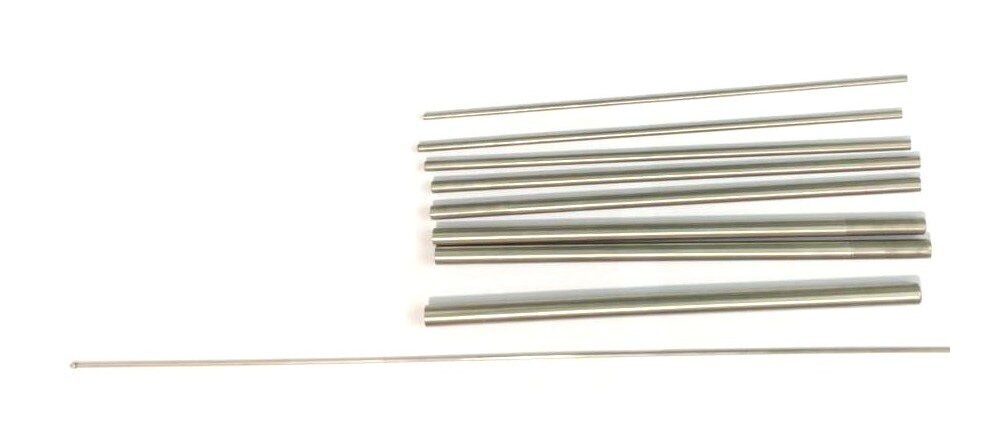
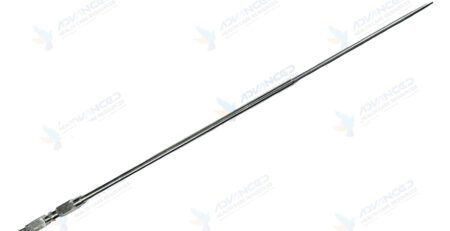
The central rod — sometimes called the guide rod or Alken guide — is the innermost component of the metal telescopic dilator set used in PCNL. It is a long, rigid metal rod with a blunt or gently tapered tip, designed to pass smoothly over a previously placed guidewire and into the renal collecting system through the puncture tract. Once positioned, it becomes the rail that every subsequent dilator in the telescopic set slides over, one size at a time, until the tract reaches the diameter needed for the working sheath.
In short: the central rod doesn’t dilate anything itself. Its job is to hold the line — to give every larger dilator that follows it a fixed, stable, centered path to travel along.
Also read: Alken Needle vs Chiba Needle: Which Is Better for PCNL and Percutaneous Renal Access?
How the Central Rod Fits Into the Telescopic Dilator System
A complete metal telescopic dilator set typically includes the central rod plus a series of progressively larger metal dilators (commonly ranging from around 8 Fr up to 30 Fr or beyond, depending on the manufacturer’s set), each of which is hollow and threads over the one before it. The sequence works like this:
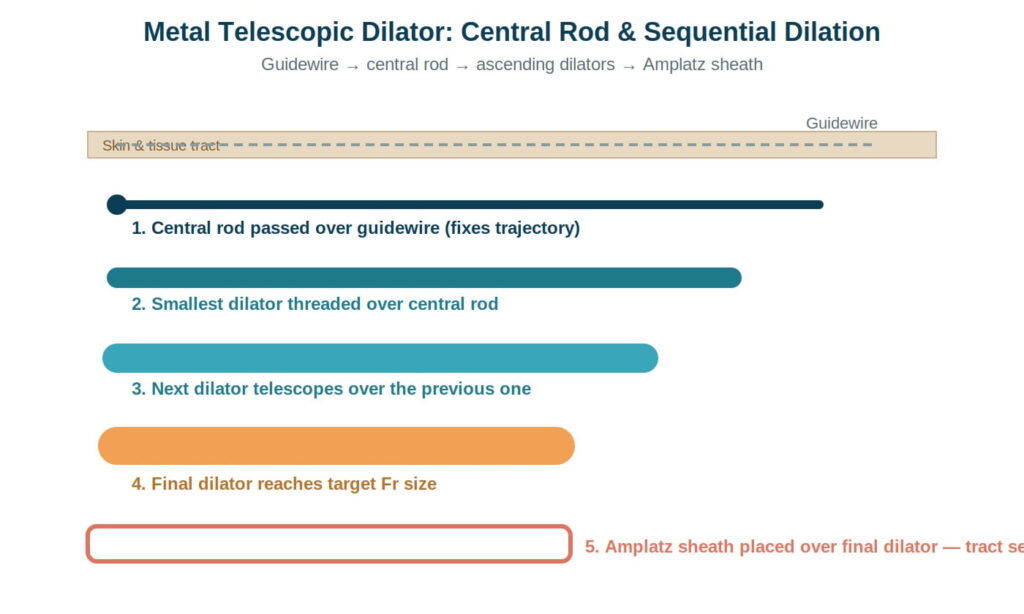
- A guidewire is placed into the collecting system under fluoroscopic or ultrasound guidance following successful renal puncture.
- The central rod is advanced over the guidewire, establishing the first fixed track through the tissue.
- The smallest metal dilator is passed over the central rod and advanced to the desired depth.
- Each subsequent dilator is threaded over the previous one in ascending size order — a true “telescoping” action — until the tract reaches the target Fr size.
- An Amplatz sheath is then passed over the final dilator (or, in the single-step technique, directly over the central rod) to keep the tract open for the nephroscope.
Because every dilator in the set locks onto the one before it, the central rod effectively determines the trajectory for the entire tract. Any wobble, bend, or misalignment at the central rod stage compounds through every dilator that follows — which is exactly why its rigidity and straightness matter so much.
Step-by-Step: The Central Rod’s Role in Tract Dilation
From the surgeon’s perspective, the central rod does three specific jobs during the procedure. First, it converts a thin, flexible guidewire into a rigid working axis strong enough to bear the load of dilators being pushed over it. Second, it maintains centration — keeping the eventual tract aligned with the calyx that was punctured, rather than drifting off-axis as tissue resistance is met. Third, it provides tactile feedback to the operating surgeon: an experienced hand can often sense whether the rod is advancing along a clean, expected path or meeting resistance that suggests the tract is off-course, well before that information becomes visible on fluoroscopy or ultrasound.
Why Surgeons Still Choose Metal Telescopic Dilation
With balloon dilators and one-shot Amplatz dilation both widely available, the metal telescopic system — and by extension the central rod — remains in active use across Indian and international urology practice for a few consistent reasons. It is reusable, which keeps per-case cost meaningfully lower than single-use balloon systems over the life of the instrument. It provides a continuous tamponade effect during dilation, which many surgeons find helpful for controlling bleeding at the tract site. And comparative studies have repeatedly found the technique to be a safe, cost-effective option, with some research specifically highlighting Alken metal telescopic dilation as well suited to developing countries where cost-effectiveness and reusability are practical priorities. It has also proven adaptable to ultrasound-guided, radiation-free PCNL protocols, giving centers without constant fluoroscopy access a reliable dilation method.
Design and Material Specifications That Matter
Not every central rod performs the same way in the OT. When evaluating one for procurement, the specifications below have the most bearing on clinical performance and instrument longevity:
- Straightness and rigidity: even a slight permanent bend transfers misalignment to every dilator that follows it.
- Surgical-grade stainless steel construction: needed for corrosion resistance across repeated autoclave cycles.
- Tip design: a smoothly tapered, atraumatic tip reduces resistance and tissue trauma on insertion.
- Guidewire lumen tolerance: the internal bore must track a standard 0.035″–0.038″ guidewire snugly, without excess play that allows the rod to wobble off-axis.
- Compatibility with the dilator set: the rod’s outer diameter and length must match the specific telescopic dilator series it’s paired with — mixing components across brands is a common and avoidable source of tract misalignment.
- Length: sufficient to accommodate variations in patient body habitus and puncture-to-collecting-system distance without the handle end disappearing into the tract.
Central Rod vs. Other Guide Mechanisms
It’s worth situating the central rod against the alternatives a hospital might be comparing it to. In balloon dilation, the guidewire itself, backed by a semi-rigid coaxial catheter, plays a similar guiding role, but the tract is dilated in a single controlled inflation rather than a sequential mechanical push. In single-step Amplatz dilation, some centers have adopted a hybrid approach — advancing a large Amplatz dilator directly over the central Alken rod in one motion, rather than working through the full telescoping sequence, specifically to reduce operative duration and radiation exposure while avoiding the dilator exchanges that can increase bleeding risk. This hybrid technique still depends entirely on the central rod’s guiding function — underscoring that even as dilation techniques evolve, the rod’s core job hasn’t changed.
Care, Sterilization, and Maintenance
Because the central rod is a reusable surgical-grade instrument, its performance over time depends heavily on how it’s handled between cases. Hospitals should inspect the rod before every use for surface scoring, pitting, or any visible bend — even minor deformation can translate into tract misalignment during the next procedure. Standard steam autoclave sterilization (in line with ISO 17665 protocols) is appropriate for surgical-grade stainless steel rods, but repeated cycles do gradually affect surface finish, so periodic replacement should be built into the instrument lifecycle rather than treated as a one-time purchase. Storing the rod in a dedicated tray alongside its matched dilator set — rather than loose with mixed instruments — also reduces the risk of accidental bending during handling and transport.
What to Check Before Buying
For hospitals and procurement teams sourcing a central rod — whether as a replacement component or as part of a full telescopic dilator set — a few practical checks go a long way:
- Confirm the rod is sold as part of a matched, compatible set rather than a generic component that may not fit your existing dilators.
- Ask for material certification confirming surgical-grade stainless steel and CE/ISO 13485 compliance.
- Check manufacturer warranty terms and whether individual components (like the central rod alone) can be reordered separately if lost or damaged.
- Verify the rod’s guidewire compatibility matches the guidewires your urology team already stocks.
- Where possible, request a demonstration or trial unit before committing to a full-set purchase, particularly for a first-time supplier.
Frequently Asked Questions
What does the central rod do in a metal telescopic dilator set?
The central rod passes over the guidewire first and establishes a fixed, rigid trajectory through the puncture tract. Every subsequent dilator in the telescopic set threads over it and over each preceding dilator, so the central rod effectively determines the alignment of the entire dilated tract.
Is the central rod reusable?
Yes. Central rods used with metal telescopic (Alken) dilator sets are designed as reusable, autoclavable surgical-grade instruments, which is a major reason the telescopic dilation technique remains cost-effective compared to single-use balloon systems.
Can a central rod from one manufacturer be used with another brand’s dilator set?
It’s not recommended. Outer diameter, taper geometry, and length tolerances vary between manufacturers, and mixing components across brands increases the risk of poor fit and tract misalignment. It’s best to source a matched central rod and dilator set from the same manufacturer.
How often should a central rod be replaced?
There’s no fixed universal interval — it depends on usage frequency and sterilization cycles — but the rod should be inspected before every case for bending, pitting, or surface wear, and replaced as soon as any deformation is visible, since even minor misalignment compounds through the dilation sequence.








Leave a Reply