
A urology instrument is only as safe as its last reprocessing cycle. Whether it is a cystoscope sheath, a PCNL dilator or a urethral dilator, every reusable instrument that enters a patient has to be cleaned, inspected and sterilized correctly, every single time. When that chain breaks, the result is infection risk for patients, damaged instruments and costly replacements for the hospital.
This guide explains sterilization of urology instruments in practical terms for CSSD teams, OT managers, biomedical engineers and procurement heads. It covers the full reprocessing cycle, how to choose a sterilization method, how to care for specific instruments, common mistakes, and what to ask your supplier before you buy.
Key takeaways
- Cleaning comes first. Sterilization cannot work on an instrument that still carries tissue, blood or detergent residue.
- Always follow the manufacturer’s instructions for use (IFU) for each instrument. Not every item tolerates every method.
- Do not soak instruments in saline or hypochlorite. Both can corrode stainless steel.
- Inspect before you pack. A damaged instrument that is sterilized is still a damaged instrument.
- Well-made instruments from a certified manufacturer survive more cycles, which lowers cost per procedure.
Why Reprocessing Matters in Urology
Urology is instrument-heavy. A single stone procedure can involve a cystoscope or ureteroscope, access needles, dilators, sheaths, forceps and a lithotripsy probe. Many of these have narrow channels, hinged joints or fine tips where debris hides. Reprocessing is difficult precisely because urology instruments are complex.
The World Health Organization describes decontamination, which covers cleaning, disinfection and sterilization, as a key part of preventing health care-associated infections. It also stresses that each step needs quality control, because one failed step can undo the rest.
There is a financial angle too. Instruments that are cleaned poorly, soaked in the wrong solution or sterilized with the wrong method wear out faster. For a department running daily lists, proper reprocessing protects both patients and the budget.
Understanding Risk: Critical and Semi-Critical Instruments
Infection control guidance classifies devices by the risk they carry, using the Spaulding classification. Two categories matter most for urology:
- Critical devices enter sterile tissue or the vascular system. In urology this includes PCNL puncture needles, telescopic dilators and Amplatz sheaths, which pass through the skin into the kidney. These must be sterilized.
- Semi-critical devices contact mucous membranes or non-intact skin. Cystoscope sheaths, urethral dilators and ureteroscopes fall here. Under CDC guidance, these need at least high-level disinfection, and sterilization is preferred wherever the instrument can tolerate it.
In practice, most reusable stainless steel urology instruments can be steam sterilized, so many hospitals simply sterilize everything that allows it. This removes any doubt about the classification at the point of use.
The Urology Instrument Reprocessing Cycle, Step by Step
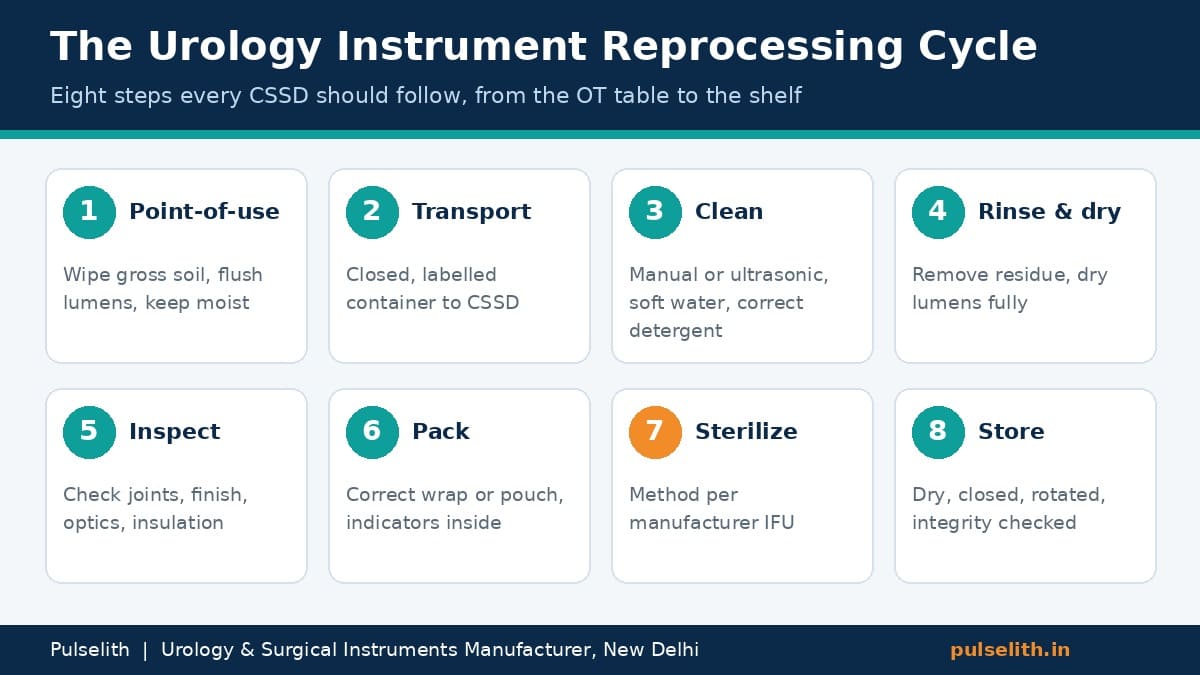
1. Point-of-use pre-cleaning
Reprocessing starts in the operating theatre, not the CSSD. Wipe visible soil from the instrument with a damp, lint-free cloth straight after use and flush any lumens with sterile water so blood and tissue do not dry inside. Dried bioburden is far harder to remove later. Remove sharps and separate delicate items such as telescopes before transport.
2. Safe transport
Move used instruments to the CSSD in a closed, labelled, leak-proof container. Place heavy instruments at the bottom and delicate ones on top. Keep transit time short, so debris does not dry on the surface.
3. Cleaning
Cleaning removes the organic and inorganic material that shields microorganisms from the sterilant. CDC guidance is clear that sterilization and disinfection work best after thorough cleaning. Key points include:
- Use a detergent suited to surgical instruments, at the dilution the manufacturer specifies.
- Use soft water with low mineral content. WHO recommends soft water with low mineral and salt content for decontamination.
- Open all hinged instruments and disassemble anything that comes apart, such as cystoscope sheaths, obturators and bridges.
- Brush lumens with correctly sized, clean brushes and flush them with a syringe.
- Use ultrasonic cleaning for stainless steel instruments with joints and serrations, but only for optics and delicate items if the IFU explicitly allows it.
4. Rinsing and drying
Rinse thoroughly so no detergent residue remains. Residue can interfere with the sterilization process and stain the metal. Then dry completely, including lumens, with filtered compressed air where available. Moisture left on an instrument encourages corrosion and causes wet packs after steam sterilization.
5. Inspection and lubrication
Inspect every instrument under good light, ideally with magnification for fine tips and joints. Check that box locks move freely, jaws align and surfaces are free of pitting or rust. Apply a water-soluble, steam-permeable instrument lubricant to hinged joints. Avoid mineral oil or silicone products that can block steam contact.
6. Packaging
Choose wraps, pouches or rigid containers compatible with your sterilization method. Include a chemical indicator inside each pack and protect fine tips so they cannot puncture the wrap. Instruments should be assembled in a way that lets the sterilant reach every surface.
7. Sterilization
Select the method the manufacturer’s IFU permits, and monitor each load with physical, chemical and biological indicators. The next section compares the main options.
8. Storage and handling
Store sterile packs in a clean, dry, closed area, off the floor and away from moisture and heavy traffic. Check pack integrity before use, rotate stock on a first-in, first-out basis and reprocess any pack that is damaged, wet or past its storage limit.
Choosing a Sterilization Method for Urology Instruments
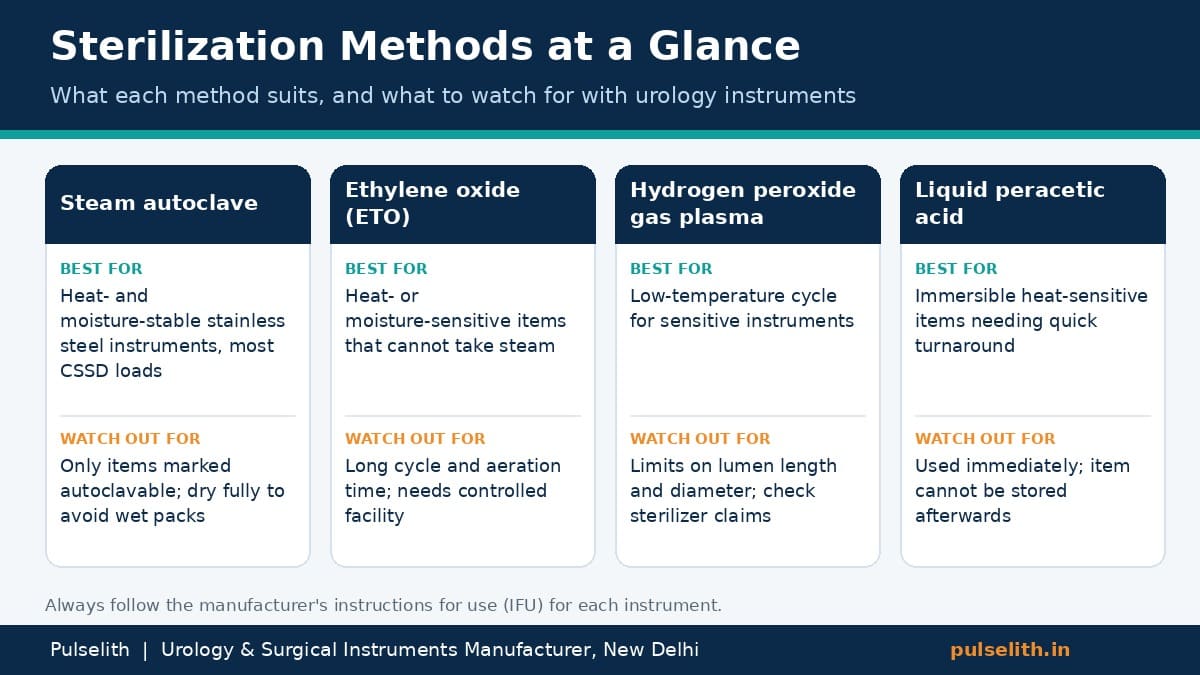
CDC lists steam, ethylene oxide (ETO), hydrogen peroxide gas plasma and liquid peracetic acid among the sterilization methods used in healthcare. Each suits different instruments.
| Method | Best suited to | Key considerations |
|---|---|---|
| Steam autoclave | Heat- and moisture-stable stainless steel instruments | The most common hospital method. Only for items marked autoclavable. Dry loads fully to avoid wet packs. |
| Ethylene oxide (ETO) | Heat- or moisture-sensitive items | Long cycle plus an aeration period. Needs a controlled facility. |
| Hydrogen peroxide gas plasma | Sensitive instruments needing a low-temperature cycle | Limits apply to lumen length and diameter, so check the sterilizer’s claims. |
| Liquid peracetic acid | Immersible, heat-sensitive items | Processed items are used immediately and cannot be stored. |
A note on flash sterilization: it is intended for urgent situations, not for routine turnaround. If your department relies on flash cycles to keep lists moving, that is usually a sign you need more instrument sets, not faster cycles.
Match the method to the instrument. Metal PCNL needles, dilators and most forceps are generally suited to steam. Telescopes, light cables and instruments with electronics or sealed optics often have specific limits, so look for the manufacturer’s autoclave marking and the IFU before you load them.
Building or upgrading your urology OT?
AHCR manufactures urology instruments in New Delhi. Tell us your procedure volume and we will recommend sets and quantities sized for your CSSD turnaround.
Caring for Specific Urology Instruments
Cystoscope sheaths, obturators and bridges
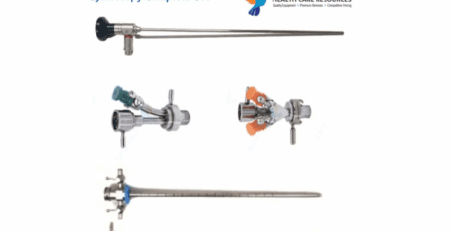
Cystoscope cleaning and sterilization starts with disassembly. Separate the sheath, obturator, bridge and telescope before cleaning, because fluid and debris collect at junctions and in the irrigation channels. Flush the stopcocks and ports, brush the sheath lumen and check that the locking mechanism closes cleanly afterwards. Mismatched or worn locks cause leaks and poor fit, which is why compatibility matters when you reorder. Our cystoscope sheath size and compatibility chart and buying questions guide cover this in more detail.
Telescopes and light cables
Rigid telescopes are the most delicate part of the set. Handle them separately, never stack them in a tray with heavy instruments and avoid ultrasonic cleaning unless the IFU permits it. Look through the telescope after every cycle. A hazy or dark image usually means moisture ingress or damaged optics, and it should be serviced, not used.
PCNL needles, dilators and sheaths
PCNL instrument sterilization demands extra attention because these items go directly into the kidney, which makes them critical devices. Alken needles and metal telescopic dilators have narrow lumens and a central rod that must be cleaned along its entire length. Flush the needle lumen immediately after use, brush where the design allows, then dry thoroughly. If you are building or auditing a set, our guides to the PCNL instrument checklist, complete PCNL set components, Alken needle gauges and central rod for metal telescopic dilators are useful companions.
Urethral dilators
Teflon and metal urethral dilators are simple in shape but are used on mucosa, so they need thorough cleaning and a validated sterilization step. Check each dilator for surface scratches, cracks and deformation, because roughness can injure tissue. Our Teflon urethral dilator set guide explains sizes and uses.
Pneumatic lithotripter probes and handpieces
Probes and handpieces that contact the patient follow the same clean, inspect and sterilize logic, while the compressor and control unit are wiped down but not sterilized. Worn probes lose fragmentation efficiency, so track usage and replace them on schedule. See our guide to pneumatic lithotripter spare parts and troubleshooting for details.
Laparoscopic and hysteroscopy instruments
Instruments with long shafts and internal channels need flushing ports, specially sized brushes and full disassembly where the design allows. Pay close attention to insulation on electrosurgical instruments, since cracks create a patient and staff safety hazard. If your hospital also runs gynecology or minimally invasive lists, explore our laparoscopy instruments and hysteroscopy set.
Common Mistakes That Shorten Instrument Life
Most instrument damage comes from handling and process errors rather than from the procedures themselves. Watch for these:
- Soaking in saline or hypochlorite. WHO guidance specifically warns against it, because both can pit and corrode stainless steel.
- Letting blood and tissue dry. Dried soil resists cleaning and can block lumens.
- Using the wrong detergent or abrasive pads. Scratches become corrosion starting points.
- Cleaning optics like metal instruments. Ultrasonic baths and harsh chemicals can damage telescopes.
- Mixing metals in the same tray or bath. This can cause staining and galvanic corrosion.
- Overloading trays and autoclaves. Steam cannot reach crowded surfaces, and loads come out wet.
- Using the wrong lubricant. Oil-based products can interfere with steam penetration.
- Skipping inspection. Damage is easiest to catch before the instrument goes back into circulation.
- Ignoring the IFU. A method that is fine for one model can destroy another.
Inspection Checklist Before Every Use
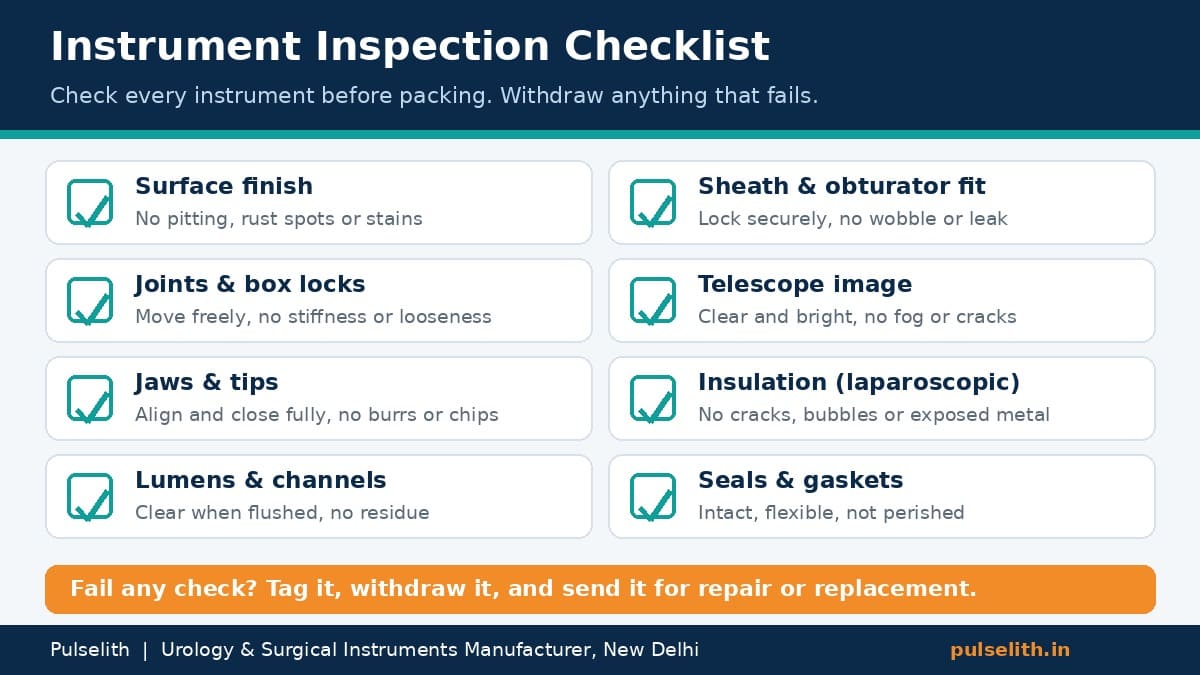
Build a short inspection routine into your CSSD workflow and train every technician on it. Check surface finish, joints and box locks, jaws and tips, lumens, sheath and obturator fit, telescope image quality, insulation and seals. Any instrument that fails a check should be tagged, withdrawn and sent for repair or replaced. Keeping a simple log of failures also helps you spot patterns, such as one tray that repeatedly returns damaged.
Repair or Replace? A Practical Guide
| What you find | Likely action |
|---|---|
| Light staining or water spots | Re-clean with the correct detergent and rinse in soft water |
| Stiff or loose box lock | Send for repair by a qualified service provider |
| Pitting, rust or deep corrosion | Withdraw. Corrosion harbours debris and spreads. |
| Bent shaft, misaligned or chipped jaws | Replace |
| Cracked or worn insulation | Withdraw and replace or re-insulate through an approved service |
| Hazy telescope image | Service or replace. Do not use. |
| Perished seals or gaskets | Replace the part |
As a rule, if a defect could affect patient safety, withdraw the instrument. The cost of a replacement is small compared with the cost of a complication.
How Manufacturing Quality Affects Reprocessing Life
The best reprocessing protocol cannot rescue a poorly made instrument. Material grade, heat treatment, surface finish and passivation all determine how well an instrument survives repeated cleaning and sterilization cycles. A smooth, properly passivated surface resists corrosion and is easier to clean. Precisely machined joints stay aligned instead of loosening over time.
International standards reflect this link. ISO 17664-1 requires manufacturers of critical and semi-critical devices to provide detailed processing information, covering steps from point-of-use treatment to storage. A manufacturer that works under a certified quality management system such as ISO 13485 and CE certification is better placed to give you reliable, tested reprocessing instructions.
That is why sourcing matters. Our guides on how to validate quality before ordering bulk surgical instruments, which certifications Indian manufacturers need and manufacturer vs trader explain what to look for.
What to Ask Your Supplier Before You Buy
Include reprocessing in your purchase decision, not just price. Before you finalize an order, ask:
- Can you provide written reprocessing instructions (IFU) for each model?
- Which sterilization methods are approved for each instrument, and at what parameters?
- What material and finish are used, and is the surface passivated?
- Which parts are autoclavable, and which are not?
- Which spare parts, such as seals, gaskets and probes, are available, and what are the lead times?
- What certifications does the manufacturer hold, and can you see the certificates?
- What repair and after-sales support do you offer?
- Can the supplier help size your set quantities to match your CSSD cycle time?
If you are preparing a tender, our urology instrument tender specification checklist shows how to write these requirements into your specification.
Frequently Asked Questions
Can all urology instruments be autoclaved?
No. Many stainless steel instruments such as needles, dilators and forceps are designed for steam sterilization, but telescopes, light cables, electronic parts and some plastics may have restrictions. Always check the manufacturer’s marking and IFU.
What is the difference between cleaning, disinfection and sterilization?
Cleaning physically removes soil and debris. Disinfection reduces the number of microorganisms but does not necessarily eliminate all of them. Sterilization is the process intended to eliminate all forms of microbial life. Cleaning must always come first.
How should a cystoscope sheath be cleaned after use?
Disassemble the sheath, obturator and bridge, flush the channels and stopcocks, brush the lumen, rinse in soft water, dry completely, inspect the locks and seals, then pack and sterilize by the method approved in the IFU.
Can I use ultrasonic cleaning for urology instruments?
Yes for most stainless steel instruments, especially those with joints and serrations. For telescopes and other delicate or optical items, use it only if the manufacturer’s instructions explicitly allow it.
How often should reusable urology instruments be replaced?
There is no fixed number of cycles. Replacement depends on build quality, usage, and how well the instrument is cleaned and handled. Inspect after each cycle and withdraw anything showing corrosion, deformation or functional wear.
Why should I buy from a manufacturer rather than a trader?
A manufacturer controls materials, finishing and quality checks, and can supply reprocessing guidance, spares and repair support directly. That usually means longer instrument life and fewer compatibility problems.
Conclusion
Good sterilization of urology instruments is a chain: pre-clean at the point of use, clean and rinse properly, dry, inspect, pack correctly, sterilize by an approved method and store with care. Each link protects patients and extends instrument life. Combine a disciplined CSSD routine with well-made, clearly documented instruments and your department will see fewer failures, fewer delays and lower cost per procedure.
Need reliable urology instruments built for repeated sterilization?
AHCR is an ISO 13485 and CE certified manufacturer of urology, laparoscopy and gynecology instruments in Okhla, New Delhi. Share your requirement and our team will respond with specifications, reprocessing guidance and pricing.
Get a Quote Browse Urology Instruments
Call +91 98109 86387 | Email info@pulselith.in
Disclaimer: this article is general educational information for hospital staff and buyers. It does not replace the manufacturer’s instructions for use, your facility’s infection control policy or advice from your infection prevention team.
Sources and Further Reading
- Centers for Disease Control and Prevention (CDC). Guideline for Disinfection and Sterilization in Healthcare Facilities, 2008. cdc.gov
- World Health Organization and Pan American Health Organization. Decontamination and reprocessing of medical devices for health-care facilities. 2016. who.int
- World Health Organization. Decontamination and reprocessing of medical devices for health care facilities: aide-memoire. WHO/UHL/IHS/IPC/2022.4. Available from who.int.
- International Organization for Standardization. ISO 17664-1:2021, Processing of health care products: Information to be provided by the medical device manufacturer for the processing of medical devices, Part 1: Critical and semi-critical medical devices. iso.org





Leave a Reply