

It is the first question every hospital administrator, urologist and procurement head asks when a new operation theatre is being equipped: how many instrument sets do we actually need? Buy too few and lists run late, cases get cancelled and the CSSD ends up taking risky shortcuts. Buy too many and you lock up capital in sets that sit on a shelf, while the CSSD processes more than it needs to.
There is no single magic number, but there is a sensible method. This guide shows how to work out the right quantity of urology instrument sets for a new OT using five inputs: peak case volume, case duration, reprocessing turnaround, parallel tables and a safety buffer. It includes a worked example, a phased buying plan and a free Excel calculator you can fill in with your own numbers.
Key takeaways
- Size your sets to the busiest realistic day, not the average day.
- The number that matters most is turnaround time: how long a set takes to get from the end of a case back to the OT, sterile and ready.
- Always add a buffer for repairs, failed inspections and emergencies, and give extra thought to telescopes and light cables.
- CDC advises against using flash sterilization as an alternative to buying additional instrument sets.
- Buy in phases, then adjust using your own usage data after the first few months.
Why There Is No Single “Right” Number
Industry commentary points out that there is very little benchmarked data on the ratio of instrument sets to the daily OR schedule, which is why getting the number right can be so frustrating for surgeons, administrators, scrub staff and sterile processing teams. In other words, a copied number from another hospital may not fit yours.
Two urology departments with the same number of operating tables can need very different quantities. A day-care centre running mostly cystoscopies has short cases and fast turnover. A tertiary hospital running TURP, URS and PCNL lists back to back has longer cases, more complex sets and a CSSD that may serve several departments. The variables that change the answer are:
- How many cases of each type you run on a peak day
- How long each case takes
- How long your CSSD takes to return a sterile set to the OT
- How many tables run the same procedure at the same time
- How much margin you want for repairs, loss and emergencies
The Cost of Getting It Wrong
Too few sets
The most visible symptom of under-buying is flash sterilization used to keep the list moving. CDC guidance is explicit: flash sterilization is acceptable for items that cannot be packaged, sterilized and stored before use, or when there is insufficient time to sterilize by the preferred method, but it should not be used for reasons of convenience, as an alternative to purchasing additional instrument sets, or to save time. Beyond the compliance risk, a short inventory causes late starts, longer gaps between cases, rushed cleaning and more wear on the few sets you do have.
Too many sets
Over-buying is quieter but expensive. Extra sets tie up budget, take up sterile storage, add to the CSSD’s daily workload and may never be used. A well-known hospital improvement project that moved to right-sized, build-to-order sets reported cutting the number of sets for one procedure from five to two, while removing large quantities of unused instruments from circulation. The lesson for a new OT is to buy what the data supports, then grow.
Step 1: List Your Procedures and Your Peak Day
Start with the procedures you expect to run, and estimate cases per day on a peak day, which is the busiest day you can realistically expect once the department is established. For a new urology OT the list usually includes:
- Cystoscopy: sheaths, obturators, bridges, forceps and a telescope. See our cystoscope sheath size and compatibility chart.
- TURP / resectoscopy: resectoscope sheaths, working elements and electrodes, plus a telescope.
- Ureteroscopy (URS): ureteroscope, guidewires, baskets and forceps.
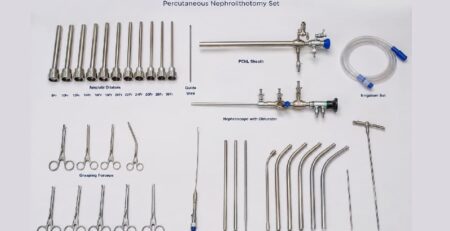
- PCNL: puncture needles, dilators, sheaths and nephroscopy accessories. See our complete PCNL set guide and PCNL instrument checklist.
- Urethral dilatation and urethrotomy: see our Teflon urethral dilator set guide.
- Bladder stone procedures: see our bladder stone set.
Set contents vary with surgeon preference and technique, so involve your urologists at this stage. Ask which instruments they use in almost every case and which only appear occasionally. That list becomes the basis for your set design, which we return to below.
Step 2: Measure Your Real Turnaround Time
Turnaround time is the single biggest driver of how many sets you need. Define it as the time from the end of use in the OT to the moment a sterile, ready set is back in the OT. It includes:
- Point-of-use cleaning and transport to the CSSD
- Manual or machine cleaning, rinsing and drying
- Inspection, assembly and packaging
- Waiting for a sterilizer load, the sterilization cycle itself and cooling
- Release, storage and delivery back to the OT
Many teams underestimate this. If your CSSD runs a single shift, sets used late in the day may not be back until the next morning, which means those sets effectively get one use per day. If you have more than one sterilizer and staff through the afternoon, you may get two uses. Walk the process with your CSSD lead and time it. Our guide to sterilization of urology instruments describes each stage in detail.
Also check sterilizer capacity. If the autoclave can only take a limited number of packs per cycle, your set quantity should not assume a throughput the CSSD cannot deliver.
Step 3: Apply the Two Formulas
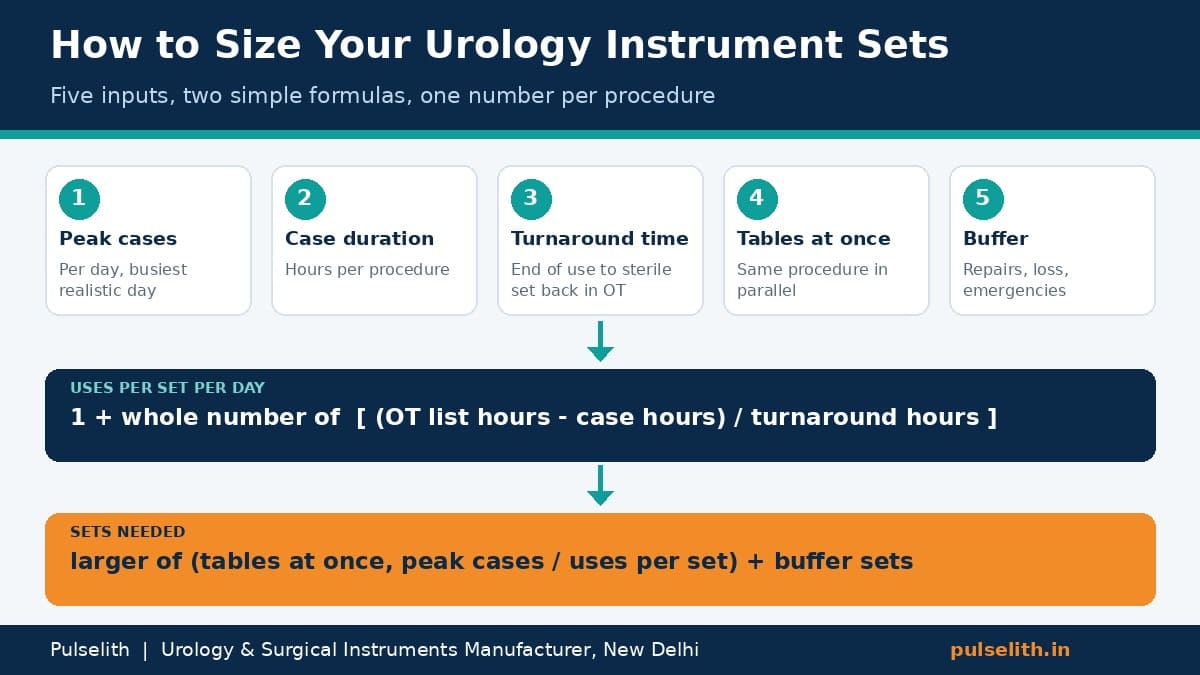
First, work out how many times one set can be used in a day:
Uses per set per day = 1 + the whole number of [ (OT list hours − case hours) ÷ turnaround hours ]
The set is used once, then becomes available again after the turnaround time. For an 8-hour list, a 0.5-hour cystoscopy and a 5-hour turnaround, that gives 1 + whole number of (7.5 ÷ 5) = 2 uses a day.
Second, work out the sets needed for each procedure:
Sets needed = the larger of (tables running the procedure at once, peak cases ÷ uses per set) + buffer sets
The first part of the “larger of” rule matters. If two tables can run cystoscopies at the same time, you need at least two sets regardless of how fast the CSSD is. The second part covers days when volume is the constraint.
This is a planning method, not an industry standard. Its value is that it forces you to write down your assumptions and check them against your own CSSD, which is where most set shortages actually begin.
Step 4: Add a Buffer
A set count that exactly matches peak demand has no room for real life. Instruments fail inspection, a joint needs repair, a pack is dropped or an emergency case arrives. Sterile processing guidance on par levels recommends a loose-instrument back-up inventory for items that go missing, are damaged, are out for repair or need replacing, and the same logic applies to full sets.
As a planning rule of thumb, many teams allow roughly 15 to 25 percent extra, with at least one spare for every critical item. Treat these as starting assumptions, not a standard, and refine them with your own repair and failure log. Our guide to pneumatic lithotripter spare parts and troubleshooting shows how to plan spares for equipment that carries a long repair lead time.
Free download: Urology OT Instrument Set Calculator
An editable Excel workbook that applies these formulas to your own procedures, case volumes, turnaround time and buffer. The sample rows match the worked example below.
Worked Example: A New Urology OT on a 12-Case Peak Day
The numbers below are illustrative assumptions, not benchmarks. Replace them with your own.
- OT list: 8 hours per day
- Reprocessing turnaround: 5 hours (single-shift CSSD)
- Buffer: 20 percent of base sets, with a minimum of 1 spare per item
- Peak day: 12 urology cases
| Procedure set | Peak cases | Case time | Uses per set per day | Base | Buffer | Total |
|---|---|---|---|---|---|---|
| Cystoscopy (2 tables at once) | 4 | 0.5 h | 2 | 2 | 1 | 3 |
| TURP / resectoscope | 2 | 1.5 h | 2 | 1 | 1 | 2 |
| Ureteroscopy (URS) | 2 | 1 h | 2 | 1 | 1 | 2 |
| PCNL | 1 | 2.5 h | 2 | 1 | 1 | 2 |
| Urethral dilator / urethrotomy | 2 | 0.5 h | 2 | 1 | 1 | 2 |
| Bladder stone | 1 | 1 h | 2 | 1 | 1 | 2 |
| Total procedure sets | 13 | |||||
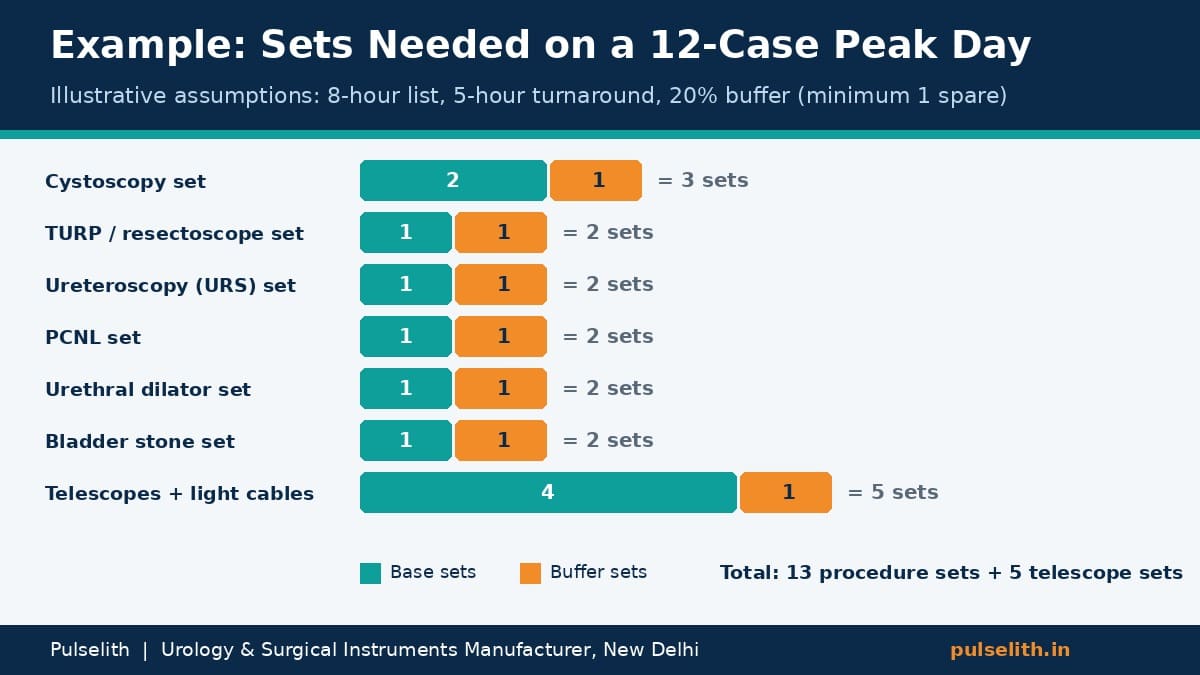
Telescopes and light cables are shared. Eight of the twelve cases (cystoscopy, TURP and URS) need a rigid telescope. The case-weighted average duration is 0.875 hours, so each telescope can be used twice a day. That gives 8 ÷ 2 = 4 base telescope and light-cable sets, plus 1 spare, so 5 in total.
For this example, the plan comes to 13 procedure sets and 5 telescope and light-cable sets. The result is only as good as its assumptions: if your CSSD can return sets in three hours, or if it takes eight, the numbers change substantially. That is why measuring turnaround first matters.
Do Not Forget Shared and High-Risk Items
Some items cut across every procedure and quietly become the bottleneck:
- Rigid telescopes: the most fragile and costly part of an endoscopy set, and often the slowest to repair. Plan an extra spare and handle them separately in the CSSD.
- Light cables, camera cables and electrosurgical cables: wear and cable damage can take a whole set out of use.
- Lithotripsy probes and handpieces: consumable-style parts that lose efficiency with use. Track usage and stock spares.
- Seals, gaskets and stopcocks: cheap parts that stop a set from working when they fail.
Ask each supplier what spare parts are available and what lead times to expect. A set with one failed small part is just as unusable as a set that is missing entirely.
Build Smaller, Smarter Sets
The cheapest way to reduce how many sets you need is to make each set better. Infection control commentary recommends reviewing which instruments are used most often and building streamlined sets around them, because fewer instruments per set means faster processing and no money wasted on rarely used items.
- Create a core set of the instruments used in nearly every case of that type.
- Keep occasional instruments in add-on modules that can be opened only when needed.
- Review set contents with the surgeons and CSSD team every few months.
- Make sure sheaths, obturators, bridges and telescopes are compatible across sets, so parts can be swapped when one fails. Our cystoscopy sheath buying questions explain what to check.
A Phased Buying Plan
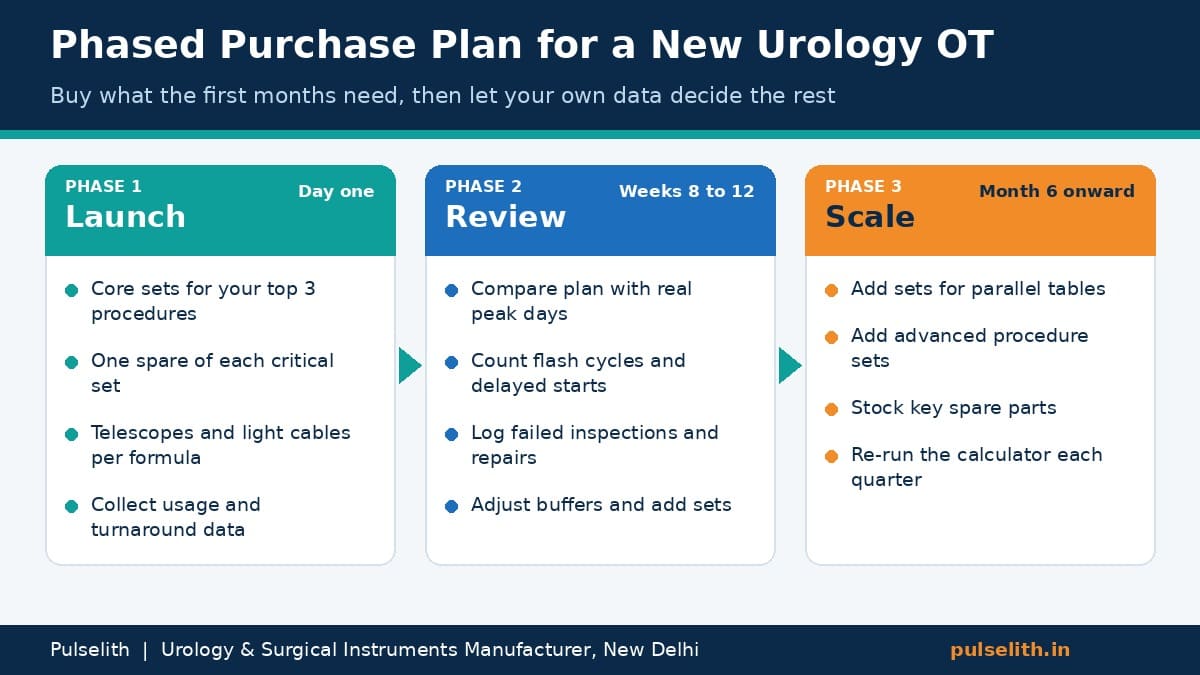
You do not have to buy everything on day one. A phased plan protects your budget while the department builds its volume.
- Phase 1, launch: buy core sets for your top three procedures, one spare of each critical set, and telescopes and light cables per the formula. Start recording actual cases, turnaround times and failures from the first week.
- Phase 2, review (weeks 8 to 12): compare your plan with real peak days. Count flash sterilization cycles, late starts caused by missing sets and instruments that failed inspection. Adjust buffers and add sets where the data shows a gap.
- Phase 3, scale (month 6 onward): add sets for parallel tables and advanced procedures, stock key spare parts, and re-run the calculator every quarter as volume grows.
Four simple numbers tell you whether you have the right quantity: flash cycles per month, cases delayed because a set was not ready, instruments withdrawn after inspection, and how often each set is used per day. If flash cycles and delays are near zero and utilization is healthy, you are close to right.
Common Mistakes When Sizing Instrument Sets
- Planning for the average day. The busiest day is the one that breaks the OT.
- Guessing turnaround time. Measure it with your CSSD before you buy.
- Ignoring CSSD hours. A single-shift CSSD returns fewer sets per day than a two-shift one.
- Relying on flash sterilization to cover a shortfall. CDC specifically advises against this.
- Making sets too big. Oversized sets take longer to process and hide unused instruments.
- Forgetting parallel tables. Two tables can mean two simultaneous sets even when volume is low.
- Skipping spares for optics. A single broken telescope can halt every endoscopic case.
- Not reviewing after launch. Real data beats any estimate.
Checklist Before You Place the Order
- Peak cases per day for each procedure, agreed with your urologists
- Average case duration for each procedure
- CSSD turnaround time, measured and signed off by the CSSD lead
- CSSD hours and sterilizer capacity checked against the plan
- Number of tables that can run the same procedure at the same time
- Buffer percentage and minimum spares agreed
- Core sets and add-on modules defined for each procedure
- Telescope, light cable and spare parts quantities confirmed
- Written instructions for use requested for every instrument
- Phase 1 and Phase 2 purchase quantities and review dates set
Equipping a new urology OT?
Send us your procedure list, peak cases per day and CSSD turnaround time. Our team will respond with a suggested set list and a quotation for Phase 1.
Choosing a Supplier for a New OT
Instruments you buy for a new OT will be cleaned and sterilized hundreds of times, so look beyond the unit price. Check that a supplier can provide:
- Consistent quality and finish across every set, so replacements match what you already own
- Compatibility across sheaths, obturators, bridges and telescopes
- Written instructions for use and reprocessing information
- Spare parts and repair support, with realistic lead times
- Valid quality certification, such as ISO 13485 and CE marking, that you can verify
These guides help with the evaluation: how to validate quality before a bulk order, which certifications matter, what to look for in a urology instruments manufacturer and Made in India vs imported urology instruments. If you buy through a tender, use our tender specification checklist. You can also browse our full urology instruments range, and if your hospital is also setting up gynecology services, see the hysteroscopy set-up guide.
Frequently Asked Questions
How many cystoscopy sets does a new urology OT need?
It depends on peak cases, case duration, turnaround time and how many tables run cystoscopies at once. Use the formulas above: the larger of simultaneous tables and cases divided by uses per set, plus a buffer. Never fewer than one spare.
Can we use flash sterilization instead of buying more sets?
No. CDC advises that flash sterilization should not be used for convenience, as an alternative to purchasing additional instrument sets, or to save time. It is meant for urgent situations that cannot be planned for.
How many telescopes and light cables should we buy?
Count the cases per day that need a telescope, work out how many uses each telescope gets between reprocessing cycles, and add at least one spare. Because telescopes are fragile and often slow to repair, many departments carry more spare optics than they do for ordinary instruments.
What turnaround time should we assume?
Measure it. Time one set through your own CSSD from the end of a case to a sterile set back in the OT. Use your real figure in the calculator, not a number from another hospital.
How often should we review our set quantities?
Review after the first 8 to 12 weeks, then every quarter during the first year, and again whenever you add a table, a procedure or a CSSD shift.
Should we buy all sets from one supplier?
One supplier can simplify compatibility between sheaths, obturators, bridges and telescopes and make spare parts easier to manage. Whichever route you choose, compare quality, certification, instructions for use and after-sales support, not just price.
Conclusion
The right number of instrument sets for a new urology OT comes from a short, honest calculation: peak cases, case duration, real turnaround time, simultaneous tables and a sensible buffer. Add a phased purchase plan and a quarterly review, and you avoid both the late lists that come from under-buying and the idle capital that comes from over-buying.
Ready to plan your urology OT instrument list?
AHCR is an ISO 13485 and CE certified manufacturer of urology, laparoscopy and gynecology instruments in Okhla, New Delhi. Share your requirement and we will respond with specifications and pricing.
Get a Quote Download the Calculator
Call +91 98109 86387 | Email info@pulselith.in
Disclaimer: this article is general planning information for hospital teams. The worked example uses illustrative assumptions, not benchmarks. Validate any estimate with your CSSD lead, infection-control team and surgeons, and follow each instrument’s instructions for use.
Sources and Further Reading
- Centers for Disease Control and Prevention (CDC). Flash Sterilization, Guideline for Disinfection and Sterilization in Healthcare Facilities (2008). cdc.gov
- Infection Control Today. Steps to Management of Surgical Instrumentation. infectioncontroltoday.com
- Infection Control Today. Quick Guide: Flash Sterilization Considerations. infectioncontroltoday.com
- Virginia Mason Institute. Case Study: Surgical Setup Reduction Improves Patient Outcomes. virginiamasoninstitute.org
- Belimed. Using PAR Levels in Inventory Management for CS. belimed.com
- World Health Organization. Decontamination and reprocessing of medical devices for health-care facilities. 2016. who.int





Leave a Reply