
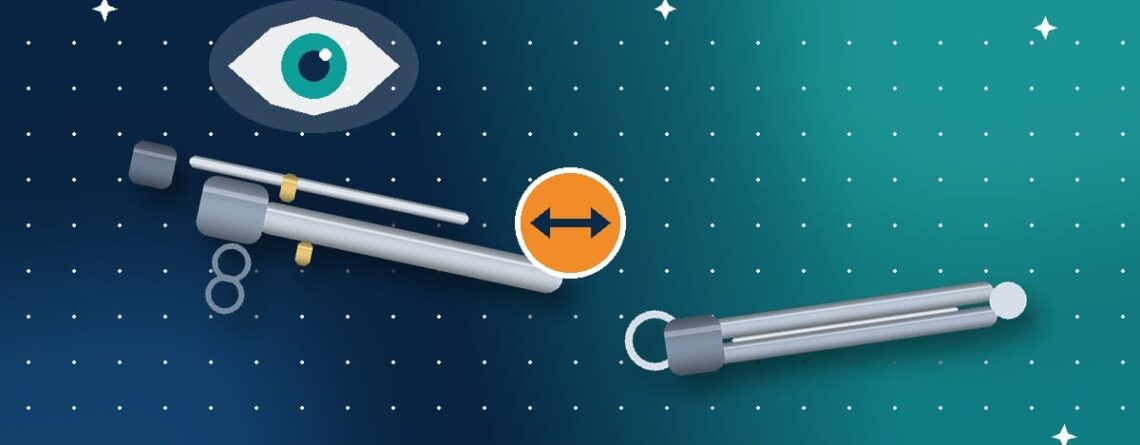
When a hospital sets up or upgrades its urology OT, the instrument list often includes an internal urethrotomy set, and the same question comes up: Sachse or Otis? The two names are often used as if they were two versions of the same instrument. They are not. They describe two different ways of cutting a urethral stricture from the inside, and they need very different equipment around them.
This guide explains the Sachse vs Otis urethrotome difference in plain terms, lists the components in a typical internal urethrotomy set, and gives procurement teams, OT managers and urologists a practical framework for choosing and ordering. It covers instruments and buying decisions only. Which technique is right for a particular patient is always a clinical decision for the treating surgeon.
Key takeaways
- A Sachse urethrotome is an optical, direct-vision instrument. It needs a telescope, a light source and irrigation.
- An Otis urethrotome is an older, blind, dilating instrument that works without optics.
- The set you buy must match the equipment you already own, especially the telescope.
- Check blade types, spare blade supply, sterilization compatibility and written instructions for use before ordering.
- Plan quantities from your case mix. Use our set planning guide and free calculator.
What an Internal Urethrotomy Set Is Used For
A urethral stricture is a narrowing of the urethra caused by scar tissue. Internal urethrotomy treats it by cutting the scar from inside the urethra, rather than through an open incision. The modern version of this procedure, performed under vision through a telescope, is called direct visual internal urethrotomy, or DVIU.
Current guidance shapes how often these sets are used. The American Urological Association guideline says surgeons may offer urethral dilation, DVIU or urethroplasty as the initial treatment for a short bulbar stricture under 2 cm. It also advises that urethroplasty, rather than repeated endoscopic treatment, should be offered for recurrent anterior strictures. A published review likewise describes DVIU as a first-choice option mainly for short bulbar strictures with minimal scarring, with no role for repeated urethrotomy. For hospital buyers, the practical point is that a urethrotomy set is a specialist item used on selected cases. It needs to be right, but you will rarely need a large number of them.
The Sachse Urethrotome: Optical, Direct Vision
The Sachse urethrotome is named after the German urologist Otto Sachse, who introduced the sharp-bladed cold-knife urethrotome used under direct vision in 1971. It became the basis of the DVIU technique that is widely described today.
In practice, the instrument is built around a telescope. In a published description of the technique, a guidewire is first passed beyond the stricture under cystoscopic vision. The Sachse urethrotome, with a 21 Fr sheath and a 0 degree telescope, is then advanced to the stricture with the knife drawn in, and the stricture is incised under vision. Because the surgeon sees the urethra throughout, the set depends on good optics, a light source and a steady flow of irrigation fluid.
Components of a Sachse Urethrotome Set
Exact contents vary between manufacturers, but a typical optical urethrotome set, based on a major manufacturer’s catalogue, includes the following.
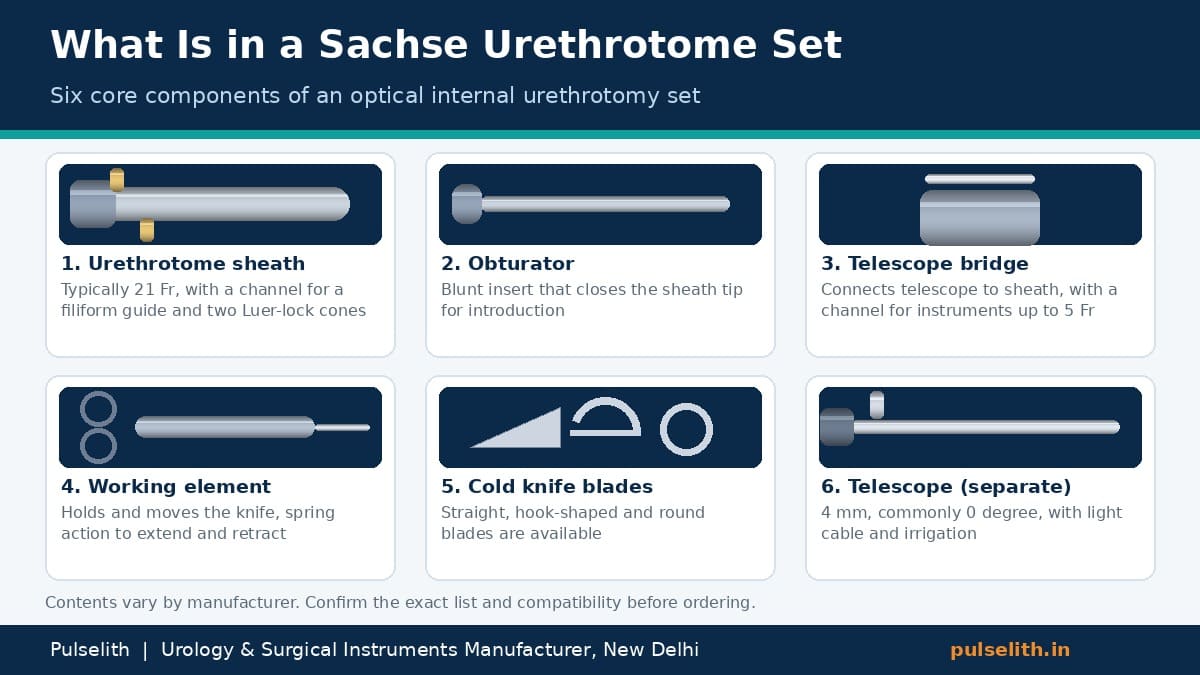
- Urethrotome sheath. Commonly 21 Fr, with a channel for a filiform guide and two Luer-lock cones for irrigation inflow and outflow. This is the outer tube that goes into the urethra.
- Obturator. A blunt insert that fills the sheath for introduction when the telescope is not in place.
- Telescope bridge. Connects the telescope to the sheath and typically carries a channel for instruments up to about 5 Fr.
- Working element. The mechanism that holds the knife and moves it forward and back, usually with a spring action and a thumb or finger grip.
- Cold knife blades. A straight knife is the classic Sachse blade. Hook-shaped and round knives are also offered. Blades are fine, sharp and need protection in storage.
- Telescope and light cable. A 4 mm telescope, commonly 0 degree, is used with the set. It is often bought separately and shared with other endoscopic procedures.
Some manufacturers also offer supplementary sheaths for continuous irrigation and suction, or for introducing a balloon catheter, and smaller-diameter urethrotome sets. Ask what is included in the quoted price and what is optional.
The Otis Urethrotome: Blind, Dilating
The Otis urethrotome dates from the 1870s and is named after the New York surgeon Fessenden Otis. His own description of the instrument explains that it combines dilatation with incision, and that the degree of dilatation is read from a scale near the handle, graded on the French scale.
The key difference is that it works without a telescope. One manufacturer describes the modern version as a device for blind transurethral incision of strictures, with adjustable ball, flat and conical tips, a circular marker for the extent of spreading, and a small blade that slides along the instrument’s rail. The surgeon relies on tactile feel and anatomical landmarks, usually with a guide in place.
Contemporary technique reviews of stricture treatment emphasise direct visualisation, for example placing the guidewire under vision with a rigid or flexible cystoscope, and note that with newer instrumentation blind dilation can be avoided. That is one reason the Otis is now seen as an older technique. Otis-type instruments are still listed in manufacturer catalogues, however, so hospitals do come across them in tenders and purchase lists.
Components of an Otis-Type Urethrotome
- Expanding body. The part that is introduced into the urethra and opened to a set diameter.
- Handle with calibration scale. Shows the amount of dilatation, usually in Fr.
- Blade or knife. Mounted on a thin wire or rail and advanced through the instrument.
- Interchangeable tips. Ball, flat or conical tips to suit different anatomies.
- Guide. Typically used with a filiform guide to direct the instrument.
Sachse vs Otis Urethrotome at a Glance
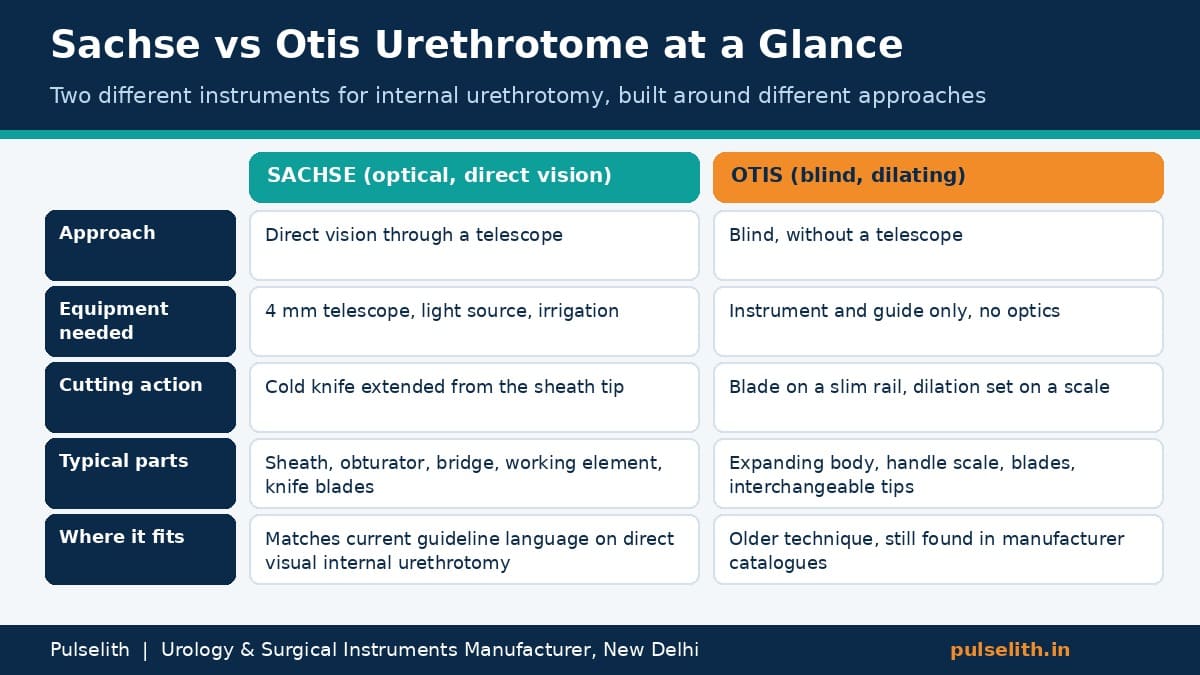
| Feature | Sachse (optical) | Otis (blind) |
|---|---|---|
| Approach | Direct vision through a telescope | Blind, without a telescope |
| Equipment needed | 4 mm telescope, light source and cable, irrigation, often a camera | The instrument and a guide, no optics |
| Cutting action | Cold knife advanced from the sheath tip | Blade on a rail, dilation set by a scale |
| Parts to manage | Sheath, obturator, bridge, working element, knives, plus optics | A single multi-part stainless steel instrument |
| Reprocessing | More components, channels and fine blades; telescope handled separately | Fewer parts, but still needs thorough cleaning of moving mechanisms |
| Upfront investment | Lower if you already own telescope and light source; higher if you must buy optics | Lower, as no optics are needed |
| Guideline language | Matches direct visual internal urethrotomy (DVIU) | Older technique, not the focus of current guidelines |
The comparison shows that this is not a like-for-like product choice. Buying a Sachse set means buying into an endoscopic workflow. Buying an Otis means buying a standalone instrument. The decision should start with how your surgeons practise and what equipment you already have.
How to Choose: A Buyer’s Framework
Because clinical selection belongs to the surgeon, procurement teams are best placed to confirm that the set can actually be used safely and reliably in their hospital. Work through these questions in order.
1. Start with your surgeons’ protocol
Ask the urologists which technique they use, which they plan to use in the new OT, and whether they have a preferred sheath size or blade. Do not choose a set to fit a price and then ask the surgeons to adapt.
2. Check your existing endoscopy equipment
A Sachse set needs a compatible telescope, light cable, light source and irrigation. If you already own cystoscopes and 4 mm telescopes, confirm that the urethrotome bridge and sheath accept them. Our cystoscope sheath size and compatibility chart and buying questions guide explain how sheaths, obturators, bridges and telescopes fit together.
3. Confirm sheath size and channels
The common urethrotome sheath is 21 Fr, but sizes and channel layouts differ between makers. Confirm the Fr size, the guide channel and the irrigation connections, and whether a smaller size is available if your case mix needs it.
4. Look at the blades
Cold knife blades are fine, sharp and wear with use. Ask which blade shapes are included, what is optional, how long replacements take to arrive and whether blades come with protection tubes for sterilization and storage.
5. Check the working element
The spring action should be smooth, the knife should extend and retract cleanly, and the mechanism should be designed for disassembly and cleaning. A stiff or sticky working element is a patient-safety and workflow problem.
6. Plan sterilization and reprocessing
Multi-part sets with channels and fine blades add work for the CSSD. Check autoclave markings, the manufacturer’s written instructions for use and whether the telescope is autoclavable. Our guide to sterilization of urology instruments covers the full cleaning and inspection cycle.
7. Plan quantities from your case mix
Estimate your peak-day urethrotomy cases, your CSSD turnaround and your buffer, then calculate the number of sets. Our guide to how many instrument sets a new urology OT needs includes a free calculator. For most departments, a specialist set like this needs one working set and one spare rather than a large stock.
8. Verify quality and certification
Ask for ISO 13485 and CE certificates and check them. Read how to validate quality before a bulk order and which certifications matter.
Need an internal urethrotomy set quoted?
Tell us which telescope and light source you already use, and the sheath size and blade types you need. We will confirm compatibility and send specifications and pricing.
Which Set Fits Which Situation?
| Your situation | What to consider |
|---|---|
| New urology OT with a full endoscopy tower | An optical Sachse set that fits your telescope, with spare blades and one spare set |
| Existing cystoscopy and TURP sets already owned | Check whether your telescope and bridge are compatible before buying optics again |
| Hospital without endoscopic equipment | Budget for a telescope and light source first, or discuss with your surgeons whether a different approach is intended |
| Tender with a stated technique | Follow the clinical specification and confirm the supplier can match it. See our tender specification checklist. |
| Low volume of urethrotomy cases | One working set plus one spare, and a reliable source of replacement blades |
Care, Cleaning and Sterilization of Urethrotome Sets
Urethrotome sets have narrow channels, a moving working element and fine knife edges, so they need careful handling. In general terms:
- Disassemble the sheath, bridge, working element and knife as the instructions for use specify.
- Flush the channels and Luer-lock cones, and brush where the design allows.
- Handle blades separately and protect their edges. Inspect for chips, dullness and bending.
- Check the working element for smooth spring action and clean its mechanism thoroughly.
- Keep telescopes separate from metal instruments, and follow the autoclave marking on each telescope.
- Dry fully and inspect before packaging.
For Otis-type instruments, pay particular attention to the expanding mechanism and scale, because debris can collect in moving joints. Our full reprocessing guide covers cleaning, inspection and sterilization in detail.
Common Buying Mistakes
- Treating Sachse and Otis as interchangeable. They need different equipment and suit different workflows.
- Assuming any telescope will fit. Confirm size, angle and bridge compatibility before ordering.
- Ignoring blade supply. A set with no reliable source of replacement blades quickly becomes unusable.
- Buying on price alone. Cheap instruments with poor finish or loose tolerances often cost more through repairs and replacements.
- Skipping the instructions for use. Your CSSD cannot reprocess a set properly without them.
- Over-ordering. This is a specialist set with limited volume, so size quantities to real demand.
- Forgetting the spares. Keep one spare set and spare blades to avoid cancelled cases.
Before You Order: A Checklist
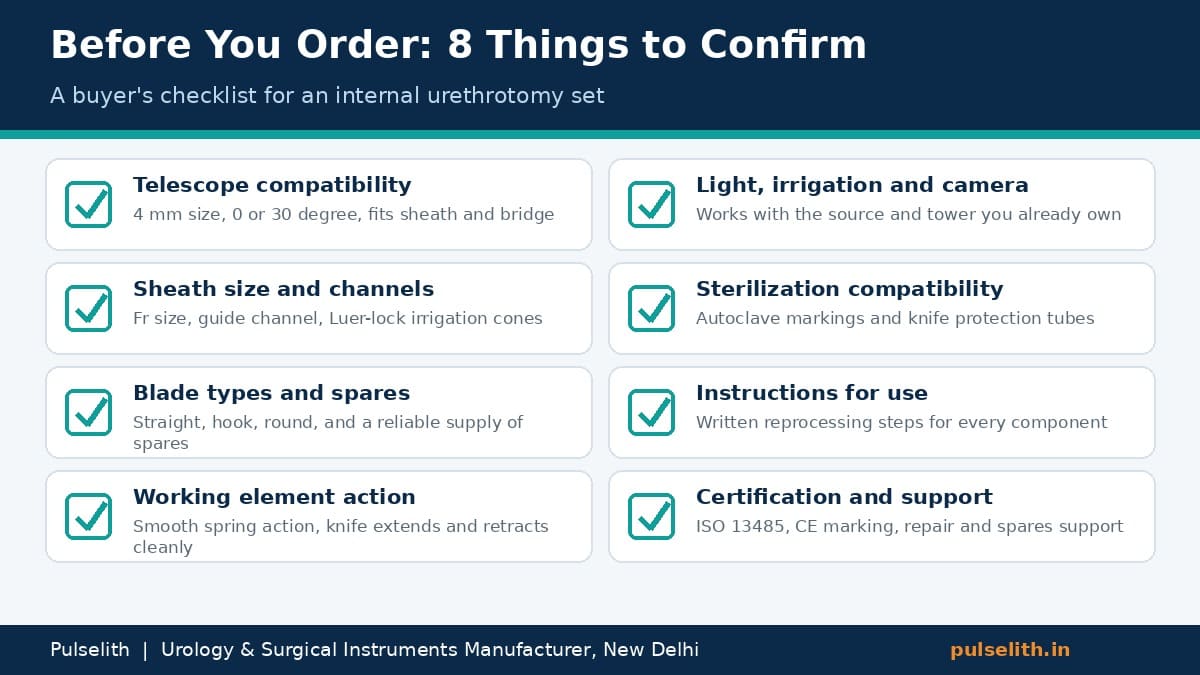
Before placing an order, confirm telescope compatibility, sheath size and channels, blade types and spares, working element action, light and irrigation connections, sterilization compatibility, written instructions for use, and the supplier’s certification and after-sales support. If any item is unclear, ask for it in writing.
Choosing a Supplier
An internal urethrotomy set is a precision instrument, so quality, compatibility and support matter more than the unit price. Look for a supplier that can show consistent finish, supply spare blades and parts, provide instructions for use, and hold valid ISO 13485 and CE certification. These guides help with the evaluation: manufacturer vs trader, what to look for in a urology instruments manufacturer and Made in India vs imported urology instruments. You can also browse our urology instruments range, including the bladder stone set and Teflon urethral dilator sets.
Frequently Asked Questions
What is the difference between a Sachse and an Otis urethrotome?
A Sachse urethrotome is an optical instrument used under direct vision with a telescope, a light source and irrigation. An Otis urethrotome is an older, blind, dilating instrument that works without a telescope. They need different equipment and suit different workflows.
What does a Sachse urethrotome set include?
Typically a urethrotome sheath (commonly 21 Fr) with a guide channel and Luer-lock cones, an obturator, a telescope bridge, a working element and cold knife blades. A 4 mm telescope and light cable are used with it and are often bought separately.
Which telescope is used with a Sachse urethrotome?
A 4 mm rigid telescope is commonly used, often 0 degree. Always confirm the size, angle and bridge compatibility with your supplier before ordering.
Can an Otis urethrotome replace a Sachse set?
They are different instruments for different techniques, so one does not simply replace the other. The choice is made by the treating surgeon according to the patient and the hospital’s equipment.
How many urethrotomy sets does a hospital need?
It depends on your case volume and CSSD turnaround. Many departments with a modest urethrotomy workload work with one working set and one spare, plus spare blades. Use our calculator to size it for your own numbers.
Are urethrotome sets reusable?
The sheath, obturator, bridge and working element are reusable stainless steel components, subject to the manufacturer’s instructions. Cold knife blades wear with use and need regular inspection and replacement. Always follow the written instructions for use.
Conclusion
Sachse and Otis are two very different instruments, not two versions of the same one. The Sachse is an optical, direct-vision set that depends on your endoscopy equipment, while the Otis is an older blind instrument that stands alone. Start with your surgeons’ technique, check compatibility with the telescope and light source you already own, confirm blade supply, sterilization and instructions for use, and size your quantities from real case numbers.
Looking for urethrotomy sets from an Indian manufacturer?
AHCR is an ISO 13485 and CE certified manufacturer of urology, laparoscopy and gynecology instruments in Okhla, New Delhi. Share your requirement and our team will respond with specifications, compatibility confirmation and pricing.
Get a Quote Browse Urology Instruments
Call +91 98109 86387 | Email info@pulselith.in
Disclaimer: this article is general information about instruments for hospital staff and buyers. It is not medical advice. Choice of technique and instrument is a clinical decision for the treating surgeon, and component lists vary by manufacturer. Always follow the manufacturer’s instructions for use and your hospital’s policies.
Sources and Further Reading
- American Urological Association. Urethral Stricture Disease Guideline (2016, amended 2023). auanet.org
- Opinion: Endoscopic Urethrotomy (history of Sachse’s cold-knife urethrotome under direct vision). ncbi.nlm.nih.gov
- Jhanwar A, et al. Holmium laser vs. conventional (cold knife) direct visual internal urethrotomy for short-segment bulbar urethral stricture: Outcome analysis. Canadian Urological Association Journal. pmc.ncbi.nlm.nih.gov
- Dubey D. The current role of direct vision internal urethrotomy and self-catheterization for anterior urethral strictures. Indian Journal of Urology. pmc.ncbi.nlm.nih.gov
- Urethral dilation and direct vision internal urethrotomy, technique review. pmc.ncbi.nlm.nih.gov
- Otis FN. A Description of the Instruments and Apparatus of the Author. New York, 1875. collections.nlm.nih.gov
- Surtex Instruments. Otis Urethrotome (product description). surtex-instruments.com
- Karl Storz. Optical Urethrotomes catalogue pages (component list used as an industry reference). catalogue extract




Leave a Reply