

Types, Sizes and How to Choose (Zero-Tip vs Helical, Nitinol vs Stainless Steel)
A stone retrieval basket is a small device that does an important job: it captures stones or fragments and brings them out through a scope. Choosing the wrong one wastes procedure time, can damage a scope, and in rare cases leads to a basket that will not release. The choice depends on the tip design, the wire material, the catheter size and, above all, whether the basket fits the working channel of the scope you use.
This guide explains how stone baskets work, compares tipless and helical designs and nitinol and stainless steel wires, shows how to read basket sizes against a working channel, and gives a checklist and free selection sheet for urology departments and procurement teams. It supports equipment planning and does not replace the clinical judgement of the treating urologist.
What a stone retrieval basket does
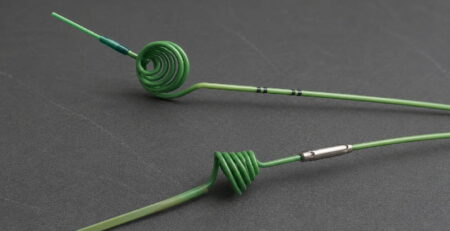
A basket is made of a handle, a long thin catheter or sheath, and a set of wires that form a cage at the distal end. The surgeon passes the closed basket through the working channel of a ureteroscope, nephroscope or cystoscope, opens it beyond the stone, captures the stone, closes the basket and withdraws it. Baskets are used for stones and fragments in the ureter, kidney and, via a bridge channel, the bladder. They are often used together with lithotripsy: the lithotripter breaks the stone, and the basket removes the fragments. See our guides to choosing a pneumatic lithotripter for URS and PCNL, probe sizes and pneumatic vs laser lithotripters.
Basket designs: tipless, helical and more
| Design | How it works | Strengths | Limits |
|---|---|---|---|
| Tipless (zero tip) | Wires meet at the end with no tip beyond them | Head-on approach, capture near the base of a calyx, avoids a protruding tip on the lining | Fine fragments may slip through between wires |
| Helical, with a tip | Wires spiral, with a tip at the end | Secure side capture of stones in a ureter | Stone usually enters from the side, and a tip can touch the lining |
| Flat-wire | Wires are flat rather than round | Stable opening in some designs | Behaviour varies by maker |
| Wire count (3, 4, 5 or 6) | More wires give more contact points | More wires can hold small fragments better | More wires can make the basket stiffer or bulkier |
For small or flat stones and for stones lying in large cavities where they can move away, tipless designs are often preferred because the wires can be placed over the stone from the front. Helical baskets are generally associated with entry from the side only. Manufacturers’ pages and published device descriptions describe these differences, but handling still varies by design, so test your preferred basket on the bench before you buy in bulk.
Nitinol vs stainless steel
- Nitinol is a superelastic nickel-titanium alloy. It resists kinking, returns to shape after repeated captures and can be made very slim, which suits flexible ureteroscopes. Nitinol baskets generally do not impair the deflection of a flexible scope.
- Stainless steel is strong and holds shape, and larger stainless steel baskets are common for semi-rigid and percutaneous work. Stainless steel wire is more prone to kinking when made very fine, which limits how slim and how large a stainless basket can be. Some stainless steel designs are described by their manufacturers as compatible with lithotripsy.
Neither material wins everywhere. Match the material to the scope, the stone and the manufacturer’s stated use, and check whether the basket is designed for retrieval only or also for use with a laser or probe.
Basket sizes and working channel fit
Basket catheter size is given in French (Fr). One Fr is one third of a millimetre, so divide by 3 to get millimetres, as in our cystoscope sheath size chart. Basket sizes you will see range from about 1.3 Fr to 3 Fr for slim nitinol baskets, with larger 4 to 5 Fr baskets used where the channel allows. A separate figure is the opened basket’s diameter, for example 12 mm or 16 mm for common 2.4 and 3.0 Fr baskets.
The rule is simple: the basket’s Fr size must be smaller than the scope’s working channel. The clearance left over carries irrigation fluid. In manufacturer data for a 3.6 Fr channel, a 1.9 Fr basket sheath gives 41 percent more irrigation flow than a 2.2 Fr sheath (Boston Scientific), which shows why slimmer is often better for flexible scopes. Larger baskets give a bigger capture diameter, so the trade-off is irrigation versus stone size. The free sheet below includes a fit checker.
Choosing a basket by procedure
These are starting points to discuss with your urology team, not clinical recommendations. For bladder stones, see our guide to bladder stone lithotripsy options and the Bladder Stone Set. For percutaneous work, see the PCNL instrument checklist and what a complete PCNL set includes. For the practical side of ureteroscopy, read common challenges during ureteroscopy.
Safe use and entrapment
Baskets are small, delicate devices, and misuse can cause problems. Retained or broken baskets are a recognised complication, and published case reports describe an embedded basket that needed laser incision and combined endoscopic and percutaneous retrieval (case report). To reduce risk:
- Choose a basket whose size and capacity suit the stone and the channel.
- Do not force a basket to open, close or withdraw, and do not capture a stone that is too large to pass the ureter.
- Know the release method before you start: some handles can be detached, and the instructions for use describe how.
- Inspect the basket before use for kinks, broken wires or a damaged handle.
- Keep a spare basket and an alternative method, such as a laser, available.
Decisions during a procedure belong to the treating urologist. Our guide to lithotripter spare parts and troubleshooting shows how to plan spares so that equipment failure does not stop a list.
Single-use, reusable and reprocessing
Some baskets are single-use, and others are designed for reuse after reprocessing, depending on the manufacturer and the design. Ask the supplier which applies to the basket you are buying, because it affects cost per case and your CSSD workload. If a basket is reusable, follow the instructions for use for cleaning, inspection and sterilisation, and inspect the wires and handle on every cycle. Our CSSD guide to sterilization of urology instruments covers the principles.
Buying checklist: questions to ask your supplier
| Question | Why it matters |
|---|---|
| Which catheter sizes (Fr), lengths (cm) and basket diameters (mm) are available? | Must fit the working channel and the stone size |
| How many wires, and from which material? | Affects strength, flexibility and grip |
| Is it tipless, helical or open-ended? | Affects stone capture and contact with the lining |
| Can the handle release or detach in an emergency? | Helps manage an entrapped basket |
| Single-use or reusable, and how is it reprocessed? | Cost per case and CSSD workload |
| Is it compatible with lithotripsy? | Not every basket is designed for use with a laser or probe |
| Which instructions for use and certificates are supplied? | Training, audits and import |
For wider supplier checks, read what to look for in a urology instruments manufacturer and how to validate quality before a bulk order.
AHCR stone basket range
AHCR (Advanced Health Care Resources) is an ISO 13485 and CE certified urology instrument manufacturer in Okhla Industrial Area, New Delhi. It lists a four-wire, zero-tip stainless steel stone retrieval basket in 3, 4 and 5 Fr. Send your scope make, model and working channel size, and the team will confirm which size fits.
- Zero-tip stone retrieval basket
Four-wire, stainless steel, in 3, 4 and 5 Fr. - Pneumatic lithotripter
With probes for breaking stones before retrieval. - PCNL sets
Needles, dilators, sheaths and forceps for percutaneous access. - Bladder Stone Set
Stone punch, sheath and accessories for bladder stones.
Browse the urology instruments range or the full catalogue. Buying from overseas? Read how to import surgical instruments from India, what makes a reliable exporter and our OEM guide.
Free stone basket selection sheet
Use our editable workbook to check basket and scope fit, convert Fr to mm, list the baskets you need and record your supplier’s answers. It has a fit checker with a clearance calculation, an order sheet with dropdowns and a nine-question supplier checklist.
Frequently asked questions
What is a zero-tip stone retrieval basket?
A zero-tip, or tipless, basket has wires that meet at the end of the basket without a tip extending beyond them. That lets the surgeon approach and capture a stone head-on, including close to the base of a calyx, and avoids a protruding tip touching the lining of the collecting system.
Nitinol or stainless steel: which basket wire is better?
Neither is better in every case. Nitinol is superelastic and kink-resistant, so it holds its shape after repeated captures and suits slim baskets for flexible scopes. Stainless steel is strong and holds shape well in larger baskets, and some stainless steel designs are made for use with lithotripsy. Choose by the scope, the stone and the manufacturer’s instructions for use.
How do I know whether a basket fits my scope?
The basket’s catheter size in Fr must be smaller than the scope’s working channel in Fr, ideally with clearance for irrigation. For example, a 1.9 Fr basket passes through a 3.6 Fr channel with room to spare, but a 4 or 5 Fr basket needs a larger channel. Confirm with the scope and basket instructions for use.
Does a smaller basket catheter improve irrigation?
Yes. A slimmer catheter leaves more room in the working channel for irrigation fluid. In one manufacturer’s data for a 3.6 Fr channel, a 1.9 Fr basket sheath gives 41 percent more irrigation flow than a 2.2 Fr sheath. Larger baskets give a bigger capture diameter, so there is a trade-off.
What should I do if a basket becomes entrapped?
Stop, do not pull hard, and follow the basket’s instructions for use, which may describe releasing the stone or disengaging the handle. Retained or broken baskets are a recognised complication and may need laser or combined endoscopic and percutaneous retrieval, so the decision belongs to the treating urologist.
Are stone baskets single-use or reusable?
It depends on the design and the manufacturer. Ask the supplier whether the basket is single-use or reusable, and follow its reprocessing instructions if it is reusable. Our CSSD guide covers reprocessing principles for reusable urology instruments.
Does AHCR supply stone retrieval baskets for export?
AHCR lists a four-wire, zero-tip stainless steel stone retrieval basket in 3, 4 and 5 Fr. AHCR is a New Delhi manufacturer that exports to the Asia-Pacific region, the Middle East, Africa and the Americas. Send your scope details and quantity through the contact page for a quotation.
Need help choosing a basket?
Send your scope details, the procedures you perform and the quantity you need. We will confirm sizes, fit and a quotation.
This guide is general information for equipment planning. It is not medical advice. Choosing and using a stone basket is a clinical decision for the treating urologist, who should follow the manufacturer’s instructions for use and local guidelines.






Leave a Reply