
Virtual Factory Audit Checklist for Overseas Buyers of Surgical Instruments from India
A certificate proves very little until you have seen the factory behind it. For overseas hospitals, distributors and importers, a virtual factory audit is now the fastest practical way to check an Indian surgical instruments manufacturer before the first order, without the cost and delay of flying out.
This guide gives you a five-step audit process: what documents to request, how to run a live video walk-through, which production stations to see, how to test samples, and how to score the supplier. It ends with a free workbook you can use on your own audit. It is written for buyers, quality managers and procurement teams.
Why audit a surgical instruments supplier before you order
Surgical instruments look similar on a datasheet and differ enormously on the bench. The differences are in places you cannot see in a catalogue: the steel grade, the finishing and passivation, the inspection discipline and the way records are kept. A weak supplier shows up later as corroded jaws, misaligned joints, mixed-up lots and shipments held at customs.
If you are a distributor, an audit also supports your own compliance. Quality systems built on ISO 13485 expect you to evaluate and monitor your suppliers (clause 7.4, purchasing), and an audit record is the evidence. Our guides on which certifications Indian manufacturers need, manufacturer vs trader and validating quality before a bulk order cover the surrounding checks.
What a virtual audit can and cannot prove
Remote auditing is now an accepted method. ISO 19011, the international guideline for auditing management systems, was revised in 2026 and formally covers remote methods such as video walk-throughs, screen-sharing of electronic records and remote interviews. It also expects the audit report to state which methods were used and what limits they imposed on the evidence.
Be honest about those limits:
- It can show whether the facility exists, whether the process matches the documents, and whether records are real and retrievable.
- It cannot easily show fine surface defects, material hardness, the smell of a chemical process, or what happens when you are not watching.
- It can be staged. A pre-recorded tour or a rehearsed walk proves little. The controls in this guide, such as choosing the batch to trace, exist to prevent that.
Use a virtual audit to qualify a supplier, then confirm with samples, tests and a small first order.
The five-step process
Step 1: Request documents before the call
Send the request list a week ahead so the supplier has time to prepare, and so you can compare documents against each other before the call. Check the following:
| Document | What to check |
|---|---|
| ISO 13485 certificate | Company name and address match, the scope covers your products, issued by an accredited certification body, still valid |
| CE certificate or declaration of conformity | Devices covered, device class and notified body where one applies |
| Indian manufacturing licence | Licence number and listed devices. State authorities license Class A and B (Form MD-5) and CDSCO licenses Class C and D (Form MD-9). Some low-risk devices are exempt, so ask which applies |
| Importer Exporter Code (IEC) | Matches the legal company name on the invoice |
| Factory layout and process flow chart | Matches what you see later on video |
| Raw material certificates | Stainless steel grade and batch for a recent order |
| Inspection and calibration records | Signed, dated, and consistent with the batch |
| Traceability sample | One recent lot traced from raw material to dispatch |
| Complaint and corrective action summary | Shows complaints are logged, investigated and closed |
| Export references | Shipments to your region and two buyer contacts |
The workbook below lists 17 documents with columns for received and checked status.
Step 2: Hold a document review call
Use the first call to test whether the documents tell one consistent story. Ask the quality manager:
- Which product families does the ISO 13485 scope cover, and which licence covers each?
- Where is each production step done, and which steps are outsourced?
- Which steel grades do you use, and who supplies them?
- How do you inspect incoming material and final product?
- Which standards or internal specifications do you test to?
- How do you assign and record lot numbers?
- What was your last customer complaint and how was it closed?
- Which markets do you export to, and which registrations support them?
Prepare before the call
- Agree the scope. List the products, the stations and the documents you want to see.
- Choose the auditor. Use someone with a quality or biomedical background, not only a buyer.
- Test the technology. Check the camera, connection and language, and agree a backup channel.
- Handle confidentiality. Sign a short NDA if the supplier requests one, and agree what may be recorded.
- Share the checklist. A supplier that knows the standard in advance can prepare honestly.
Note outsourced steps carefully. Outsourcing is normal, but it should be controlled, and it changes what you need to audit. Our guide to what to look for in a urology instruments manufacturer adds more questions.
Step 3: Run the live video walk-through
This is the core of the audit. Follow the route the product follows through the factory, and ask to see specific evidence at each station.
How to keep the tour genuine
- Use a live call and ask the host to carry the camera continuously, without cuts.
- Choose the route. Ask to see a station you pick, or to turn the camera back to something you spotted.
- Pick the batch. Name a lot number from the samples or documents and ask to see its records.
- Zoom in. Ask for close-ups of calibration labels, material labels and finishing on a part.
- Trace a lot live. Follow one lot from raw material to dispatch. A real quality system finds the records in minutes.
- Record the call with the supplier’s consent, and note which stations were not shown.
Sample agenda for the video call
Adapt the times to the size of the factory. The agenda is indicative, and a larger site needs more time.
| Segment | What happens | Who joins |
|---|---|---|
| Opening | Confirm scope, stations to be shown and recording consent | Auditor, quality manager |
| Walk-through | Follow the eight stations, with close-ups and the batch you choose | Auditor, a guide carrying the camera |
| Records review | Screen-share inspection, calibration and traceability records | Auditor, quality manager |
| Live trace | Trace one lot from raw material to dispatch | Auditor, quality and production staff |
| Closing | Summarise findings, agree actions and dates | Auditor, management |
Mark each check as Pass, Minor gap, Major gap or Not shown. The workbook has 20 ready-made checks across the ten stations, including the traceability test.
Step 4: Order samples and test them
A video shows the process. Samples show the product. Order a few pieces of each critical item and inspect them on arrival, or send them to an independent laboratory or inspection agency. For standards, ask the supplier which ones apply to each item. Common references include:
- ISO 7153-1, covering the metals used to make surgical instruments.
- ISO 13402, the test methods for resistance of stainless steel hand instruments to autoclaving, corrosion and thermal exposure (latest edition 2025).
- ISO 7151, general requirements and test methods for non-cutting, articulated instruments (2024).
Some of these standards are written for general hand instruments, and endoscopic accessories may have manufacturer specifications instead. What matters is that the supplier can name what they test to and show the results. Read how to validate quality before ordering bulk surgical instruments for a bench-inspection routine.
Step 5: Score the supplier and decide
Scoring turns impressions into a decision you can defend. Score seven areas from 0 to 5, apply weights, and read the result against decision bands. A critical gap overrides the score.
After the audit
- Write a short report that states the methods used, what was shown, what was not shown and the evidence seen.
- Share the findings with the supplier and agree corrective actions and due dates.
- Ask for evidence of closure, such as updated records or certificates.
- Decide whether to proceed, re-audit or visit the site.
- Place a small first order and inspect it before scaling up.
Log every gap with an owner and a due date, and ask for evidence of closure. A supplier that fixes small gaps quickly and honestly is often a better bet than one that appears flawless. Then place a small first order before you commit to volume. Our guide on how to import surgical instruments from India covers contracts, payment terms and shipping, and the tender specification checklist helps if you buy through procurement rules.
Red flags during a virtual audit
- Refusing a live walk-through, or insisting on a pre-recorded video.
- Certificates in a different company name or address from the facility.
- No lot numbers, or records that cannot be found when you pick a batch.
- Gauges without calibration labels, or no inspection records.
- Unmarked material with no link to certificates.
- Reluctance to name outsourced processes.
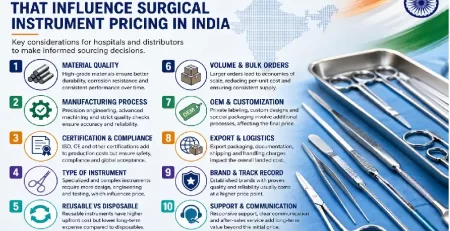
- Prices far below market with no explanation. See what drives surgical instrument pricing in India.
- No written warranty or complaint process.
Free virtual factory audit workbook
We built an editable Excel workbook for this audit. It includes a 17-item document request list, 20 video walk-through checks with colour-coded results, a weighted scorecard with a suggested decision for up to three suppliers, and a corrective action log.
Working with AHCR on supplier verification
AHCR (Advanced Health Care Resources) is an ISO 13485 and CE certified manufacturer based in Okhla Industrial Area, New Delhi, supplying hospitals, clinics and distributors in India and overseas. Buyers who want to verify a supplier can send AHCR their request: the documents they want, the products in scope and the stations they want to see. The team will confirm what can be shared and arrange a call.
- Pneumatic lithotripter
With probes, handpiece and spares for your first order. - 400W bipolar TURP system
Normal saline bipolar resection, with a monopolar option. - Stone punch set
Bladder stone set with sheath, obturator and cystoscope. - Urology instruments range
PCNL sets, cystoscopy sets and accessories. See the full catalogue.
Read how we support overseas buyers in what makes a reliable urology instruments exporter, exporting urology instruments from India, why hospitals worldwide source urology instruments from India and our OEM guide.
Frequently asked questions
What is a virtual factory audit?
A virtual factory audit is a remote assessment of a manufacturer using document review and a live video walk-through of the facility. The buyer checks certificates and records, watches the production route in real time, and scores the supplier before placing an order.
Can a virtual audit replace an on-site visit?
Not for every purchase. A virtual audit is an efficient way to qualify a supplier and decide whether a visit is needed. For high-value, high-risk or long-term contracts, many buyers still add an on-site audit or a third-party inspection.
How do I stop a supplier staging the video tour?
Use a live call, not a pre-recorded video. Choose where the camera goes, ask for a batch you select, trace that lot from raw material to dispatch, and compare what you see with the documents you received. A genuine factory can produce records within minutes.
What documents should I request before the audit?
Ask for the ISO 13485 certificate, CE certificate or declaration of conformity, Indian manufacturing licence, Importer Exporter Code, factory layout and process flow, material certificates, inspection and calibration records, a traceability sample, test reports and export references.
Which standards apply to surgical instruments?
Common references are ISO 7153-1 for metals used in surgical instruments, ISO 13402 for resistance to autoclaving, corrosion and thermal exposure, and ISO 7151 for non-cutting articulated instruments. Ask the supplier which standards or internal specifications they test each product against.
How long does a virtual factory audit take?
A focused audit usually needs a document review call of about one hour and a live video walk-through of a couple of hours, plus time to review records and score the supplier. Agree the schedule and the stations to be shown in advance.
Does AHCR support buyer audits and verification?
AHCR is an ISO 13485 and CE certified manufacturer based in Okhla Industrial Area, New Delhi. Send your audit request through the contact page, including the documents you want to see, and the team will confirm what can be shared and arrange a call.
Ready to verify a supplier?
Tell us which products you need and what you want to check. We will reply with certificates, specifications and a call to walk you through the facility.
This guide is general information, not legal or regulatory advice. Follow your own quality procedures and the regulations in your market.






Leave a Reply