
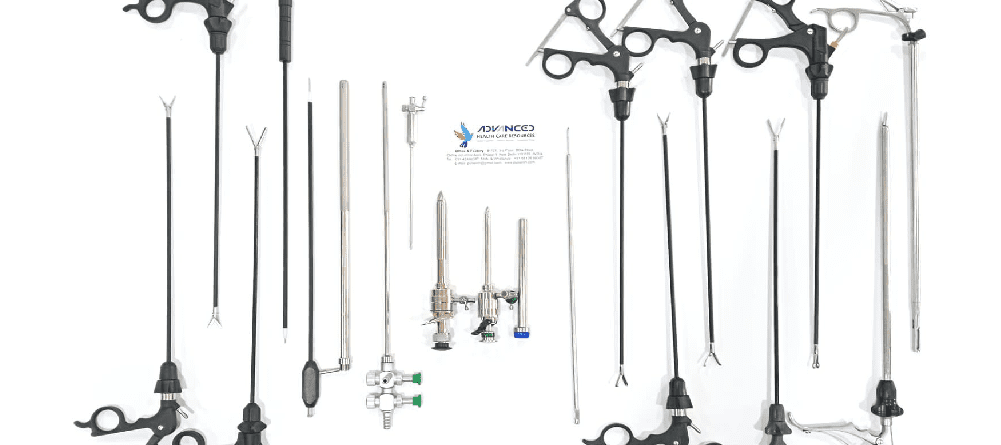
The Precision Engineering of Modern Laparoscopic Instruments
1. Metallurgical Foundations: Advanced Steel Selection
The life of a laparoscopic instrument begins with raw metallurgy. Because these tools feature incredibly thin cross-sections (often fitting through a 5 mm or 10 mm trocar) yet must exert significant mechanical force, material selection is uncompromising.
Manufacturers rely primarily on specialized surgical-grade stainless steels and advanced alloys, selected based on the instrument’s specific function:
- Martensitic Stainless Steel (e.g., 420 and 440C): Used primarily for cutting edges (scissors, dissectors). These steels feature higher carbon content, allowing them to be heat-treated to extreme hardness (often measured on the Rockwell C scale as 50–56 HRC). This ensures scissors maintain a razor-sharp edge through hundreds of cutting cycles.
- Austenitic Stainless Steel (e.g., 316LVM): The “VM” stands for Vacuum Melted—a process that removes microscopic impurities. This steel is exceptionally corrosion-resistant and ductile, making it perfect for instrument shafts, outer sheaths, and internal pull-rods that experience constant tension and flexion.
- Precipitation-Hardening Steel (e.g., 17-4 PH): Combining high tensile strength and excellent corrosion resistance, 17-4 PH is frequently used for complex, load-bearing internal linkages and jaw hinges.
2. Sub-Micron Machining and Micro-Fabrication
Transforming raw bar stock into intricate jaw mechanisms requires a combination of ultra-precise manufacturing technologies. Standard milling cannot achieve the sub-micron tolerances required for a grasper jaw that must perfectly close without pinching or slipping.
Instrument Component Fabrication Workflow
Swiss CNC Turning and Milling
The outer shafts and main components are typically machined on Swiss-style CNC lathes. Unlike traditional lathes, a Swiss CNC moves the material along the Z-axis while holding it rigidly through a guide bushing. This eliminates deflection, allowing engineers to machine long, incredibly thin tubes with tolerances as tight as ±0.005 mm.
Electrical Discharge Machining (EDM)
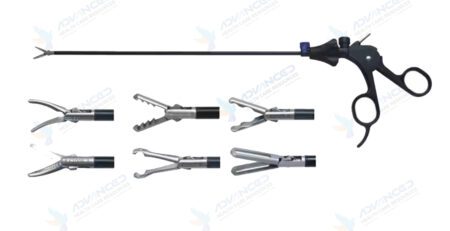
For the intricate teeth of a grasper or the complex geometry of a multi-axis hinge, manufacturers utilize Wire EDM. This process uses a microscopic wire (often thinner than a human hair) to erode material using precisely controlled electrical sparks. Because EDM exerts zero mechanical force on the part, it prevents warping and allows for incredibly sharp internal corners that would be impossible to create with a physical drill bit.
Laser Micro-Welding
Modern laparoscopic instruments often feature articulating tips (especially in robotic surgery). Joining these minuscule components requires Nd:YAG or fiber laser welding. These lasers deliver concentrated energy to a highly localized zone, creating deep, structurally sound welds without overheating and distorting the surrounding metal structure.
3. Surface Engineering: Passivation and Coating
Freshly machined steel is highly vulnerable. Microscopic iron particles left behind by cutting tools can cause rust, and the reflective metallic surface can create a blinding glare under intense OR endoscopic lighting. Surface engineering addresses these vulnerabilities.
Chemical Passivation (ASTM A967)
Passivation is a critical chemical process that strips free iron from the surface of the instrument using nitric or citric acid baths. Removing this iron allows the chromium within the stainless steel to react with atmospheric oxygen, forming a continuous, microscopic chromium oxide (Cr2O3) passive layer. This invisible shield is what actually makes the steel “stainless” and resistant to bodily fluids.
Advanced Vapor Deposition Coatings
To improve performance and longevity, premium instruments undergo Physical Vapor Deposition (PVD) or Diamond-Like Carbon (DLC) coating.
- DLC Coatings: Provide an incredibly low coefficient of friction and extreme hardness. This prevents “galling” (mechanical wear from friction) in the moving joints of the jaws.
- Anti-Reflective Finishes: A matte PVD layer (often titanium nitride or aluminum titanium nitride) darkens the instrument, eliminating glare from the laparoscope’s light source and reducing surgeon eye fatigue.
4. The Gauntlet: Multi-Phase Quality Control
Quality assurance in surgical manufacturing operates on a zero-failure philosophy. A single burr, microscopic crack, or loose joint can have catastrophic consequences during a cholecystectomy or colectomy.
| Inspection Method | Technology / Protocol | Target Defect Prevented |
|---|---|---|
| Automated Optical (AOI) | High-res vision & CMM systems | Dimensional variances outside CAD specs (μm level) |
| Non-Destructive (NDT) | Fluorescent Penetrant Inspection (FPI) | Microscopic surface cracks and material stress fractures |
| Functional & Tactile | Manual master-craftsman review | Hinge friction, poor handle haptics, jaw misalignment |
5. Designing for Sterilization Durability
An exceptional laparoscopic tool must perform flawlessly not just once, but across hundreds of operating room cycles. This means withstanding the brutal environment of autoclave reprocessing.
Between every surgery, reusable instruments undergo a harsh cleaning and sterilization regimen:
Thermal and Hydrolytic Resistance
Steam autoclaving subjects instruments to repeated thermal shock and moisture saturation. If the thermal expansion coefficients of the metal shaft and the internal plastic insulation do not match, the instrument will warp or crack. Manufacturers carefully select high-performance polymers like PEEK (Polyetheretherketone) or Radel® (PPSU) for the outer insulation sheath because they maintain structural integrity and electrical insulation properties up to 140°C.
High-Voltage Insulation Integrity
Because laparoscopic instruments are frequently attached to electrosurgical generators (monopolar or bipolar energy used to cut and coagulate tissue), the insulation must be flawless. Manufacturers test this using high-voltage dielectric breakdown testing, blasting the insulation sleeve with up to 3,000V to ensure there are no microscopic pinholes where current could leak and accidentally burn adjacent organs.
Also read:
Quality standards for laparoscopic equipment manufacturing
FAQ about surgical instrument manufacturing in India
Understanding ISO Certification in Surgical Instrument Manufacturing
Conclusion: A Symphony of Engineering
The manufacturing of high-precision laparoscopic instruments is an intricate bridge between metallurgy, micro-machining, and human biology. By combining strict material standards like 316LVM steel with cutting-edge Wire EDM fabrication, protective passive layers, and rigorous dielectric testing, medical device manufacturers ensure that when a surgeon makes a critical movement, the instrument responds with absolute, unyielding fidelity.




Leave a Reply