
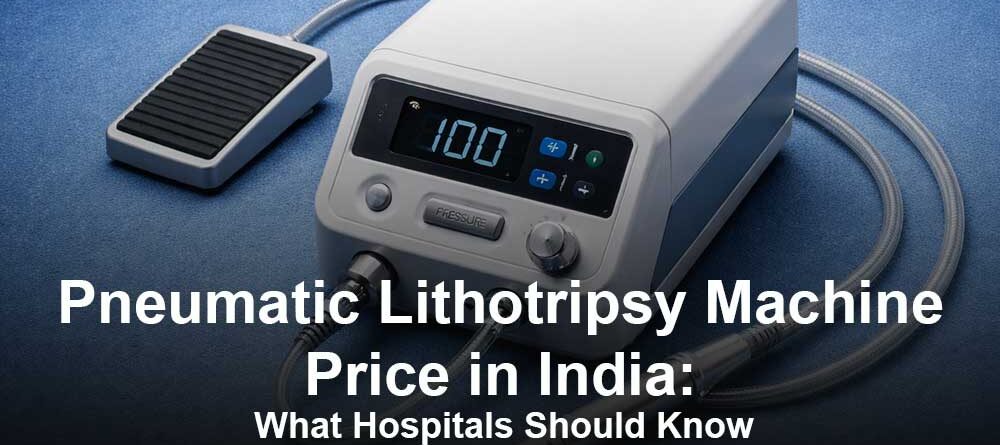
Buying a pneumatic lithotripsy machine is more than checking a price tag — it’s balancing clinical needs, total cost of ownership, safety, and long-term serviceability. This guide gives hospital procurement teams a clear, practical breakdown of Pneumatic Lithotripsy Machine Price in India, plus buying tips, import vs Indian model comparisons, and maintenance cost factors you’ll want to budget for.
Quick Overview: what “pneumatic lithotripsy” means for hospitals
Pneumatic lithotripsy refers to a technology that uses compressed-air–driven probes to fragment urinary tract stones during endoscopic procedures. These devices are commonly used alongside ureteroscopes and cystoscopes for intracorporeal stone fragmentation. They are different from extracorporeal shock wave lithotripters (ESWL), which are large, table-mounted systems that break stones from outside the body.
Headline price ranges (practical snapshot)
When procurement teams ask “what does a pneumatic lithotripsy machine cost in India?” the short answer is: it depends on the type, features and whether it’s an Indian-made unit, an imported mid-range model, or a high-end international brand. Based on suppliers and listings from Indian marketplaces and government tenders, common price bands are:
- Basic Indian intracorporeal pneumatic units / tabletop machines: approximately ₹30,000 – ₹150,000. These are compact units intended for routine ureteroscopic stone fragmentation and are widely available from Indian manufacturers and distributors. :contentReference[oaicite:0]{index=0}
- Advanced digital/standalone pneumatic lithoclast sets with multiple probes, footswitches and digital controls: roughly ₹90,000 – ₹600,000, depending on brand and probe set. :contentReference[oaicite:1]{index=1}
- Imported or integrated systems and high-end intracorporeal lithotripters (European manufacturers, specialty models or units sold on platforms for larger hospitals): prices can range from <strong₹500,000 up to ₹3,000,000 (and above for some integrated systems listed in government tenders). These tend to be either imported devices or local distributors selling premium brands.
Note: these bands combine data from product listings, distributor pages and government procurement records to reflect the breadth of options hospitals encounter. Specific models will vary by features, probe compatibility and warranty/after-sales offerings.
Why prices vary so much — the key drivers
Three main factors explain the wide price spread:
1. Core device type and feature set
- Basic pneumatic generators are simple air/hammer-driven units with manual controls — inexpensive and highly serviceable.
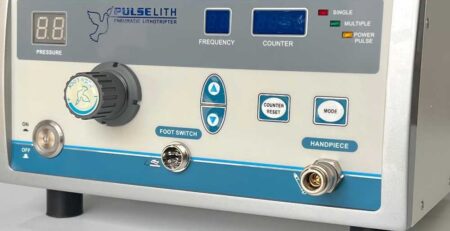
- Advanced units add digital displays, variable pulse control, integrated irrigation control, compatibility with more probe sizes, and ergonomics — each added capability increases price.
2. Brand, country of origin and certifications
- Imported European or US models (or those distributed by international brands) typically carry premium pricing due to brand, certification, and import duties. They often include robust global service networks, validated probes and longer warranty packages.
- Indian manufacturers offer lower prices due to local production, lower overheads, and streamlined supply chains — but the quality and after-sales can vary by vendor.
3. Probes & consumables
- The system price may be low, but probe cost (single-use or reusable) and tip configurations affect long-term costs. Some premium probes have higher performance and longer life but are pricier per unit.
Import vs Indian models — a detailed comparison
Hospitals often face a strategic choice: buy an imported device (or an internationally branded model) or a locally manufactured one. Here’s a practical breakdown of trade-offs.
Imported models (European / US / established international brands)
- Advantages:
- Often stricter factory QA and internationally recognized certifications (CE, FDA registration in the supply chain).
- Consistent performance across batches and widely validated clinical evidence.
- Availability of standardized accessory kits and spare parts through authorized distributors.
- Feature-rich controls and ergonomics suited for high-volume tertiary centres.
- Disadvantages:
- Higher upfront cost (import duties, distributor margins, and currency-linked pricing).
- Annual maintenance contracts (AMCs) from authorized service providers can be pricier.
- Parts replacement may involve longer lead times if stock is not kept locally.
Indian-made models
- Advantages:
- Lower initial capital outlay — many models in India start as low as ₹30,000–₹100,000 for intracorporeal pneumatic units.
- Easier local service, quicker part replacements and potential for competitive AMCs.
- Customization flexibility — private labelling, probe options, and packaging tailored to buyer needs are common.
- Disadvantages:
- Quality and longevity vary by manufacturer — some low-cost units may need more frequent servicing or have limited probe compatibility.
- Some Indian manufacturers focus on value rather than premium features (e.g., basic controls vs digital variable pulse control).
Bottom line: if you are a high-volume tertiary hospital or a referral center performing complex endourology cases, the reliability, validated performance and global warranty of premium imported units may justify the higher capital spend. For district hospitals, smaller private clinics or outreach programs where budget is constrained, high-quality Indian units offer strong value and lower total cost of ownership when sourced from reputable suppliers.
Breaking down the total cost of ownership (TCO)
Procurement decisions should consider TCO — not just the sticker price. Key TCO elements are:
- Acquisition price: what you pay the vendor (unit cost, taxes, shipping and installation).
- Consumables: probes (reusable vs single-use), probe tips, cables, and sometimes single-use handpieces. Consumable spending varies widely; plan for per-case costs.
- Maintenance and AMC: annual service contracts, preventive maintenance visits, spare parts and labor. AMCs can range from a fixed percentage of purchase price (often 5%–15% annually for sophisticated devices) to a negotiated flat fee depending on vendor and response SLA. For lower-cost Indian units the AMC will be less in absolute numbers but still important.
- Calibration & validation: periodic testing, calibration of pressure and impact force, and documentation for audits.
- Training & consumable stockholding: initial and refresher training for urology teams and maintenance staff; carrying a spare probe set reduces downtime but increases inventory cost.
- Downtime cost: lost theatre time if the device goes out of service — factor in rental/backup options if uptime is critical.
Example estimate (illustrative): a ₹100,000 Indian pneumatic unit may have:
- Annual consumables and probe replacements: ₹20,000–₹60,000 (depending on case load and probe longevity)
- AMC / servicing: ₹5,000–₹20,000 per year
- Training & spare probes initial cost: ₹10,000–₹30,000
By contrast, a ₹1,500,000 imported system might have:
- Annual consumables: ₹50,000–₹200,000 (premium probes, OEM parts)
- AMC: ₹75,000–₹225,000 per year (higher SLA and OEM support)
- Training and spares: ₹50,000+
These figures are indicative — request detailed lifecycle cost breakdowns from vendors and compare on a multi-year basis (3–5 years).
Maintenance cost factors — what to budget for
Maintenance is where hidden cost surprises happen. Here’s a checklist of important maintenance-related costs and considerations:
1. Annual Maintenance Contracts (AMC)
- AMCs typically cover preventive maintenance, periodic calibration, spare parts at discounted rates, and emergency callouts.
- For imported or high-end units, AMCs typically cost a higher percentage of purchase price because OEMs guarantee faster SLAs and use OEM parts.
2. Probes and consumables lifecycle
- Reusable probes: require careful sterilization and may need refurbishment after a defined number of uses. Sterilization technique and handling influence probe lifespan.
- Single-use probes (if used): recurring per-case expense — they simplify infection control but increase per-case cost.
3. Downtime and spare inventory
- Keeping at least one backup probe set and essential spares (pressure regulators, gaskets) reduces surgery cancellations. Budget for spare probes (often 1–2 extra sets) and 1–2 common spare parts.
4. Calibration and regulatory compliance
- Devices used in operating rooms usually need periodic calibration and documentation for hospital accreditation. Factor in technician visits and certification costs.
5. Service response times and regional coverage
- If your facility is outside major metros, choose a vendor/distributor with local service presence or promise of quick part delivery. Faster response often costs more but reduces downtime-related losses.
Practical procurement checklist for hospital buyers
Before signing a PO, use this checklist to compare vendors fairly.
- Clinical fit: Confirm probe sizes, compatibility with your ureteroscopes and the typical stone sizes you treat.
- Price breakdown: Ask for itemized pricing — base unit, probe set, footswitch, transport, installation and taxes.
- Consumable cost: Get per-probe pricing and lifespan estimates (reusable: number of sterilizable cycles; single-use: per-case cost).
- Warranty & AMC: Clarify warranty terms, AMC inclusions, expected AMC cost after warranty and SLAs for on-site repairs.
- Service network: Confirm local engineer availability, response times and availability of spare parts. Ask for client references in your state/region.
- Certifications: Request ISO / CE / other regulatory documents and factory inspection willingness (for large purchases).
- Training: Confirm on-site training for surgeons, nurses and biomedical engineers; ask whether initial training is included and whether refresher training is paid.
- Trial/demo: If possible ask for an on-site demo or short-term trial to validate performance under your OR workflow.
- Return & replacement policy: How quickly will the vendor replace a defective unit or part? What is the RM policy for probes?
Financing, tendering and price negotiation tips
Purchasing teams can often negotiate better terms by:
- Buying with consumable contracts — vendors may offer discounts on unit price in exchange for multi-year consumable commitments.
- Requesting bundled deals — buy multiple devices or related urology equipment (scopes, irrigation pumps) from one vendor to obtain quantity discounts.
- Using government schemes or medical device parks to source domestically manufactured units with incentives or lower import dependencies. Government tender records show examples of progressive pricing for integrated purchases.
Case studies & real-world examples (illustrative)
1. District hospital with constrained budget
An 80-bed district hospital that primarily performs routine ureteroscopies selected a reputable Indian pneumatic unit costing ~₹70,000. They purchased two reusable probe sets and a two-year AMC for ~₹15,000/year. Over two years the TCO (including consumables and AMC) was significantly lower than importing a premium EU unit; uptime was supported by the local engineer and spare probes kept on-site.
2. High-volume tertiary urology center
A tertiary centre with heavy case load opted for a premium imported unit integrated with advanced digital control and broader probe range (purchase price ~₹1.8M). They justified the spend with better probe longevity, lower per-case fragmentation time, and an OEM AMC that guaranteed same-day support. Consumables were more expensive, but faster OR throughput delivered higher revenue per theatre slot.
These examples illustrate that the “right” choice depends on volume, case complexity and local support infrastructure.
Common procurement mistakes and how to avoid them
- Focusing only on upfront cost: Ignoring probe and AMC costs can double or triple TCO over 3–5 years.
- Not validating probe compatibility: Some devices are proprietary; ensure probes you plan to buy are available locally.
- Skipping demo trials: A short in-OR demo will reveal ergonomics and control responsiveness that spec sheets don’t convey.
- Assuming all Indian manufacturers are the same: Vet manufacturing standards, certifications and track record.
Where to buy and who to trust
Sources for procurement include:
- Direct from Indian manufacturers: Many have export-ready models and can provide factory documentation. Check platforms and supplier directories.
- Authorized distributors of international brands: Offer OEM AMCs and certified parts but at a premium.
- Trusted medical equipment marketplaces: Online portals list multiple models with price ranges — useful for benchmarking.
- Government procurement portals (for public hospitals): tenders often show final contracted prices and vendor performance.
Checklist: questions to ask every vendor
- What exactly is included in the quoted price (probes, footswitch, transport, installation)?
- What are the probe types and their per-unit costs? Are probes single-use or reusable? Expected lifespan?
- What certification documents can you provide (ISO / CE / other)?
- What does the warranty cover and what is the AMC cost after the warranty period?
- What is your average service response time in my city?
- Can you provide client references (other hospitals using the same model)?
- Can we do an on-site demo or short-term trial?
Final recommendations for hospital procurement teams
1. Match device to clinical need: If you perform occasional ureteroscopic lithotripsy cases, a proven, mid-range Indian unit can be the most cost-effective and practical choice. If you run a high-volume tertiary practice, evaluate premium imported or high-end domestic models with robust AMCs.
2. Calculate 3–5 year TCO: Ask vendors for a detailed TCO that lists probe replacement frequency, per-case consumable estimates, AMC and spare parts price forecasts. Compare on a per-case basis if possible.
3. Negotiate a bundled arrangement: Use consumable commitments, multiple-unit purchases or combined equipment bundles to reduce unit and AMC costs.
4. Verify service footprint: Prioritize vendors who demonstrate local service capability and quick part availability; downtime costs are often underestimated.
5. Document everything: Keep records of probe lifecycles, repair logs and calibration certificates — they help negotiate better terms at AMC renewal and are important for audits/accreditation.
Summary — Pneumatic Lithotripsy Machine Price in India (what to take away)
Pneumatic lithotripsy machines in India cover a wide price range — from budget-friendly intracorporeal units (around ₹30,000–₹150,000) to advanced imported/integrated systems (₹500,000–₹3,000,000+) depending on features, brand and warranty. The headline purchase price is only the beginning: consumables, probes, AMCs, spares and downtime form the larger part of total cost of ownership. Choosing between Indian and imported models is a strategic choice tied to case volume, clinical complexity and the hospital’s tolerance for downtime and maintenance logistics. Request TCO estimates, probe cost breakdowns and service SLAs from vendors, and test a demo before committing.
Remember the keyword: when comparing options, always include Pneumatic Lithotripsy Machine Price in India in your RFQs so vendors provide India-specific pricing, taxes and AMC terms.






Leave a Reply