
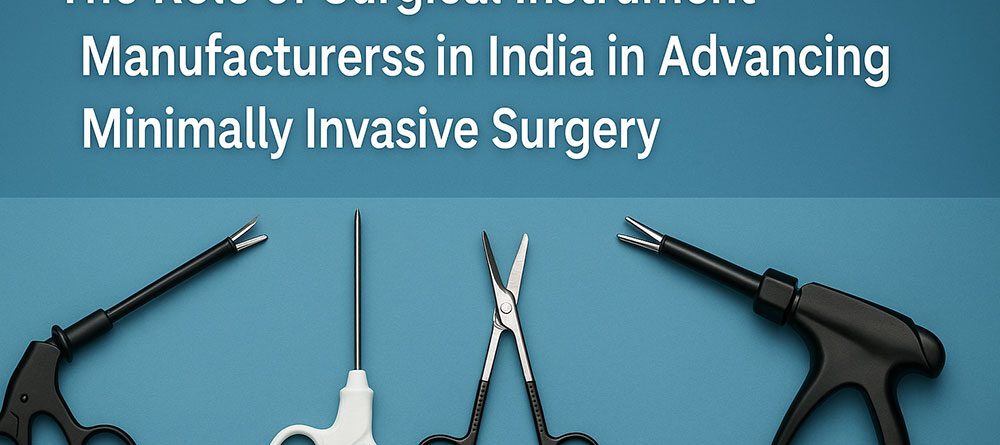
Minimally invasive surgery (MIS) — from laparoscopy to endoscopic and robotic-assisted procedures — has redefined modern healthcare.
Smaller incisions, faster recoveries, lower infection rates, and better cosmetic outcomes are now expected by patients and providers alike.
At the heart of this transformation are the tools: the trocars, graspers, dissectors, energy devices, and precision handheld instruments that make MIS possible.
This article explores how Surgical Instrument Manufacturers in India are playing a pivotal role in advancing MIS globally — improving access, driving innovation, and delivering quality at scale.
1. Why the instrument matters in minimally invasive surgery
Minimally invasive procedures depend on instruments that are accurate, reliable, and ergonomically designed. A slight misalignment, dull cutting edge, or poorly designed handle can increase procedure time, frustrate the surgical team, and, most importantly, affect patient outcomes.
That’s why surgical teams place enormous trust in their instruments — and why the manufacturers behind them must meet strict quality and performance standards.
- Precision: Instruments must reproduce exact movements through small ports or channels.
- Durability: Repeated sterilization cycles and mechanical demands require long-lasting materials and finishes.
- Ergonomics: Comfortable, intuitive handles reduce surgeon fatigue during long procedures.
- Compatibility: Devices must integrate reliably with cameras, energy generators, and patient tables.
Surgical instrument makers supply this capability, and increasingly, Surgical Instrument Manufacturers in India are meeting or exceeding global expectations in all these areas.
2. How India became an important source for MIS tools
The growth of India’s surgical instrument industry is a mix of craftsmanship, technology adoption, and export-oriented strategy. Several factors helped accelerate this rise:
- Skilled craftsmanship: Generations of metalworkers and instrument technicians provide a deep talent pool for producing finely finished surgical tools.
- Cluster manufacturing: Regional clusters enable fast prototyping, access to tooling and heat treatment services, and economies of scale.
- Investment in technology: CNC machining, laser welding, robotic polishing, and CAD/CAM design are now embedded in many facilities.
- Regulatory focus: Compliance with ISO 13485, CE marking, and export certifications has made Indian products acceptable to global markets.
- OEM partnerships: Many international brands source private-label or OEM instruments from India, validating quality and trust.
These strengths mean that Surgical Instrument Manufacturers in India are not just low-cost producers — they are technology-driven partners that supply sophisticated MIS instruments.
3. Product categories where Indian manufacturers excel
Indian suppliers produce a wide range of MIS-related instruments and consumables. Key categories include:
3.1 Laparoscopic instruments
Graspers, dissectors, scissors, clip appliers, trocars and cannulas, and laparoscopic staplers are among the most exported items. High-volume Indian manufacturers can produce both reusable and reposable variants designed for longevity and ease of sterilization.
3.2 Endoscopic & cystoscopic tools
Rigid and flexible scopes, working elements, biopsy forceps, and sheath systems for urology and ENT procedures are commonly made in India, often with compatibility for leading camera systems.
3.3 Energy devices and accessories
While the most advanced energy platforms (e.g., some ultrasonic or advanced bipolar systems) are still dominated by global brands, Indian companies produce a wide range of compatible accessories, bipolar forceps, and monopolar instruments that integrate seamlessly with established generators.
3.4 Single-use and disposable items
Cost-conscious hospitals often prefer disposables for infection control. Indian manufacturers supply many disposable trocars, insufflation tubing, and even single-use laparoscopic instruments that meet international sterility and packaging standards.
3.5 Custom and OEM solutions
Distributors and international brands routinely request OEM production. Indian manufacturers provide private-label options, customized instrument geometries, and packaging tailored to market needs.
4. Innovation and quality: what Indian makers are doing differently
Innovation doesn’t only mean new gadgets; it means practical improvements that make surgeons’ lives easier and patients safer. Here are several areas where Surgical Instrument Manufacturers in India are innovating:
- Hybrid reposable designs: Instruments that combine a reusable shaft with a disposable tip lower long-term costs while preserving reliability.
- Ergonomic handle redesigns: Local R&D teams work closely with surgeons to refine grips, angles, and thumb controls for better comfort.
- Enhanced coatings: Improved passivation, anti-corrosion treatments, and specialized coatings extend instrument life and reduce maintenance.
- Cost-efficient articulating tools: Affordable versions of articulated instruments enable hospitals in resource-constrained markets to perform complex MIS procedures.
- Rapid prototyping: Close proximity to toolmakers and rapid machining operations shortens the product development cycle from idea to OR-ready sample.
These real-world innovations show that Indian manufacturers prioritize utility and affordability — two crucial ingredients for wider global adoption of MIS.
5. Quality systems and certifications
Global hospitals demand traceability, sterility validation, and robust quality management. Many Indian manufacturers have invested heavily in:
- ISO 13485 quality management systems
- CE marking for the European market
- FDA registrations or partner approvals for specific product lines
- Process validations for sterilization, biocompatibility, and packaging
Those certifications are not just stickers on a box — they reflect documented procedures, multi-stage inspections, and the ability to respond to audits. The best companies treat quality as a continuous process, not a one-time hurdle.
6. Training, service, and surgeon engagement
An instrument’s value increases with proper use. Many manufacturers in India go beyond making instruments — they offer training, maintenance support, and surgeon engagement programs:
- Hands-on workshops: Training sessions for surgeons and OR staff on new instrument ergonomics and maintenance.
- Technical support: On-site engineering assistance for assembly, repair, and troubleshooting.
- Clinical feedback loops: Regular surgeon input incorporated into iterative product improvements.
This hands-on support is especially important in emerging markets where surgeons may be adopting MIS for the first time.
7. Cost and access: expanding MIS to more hospitals
One of the most tangible impacts of competitive instrument manufacturing in India is expanded access. When a high-quality laparoscopic set costs significantly less than an imported equivalent, hospitals can:
- Equip more ORs with MIS capabilities
- Replace instruments more frequently rather than risk dull or damaged tools
- Offer MIS procedures to a broader patient population
Lower instrument costs also reduce the financial barriers for rural hospitals and medium-sized clinics to invest in MIS, which leads to better outcomes at scale.
8. Export impact and global presence
Surgical Instrument Manufacturers in India are exporters to the Middle East, Africa, Southeast Asia, Latin America, and increasingly to parts of Europe and North America. The export success stems from:
- Competitive pricing without compromising quality
- Strong OEM relationships with global distributors
- Regulatory readiness and documentation support
- Flexible minimum order quantities that help distributors trial products
This global presence also benefits clinical advancement: feedback from diverse markets informs product design improvements that serve surgeons everywhere.
9. Challenges and how manufacturers are addressing them
No industry is free of challenges. Indian surgical instrument manufacturers face several issues — and many are actively tackling them.
- Perceptions of quality: Some buyers still equate higher price with higher quality. Manufacturers combat this with third-party testing, transparent certification, and surgeon testimonials.
- Technical complexity: Highly specialized energy devices and robotic components remain dominated by large global firms. Indian firms often focus on complementary products and partnerships to bridge gaps.
- After-sales network: Building global service infrastructure is resource-intensive. Leading firms invest in distributor training and local service tie-ups to offer reliable post-sale support.
- Regulatory variations: Different countries require different approvals. Manufacturers build regulatory teams and local partners to navigate approvals efficiently.
By addressing these challenges proactively, manufacturers strengthen their credibility and expand their market reach.
10. The human story: surgeons, technicians, and patients
Beyond certifications and exports, there’s a human story in the manufacturing of MIS instruments. Skilled artisans polishing a handle, an engineer refining a hinge after surgeon feedback, a procurement head in a district hospital finally buying a laparoscopic kit — these moments matter.
India’s instrument industry often benefits from cross-generational skills: families that once made scissors by hand now run CNC cells and export to distant continents. That continuity of craft and the willingness to adopt new technologies is what distinguishes the sector.
11. Looking ahead: where do Indian manufacturers go from here?
The future looks promising. Key trends likely to shape the next decade include:
- Smarter instruments: Integration of sensors for feedback, disposable smart tips, and ergonomics informed by motion analytics.
- Greater OEM collaboration: Co-development partnerships with global medtech firms to create mid-range robotic instruments and articulated tools.
- Eco-conscious manufacturing: Reduced waste, recyclable packaging, and energy-efficient plants to meet global sustainability expectations.
- Digital services: Remote troubleshooting, AR-enabled training, and IoT-based maintenance alerts for surgical kits.
If these trends are realized, Surgical Instrument Manufacturers in India will not only supply instruments — they will help define the next generation of minimally invasive surgery.
Conclusion
Minimally invasive surgery has shifted the way we think about surgical care, and high-quality instruments are central to that shift. Surgical Instrument Manufacturers in India have grown from regional toolmakers into global suppliers that combine craftsmanship, modern engineering, and regulatory discipline. They reduce costs, expand access, and collaborate closely with clinicians to iterate meaningful improvements — all of which accelerate the global adoption of MIS.
For hospitals, distributors, and surgeons, the takeaway is clear: the right instrument changes everything. India’s manufacturers are increasingly able to deliver that “right instrument” — affordably, reliably, and at scale — making them vital partners in the continued evolution of minimally invasive surgical care.






Leave a Reply